• TalkBass has been independent since 1998. Add your voice.
    Create a free account to reply to discussions, view embedded media, and browse with fewer display ads.
    Join freeLog in
    Want zero display ads or expanded classifieds tools? Compare plans.

The Passinwind Open Source Preamp

Well, chop chop! Kidding of course. Those faceplates look great.

Thanks, one of my luthier friends is doing them for me actually. The hangup is with the wood supplier, who got completely slammed by DIYers in lockdown, I think. The ones I pictured were just meant as proof of concept and any of them will suffice for now while I get to installing the rather convoluted preamp section. I'm hoping for blond quilted maple for the final version since that matches my practice cabs, but I'll have my friend do an alt. take or two with acrylic stabilized wood and/or some other more out-there ideas we've been spitballing.
 
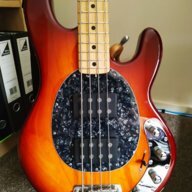
Hi passinwind, I just stumbled across this filter thread while looking for ways to integrate a filter preamp into my HH (pictured), as the stock 3 band musicman is, well, horrid in this bass, and I think the process of shoehorning it in would be too difficult. Would this design of yours lend its self to being built into a stomper I could run at the start of my chain?
 
  • Like
Reactions: Passinwind
Hi passinwind, I just stumbled across this filter thread while looking for ways to integrate a filter preamp into my HH (pictured), as the stock 3 band musicman is, well, horrid in this bass, and I think the process of shoehorning it in would be too difficult. Would this design of yours lend its self to being built into a stomper I could run at the start of my chain?

Yep, plenty of people here have done stomp boxes, maybe more than have done onboard installations actually. And using external power opens up a lot of possible subs for the opamps, which could be a pretty substantial money saver and also a lot less hassle to source.
 
Update:

Actual work has slowed me down a bit, but I should have some new open source stuff ready to go pretty soon now. Here are a few possibilties:

Simple Gain, just a no frills single opamp gain stage with a trim pot:

SimpleGain_v1.0.JPG


Next: something similar to this two bander, configurable for Bass/Treble or Bass/Mids:

PW1B_TH3.png


And then a few different daughtercards, including an active treble shelving one and the variable resonance LPF format from the original OS design. I'm capping all these designs at 1 1/8" in height (typically less), small enough to fit on edge in a standard Fender top route. The one pictured above is 1.8" by 1.08", for example.

I'm also working with a few different TB luthiers and techies to test feasibilty on offering full kits, and possibly even selling assembled units (AKA don't hold your breath, but never say never). So I'd like to hear from you folks about what sizing and shaping would be preferable. Hands up please, how many people are ready to tackle DIY all-SMD builds with nothing smaller than 0805 format parts, and mostly bigger ones? The Simple Gain board might make a nice entree for those of you who've not yet jumped into surface mount soldering.

Oh, and finally, today I'll be testing my first samples of OPA2145, a newly released low-ish current JFET opamp. I've already been having good results with the single version, OPA145, and the pairing of the two would greatly ease the sourcing hassle and high cost of using the LT1352 and LT1351 pieces. In the existing OS preamp board current consumption would jump from ~800uA to around 1300uA, but there are definte potential performace gains that come with that as well.
 
Last edited by a moderator:
Count me in as very interested. No problem with 0805 components. I was reluctant at first, but now prefer SMD to through hole in most cases, it just took a bit of practice. It's worth learning if possible as many components are becoming SMD only these days.

Paricularly interested in the variable resonance designs.
 
Update:

Actual work has slowed me down a bit, but I should have some new open source stuff ready to go pretty soon now. Here are a few possibilties:

Simple Gain, just a no frills single opamp gain stage with a trim pot:

View attachment 4154948

Next: something similar to this two bander, configurable for Bass/Treble or Bass/Mids:

View attachment 4154950

And then a few different daughtercards, including an active treble shelving one and the variable resonance LPF format from the original OS design. I'm capping all these designs at 1 1/8" in height (typically less), small enough to fit on edge in a standard Fender top route. The one pictured above is 1.8" by 1.08", for example.

I'm also working with a few different TB luthiers and techies to test feasibilty on offering full kits, and possibly even selling assembled units (AKA don't hold your breath, but never say never). So I'd like to hear from you folks about what sizing and shaping would be preferable. Hands up please, how many people are ready to tackle DIY all-SMD builds with nothing smaller than 0805 format parts, and mostly bigger ones? The Simple Gain board might make a nice entree for those of you who've not yet jumped into surface mount soldering.

Oh, and finally, today I'll be testing my first samples of OPA2145, a newly released low-ish current JFET opamp. I've already been having good results with the single version, OPA145, and the pairing of the two would greatly ease the sourcing hassle and high cost of using the LT1352 and LT1351 pieces. In the existing OS preamp board current consumption would jump from ~800mA to around 1300mA, but there are definte potential performace gains that come with that as well.

Looks good!

FWIW, I am happy with soldering an all SMD board in the sizes you mention.

Regarding the op amps, I'm hoping those numbers are microamps! If so then even at 1.3 mA that is about 3 weeks of runtime on an alkaline 9 V. Seems long enough to me!
 
Looks good!

FWIW, I am happy with soldering an all SMD board in the sizes you mention.

Regarding the op amps, I'm hoping those numbers are microamps! If so then even at 1.3 mA that is about 3 weeks of runtime on an alkaline 9 V. Seems long enough to me!

Heh. Yep, micro not milli. I'll ask a Mod to fix that.

I'd be interested in an old-school through hole original OS design, with either treble or treble and bass resonance controls, but DIY SMD is way above my pay grade and skillset.

I'll work on shrinking the original one a bit for starters, I have some solid ideas on how to get there by now. ;)
 
Thank you for being awesome.

Thanks. I took a fairly big swing at shrinking the original through-hole one, which is 2.21 by 1.66 inches. Here's what I've come up with so far:

PW3B_LPF_v4_0.JPG


Most of the shrinkage comes from using shorter KOA Speer 1/4 watt resistors, 1/8th watt ones from other manufacturers would work fine too. The KOA ones are mostly a dime apiece for 1% grade and Mouser stocks enough values to make both the stock build and many potential mods easy enough as well. I spec'ed smaller caps in several spots too, with no meaningful quailty compromises in my mind.
 
Last edited:
FWIW, unless space is seriously limited, an emphasis on having the smallest size is not necessary, IMO. And it make it more difficult for us folks with less than perfect eyesight and fine motor skills to build. Maybe it is already small enough???

Fair enough, and I'm not planning on eliminating the original one. IME space is nearly always a seriously limiting factor in onboard installs, but my motivation for using SMDs is that they're mostly just better sounding parts these days and it also opens up a lot of options on capacitor values. But in any case, the one I just posted wouldn't be a bit harder to build as far as I can see. as long as parts procurement doesn't become an issue.
 
Wasn't meant as a dig, BTW... more of a general comment. Better sound is awesome. Personally, I sometimes end up going too far down certain rabbit holes, and minimizing circuit size is potentially one of them. Next revision, only able to be manufactured by nanobots!

Nah, I didnt take it as a dig at all and I always welcome your input. With these circuits the main bogey is always going to be needing an extra pot or switch unless something changes radically. And no matter what, someone will want it to fit in a Jazz Bass with no extra routing.;)
 
Not yet, I'm still finishing up a few details and may want to build at least one myself to vet the layout. ;)

Hi Charlie,

As you know I got hold of all of the components and an original board towards the end of last year, but I've not yet built anything as the only instrument I own that it fits in is one I don't really play as it is old and retire. The original board won't fit in my StingRay and I can't decide on external housing/cases/power supply. Do you think this layout will fit under the control plate of a StingRay, once it is populated?
 
Hi Charlie,

As you know I got hold of all of the components and an original board towards the end of last year, but I've not yet built anything as the only instrument I own that it fits in is one I don't really play as it is old and retire. The original board won't fit in my StingRay and I can't decide on external housing/cases/power supply. Do you think this layout will fit under the control plate of a StingRay, once it is populated?

I can't readily find the control route dimensions but it doesn't seem to pass the eyeball test? The upcoming modular ones would probably be your best bet. If you can get me some details on the cavity route format in your bass I can at least try to accomodate that. I've been going hard at tweaks to the conventional two band section lately but I still do have standalone LPF boards waiting for their turn in the build queue.
 

Latest posts