• TalkBass has been independent since 1998. Add your voice.
    Create a free account to reply to discussions, view embedded media, and browse with fewer display ads.
    Join freeLog in
    Want zero display ads or expanded classifieds tools? Compare plans.

The Passinwind Open Source Preamp

So back to some onboard preamps soon. I ordered some of the new JTEX dual reverse log taper pots in 100k and 10k ohms, like so:
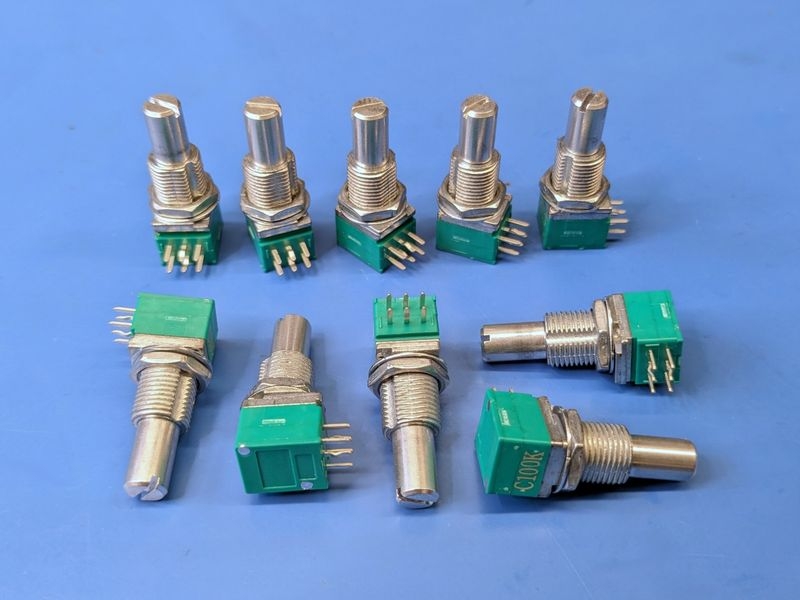
JTEX_pots.jpg


And then I did four different daughtercard PCB layouts, which are about 12 days or so out. Two have sets of parallel resistors for tweaking taper and resistance, which may or may not prove useful, but it seems worth the two dollar gamble.

I'll be starting with two Bass/Mid/LPF builds, one for my EUB and the other for my Marco Bass MV4 fretless. The EUB one will be much like the V2 pedals, but the Marco one will use the Bax board for the neck pickup and the LPF for the bridge pickup, with a mix section to blend to one output. I'll also have the option of sending each pickup off the bass separately since I have a currently unused conductor in my 4 conductor cable. I'm thinking 5 knobs plus a 3 position Q switch, and my Spice models are showing some interesting curves I've definitely never seen before. If it's a big fail at least I will have learned something, I reckon. 🌈🦄
 
Last edited:
This Marco Bass ended up being my first tester for the JTEX pots:

MV4FL_2024.jpg


I ended up spending a lot of time on on doing rolled fingerboard edges and slimming down the upper horn shape a little, and then it took two tries to get an LPF board built up that interacts with the Bax section in the way I envisioned. It's now very easy to get into and back out of a good solo setting just by tweaking the bridge pickup volume pot and leaving everything else alone. I took it to an open mic Monday and played house bassist for the evening, working through quite a few stylistic swerves, and the new format seems great for slide bass so far too. Lots more useful tones at tone control settings below noon as well, which was a definite design goal. Both volume pots are detented linear jobs, also with plenty of good sounds on tap at below noon settings. It all feels more intuitive to me than a dual filter format, although I still need to work through the Q switch settings once I get in a little more playing time through my own amps. At the open mic I was able to go direct to FOH at line level with headroom to spare, and then I tried a friend's PJB Double Four for a couple of sets and ran out of its line out, which worked quite well too.

FWIW, I'm still planning on documenting a couple of different onboard build options via my Github repository ASAP, and then I fully expect to back down my online presence a few more notches, as I've already been threatening to do for at least a couple of years by now.:cool:
 
Very nice bass.

Anything interesting about the pickups? Alnico or ceramic?

"I ended up spending a lot of time on doing rolled fingerboard edges and slimming down the upper horn shape a little, "

Did you work on the horn and then get it painted?

"It took two tries to get an LPF board built up that interacts with the Bax section in the way I envisioned." Would you elaborate on the problems you noticed and what strategy you used to address them?

Pretty slick idea to lessen the comb interactions of dual filters by splitting the functions between the PU's. Seems like one of the few times in a bass when a phase switch between the two pickups might not be so bass-killing, but could give a serious mid notch. Have you looked at that in your modeling?

Have you chosen one frequency for the mid Bax or is there a switch for it? If one freq, what did you go with?

Is the "Q switch" three fixed values for the resonance control of the LPF, and the treble knob is the frequency?

What format is your output jack that it has four conductors?

Thanks for your time and insights.
 
  • Like
Reactions: Passinwind
Very nice bass.

Anything interesting about the pickups? Alnico or ceramic?
Neodymium, actually. And they are sidewinder humbuckers that my friend wound with slide bass specifically in mind. Not super hot, very clear, with an almost piezo like airiness in the highs.
"I ended up spending a lot of time on doing rolled fingerboard edges and slimming down the upper horn shape a little, "

Did you work on the horn and then get it painted?
I only cut down black shaded areas and just hand painted new borders with acrylic paint for now. It should be pretty easy for my friend to touch that up with an airbrush when I can get over to his shop.
"It took two tries to get an LPF board built up that interacts with the Bax section in the way I envisioned." Would you elaborate on the problems you noticed and what strategy you used to address them?

Pretty slick idea to lessen the comb interactions of dual filters by splitting the functions between the PU's. Seems like one of the few times in a bass when a phase switch between the two pickups might not be so bass-killing, but could give a serious mid notch. Have you looked at that in your modeling?
I did look at that and plan to explore that idea further, for sure. It's something I investigated in my previous two filter build, which showed me that I need to improve my modeling a bit.
Have you chosen one frequency for the mid Bax or is there a switch for it? If one freq, what did you go with?
~700Hz, but I may end up wanting to take that a bit lower, I think. The new mixer format makes using mid cuts a lot more useful, since there's now makeup gain readily available.
Is the "Q switch" three fixed values for the resonance control of the LPF, and the treble knob is the frequency?
Yep, just two values for right now though, with resonant peaks at 4dB and 9dB. I'm thinking maybe 0dB/6dB/12dB once i get the right switch in.
What format is your output jack that it has four conductors?
It's a standard XLR-4 sourced from Markertek and the cable is star quad format with a separate ground drain and shield. I was originally going to do an Alembic style bipolar external power arrangement but for now I just have a 9V battery in the breakout box. I'm looking at various rechargeable formats for a longer term solution, anything up to 18V would work fine with the current build. So as usual, lots of tradeoffs to balance. This build was largely about vetting OPA205/OPA2205 and the JTEX pots, but I also felt I owed the luthier a more inspired preamp format than the standard three banders I've had in that bass over the last 4 1/2 years. This bass was a gift/barter using NOS body and neck parts, it's a long discontinued model. Originally it was Marco's entry level model, I don't think there have been many if any other fretless ones. The fingerboard is epoxy infused purpleheart, but it looks and feels very different than a typical coated board. Truly one of a kind...;)
 
Last edited:
Update: I have temporarily ported back to Commercial User status here, as I just received a commission for a variety of onboard preamps for NAMM basses. I'm not planning on going to the show myself, or pimping my work beyond this post, but if any of you guys are going and would like to audition a few of my builds feel free to PM me. I'll probably send along one or two pedals as well, depending on what I have kicking around by then.

In other news, I've mostly been testing the bass in post #1582 in different playing situations and with a few different amps. I don't think I'll be changing anything about it until at least after NAMM, if at all. It's just so different than anything else I've ever done that I want to let the possibilities sink in for a while, plus it looks like I'll have plenty of opportunity to try a few variations for a couple of the NAMM basses. One will be on it's third go-round with my preamps...LOL!
 
Last edited:
Congrats on getting the commission. Glad you're back to/still developing bass stuff. Hope somebody recognizes your work. Your circuits stand out for being transparent, capable and musical.

"[The split filter] is just so different than anything else I've ever done that I want to let the possibilities sink in for a while, plus it looks like I'll have plenty of opportunity to try a few variations for a couple of the NAMM basses."

Anything you care to share about implementing and using the split filter would be super interesting.

I love the term " slide bass", it really gets to what fretless does.

"I'm looking at various rechargeable formats for a longer term solution, anything up to 18V would work fine with the current build."

I don't remember you mentioning anything above a 9 Volt power supply in the previous 79 pages. Are you going higher because the basses you're fitting out have neodymium humbuckers or because you've always found it better for headroom, or... ?

Thanks
 
Congrats on getting the commission. Glad you're back to/still developing bass stuff. Hope somebody recognizes your work. Your circuits stand out for being transparent, capable and musical.
Thanks Dan. I've been working with this luthier since 2017, and he and several of his regular customers have long been the main thing that even keeps me going on onboard builds. Likewise for all of you here in this thread with the pedals, even those who don't end up building and/or using them.
"[The split filter] is just so different than anything else I've ever done that I want to let the possibilities sink in for a while, plus it looks like I'll have plenty of opportunity to try a few variations for a couple of the NAMM basses."

Anything you care to share about implementing and using the split filter would be super interesting.
Implementing the mixing section is a lot trickier than it looks on the face of it. As you know, I love interactivity, but also intuitive control behavior. When my luthier friend heard the new spit format for the first time on Saturday he was especially interested in how I used Vol/Vol rather than Vol/Blend, and which pickup got which EQ scheme. He tends to favor the bridge pickup and kept wanting to turn up the bass control a bit, the effect of which mostly depends on how the neck volume is set. Personally, I tend to use neck pickup at unity gain or higher and the bridge at unity or lower. Using a Q switch rather than a resonance pot cuts down the variables matrix to a much more reasonable level of complexity while I go about figuring out eleven other things, but I do miss the continuous resonance control a little at times. The usual tradeoffs, in other words. The luthier (Marco Cortes) actually gave me a new body for that bass with no control holes, so I can start from scratch on control layout if I feel like it. It was moderately damaged in his big shop fire and literally would have ended up as firewood in his shop stove, as many many body blanks already have recently. The one I got has minimal heat damage but pretty bad water damage. But it could still end up being quite pretty with enough elbow grease applied, I think. More than one way to get swamp ash, I reckon! ;)
I love the term " slide bass", it really gets to what fretless does.
True, but I meant it literally, like so:

BSQuiver.JPG


All those homemade slide bars sound different, and I have several commercial ones as well, but I've settled on one favorite, which is silicon aluminum bronze, second from left in the pic.

"I'm looking at various rechargeable formats for a longer term solution, anything up to 18V would work fine with the current build."

I don't remember you mentioning anything above a 9 Volt power supply in the previous 79 pages. Are you going higher because the basses you're fitting out have neodymium humbuckers or because you've always found it better for headroom, or... ?

I think I at least mentioned experimenting with bipolar supplies somewhere in this huge mess of a thread, but in any case I have 9v, 12V, and 15V supplies and use 15V most of the time because it happens to be a line lump and not a wall wart. I don't necessarily need more headroom than a 9V supply provides, and the neo sidewinders in my Marco fretless are not especially hot at all, as they are optimized for clear treble and a relatively flat response curve. But this is another area I want to explore a lot more eventually, and if a DIY rechargeable solution is in the cards 9V is not quite as easy to come by as a few other higher voltages, 13.2V nominal looks to be pretty easy to come by for instance.

Not sure If I've mentioned this here, but Fishman sells a pretty spiffy USB rechargeable pack: Universal Rechargeable Battery Pack - Fishman
 
It looks like the only option with those Fishman battery packs, but it should be easy since just the USB socket comes through the cover.
It should be easy to mount under any covers on a guitar body since they only intrude 9mm into the cavity, and they are just over 44mm x 38mm x 9mm in size.
I think you just use double sided tape and stick them on the inside with a 12.7mm hole for the USB socket to come through.
The only thing that will stop me from getting any is the price, at about $110 US each they are too much for me to spend on something I only play with at home.
 
"The only thing that will stop me from getting any is the price, at about $110 US each they are too much for me to spend on something I only play with at home."

Yikes! That's a lot.

I use rechargeable 9 volts, which work out pretty well in applications that can live with only 8.2V, or so.
 
"The only thing that will stop me from getting any is the price, at about $110 US each they are too much for me to spend on something I only play with at home."

Yikes! That's a lot.

I use rechargeable 9 volts, which work out pretty well in applications that can live with only 8.2V, or so.
8.2V is right about where I change 9V batteries, personally. ;)

The Fishman plate is expensive, but my primary interest would be more in using it for a mini pedalboard supply. I'm going to see if one of my luthier friends can get me a Bro Deal on one, which seems fairly likely.
 
  • Like
Reactions: Tassieviking
Is that because below that voltage the circuits they are powering start to sound bad? Or just because that's where a typical alkaline battery is close to having given all it has to give?
The former, mostly. But I’ve been using different opamps lately that should have better performance at lower voltages. I haven’t really tested for that yet, but I will soon.
 
The Fishman plate is expensive, but my primary interest would be more in using it for a mini pedalboard supply
That made me remember I bought a portable battery pack a few years back that I can put in a jeans pocket.
I bought it because I was leaving my car at the airport for 4-5 weeks at a go and the small battery pack can start a car with the clips supplied.
I even jump-started my dads completely flat limo with the tiny pack so it works, it has 12V out and USB out etc.
I wonder how that sort of battery pack would go in a pedal board, it sure has some juice in it and it cost me under $100 AU at the time.
 
  • Like
Reactions: Passinwind
That made me remember I bought a portable battery pack a few years back that I can put in a jeans pocket.
I bought it because I was leaving my car at the airport for 4-5 weeks at a go and the small battery pack can start a car with the clips supplied.
I even jump-started my dads completely flat limo with the tiny pack so it works, it has 12V out and USB out etc.
I wonder how that sort of battery pack would go in a pedal board, it sure has some juice in it and it cost me under $100 AU at the time.
Hey Mick,

Are you familiar with this: [Invalid or Expired Link Removed] ?

TB'er @Jim C has been using one for a while with a few of my EQ pedals and seems quite happy with it.
 
  • Like
Reactions: Sanj and Jim C
The luthier (Marco Cortes) actually gave me a new body for that bass with no control holes, so I can start from scratch on control layout if I feel like it. It was moderately damaged in his big shop fire and literally would have ended up as firewood in his shop stove, as many many body blanks already have recently
I have a lump of wood put aside that was the remains of a tree from a bush fire about 30 years ago, I saw it sticking up in the bush and it was all black and burnt.
It was about 7 meters long when I dropped it and about 1/2 meter thick but fairly solid, I started to cut it up for firewood but I liked the colour of the grain so I left 5 feet and cut it up for planks and made a nice outdoor table.
I have left the exterior slab that is left from cutting planks and it is about 4 feet long by 20" wide and around 5" thick in the middle, I always thought I might try to carve a guitar out of the one piece of wood and try to keep some of the burnt edges on it.
Some of the wood has gone really hard from the heat and really rings when I tap on it, the parts I used for firewood burnt for a long time when I used it.
I wonder if I could make a slot for a truss rod and then make another piece of wood to slip into the slot so you can't see how I got it in there.
I always liked the look of those mini Les Paul guitars where the body is about 3/4 size with a full neck, maybe a mini Violin Bass build ?
 
Hey Mick,

Are you familiar with this: [Invalid or Expired Link Removed] ?

TB'er @Jim C has been using one for a while with a few of my EQ pedals and seems quite happy with it.
I am now, that looks very nice.
It's a lot smaller then the battery pack I have but I think mine will be good for all my Sushi C2CE tube pedals I haven't built yet.
I want a 12V supply for the tube pedals so the heaters get full voltage, and those pedals use a fair bit of power so a larger pack might suit it better anyway.
At least there should not be any supply noise (hopefully) with a battery pack.
 
  • Like
Reactions: Passinwind
I am now, that looks very nice.
It's a lot smaller then the battery pack I have but I think mine will be good for all my Sushi C2CE tube pedals I haven't built yet.
I want a 12V supply for the tube pedals so the heaters get full voltage, and those pedals use a fair bit of power so a larger pack might suit it better anyway.
At least there should not be any supply noise (hopefully) with a battery pack.
Somewhere in the 12-15V range would suit me best, and that's a good point about filament supply considerations. My wife just bought one of those car starter appliances, I think hers does tire inflation as well.
 

Latest posts