• TalkBass has been independent since 1998. Add your voice.
    Create a free account to reply to discussions, view embedded media, and browse with fewer display ads.
    Join freeLog in
    Want zero display ads or expanded classifieds tools? Compare plans.

The Passinwind Open Source Preamp

" This thread definitely contributed to my decision to go to college and take up engineering."

Science teachers work their whole life to hear a sentence like that. It's emblematic of the many ways your gift of this thread has been useful beyond just the circuit it produced.

I see you added Sanj's distribution board at your PW3B GitHub site. :)

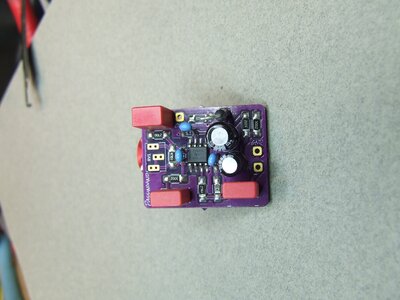
You've mentioned considering the Simple Gain V4.2 board for addition to the OS project. Stuffed with the values of the first stage of the HPF, it makes a very clean high headroom buffer to allow the use of the Bax and/or LPF sections alone. I have also used them after a pickup on-board and in an outboard box on a 6" cord for passive basses. They're super useful. I don't know if the boards are still up at OshPark, I couldn't find them just now.

What's your thinking at this time?

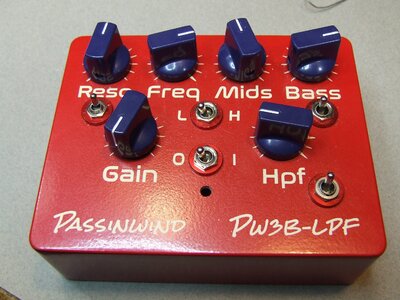
Re post 1620, what an outstanding piece of art Marco has made!

Thank you, Charlie.
 

Attachments

  • DSCF8350.JPG
    DSCF8350.JPG
    1.4 MB · Views: 10
" This thread definitely contributed to my decision to go to college and take up engineering."

Science teachers work their whole life to hear a sentence like that. It's emblematic of the many ways your gift of this thread has been useful beyond just the circuit it produced.
That hit pretty hard, but happily it’s not the first time I’ve heard that. I don’t have any kids, so all the nicer.
I see you added Sanj's distribution board at your PW3B GitHub site. :)

You've mentioned considering the Simple Gain V4.2 board for addition to the OS project. Stuffed with the values of the first stage of the HPF, it makes a very clean high headroom buffer to allow the use of the Bax and/or LPF sections alone. I have also used them after a pickup on-board and in an outboard box on a 6" cord for passive basses. They're super useful. I don't know if the boards are still up at OshPark, I couldn't find them just now.

What's your thinking at this time?

Re post 1620, what an outstanding piece of art Marco has made!

Thank you, Charlie.
I have a little bit nicer version of the SG 4 board worked up, but I have two builds with v4.2 coming up next week for my nephew and I’ll see how that goes and decide from there. I’ll see if the share is still up at OSH, I might leave it as an undocumented morsel if nothing else.

The Bax board already has a buffer and works great on its own, that is what I used in that last Marco Bass build actually. There are only a few more components to stuff in the existing board in otherwise unused positions and you’re done. If phase/polarity is an issue there needs to be an added inverter stage somewhere,but it’s never been an issue in the stuff I typically build.

There’s already an unshared standalone LPF board without the inverter stage, same footprint as the other one even. I’d prefer that to adding two unneeded opamps, personally. But it’s very tedious documenting this stuff, so in all honesty my inclination is to just stop where things are currently at. JTEX makes some cool little buffer boards and has posted a schematic or two on PedalPCB, not sure about a board layout though.

And thanks as always for asking great questions, and nicely to boot!
 
  • Like
Reactions: karter2000
It seems to me that anyone building the box would want to be able to add the very useful art you developed for the graphics.

I wonder if you can add some mention in GitHub of the box size and a reference number, or such, with AmlifyFun that would call up the drill schedule and labels to produce the cool art and well aligned holes of your builds? Pick which version you think kicks it.
 
It seems to me that anyone building the box would want to be able to add the very useful art you developed for the graphics.

I wonder if you can add some mention in GitHub of the box size and a reference number, or such, with AmlifyFun that would call up the drill schedule and labels to produce the cool art and well aligned holes of your builds? Pick which version you think kicks it.
Yeah, that graphics and drill mapping has already mostly been done on my end, but I think a lot of people would want foot switching, which I’ve only got a new but untested layout for. For desktop use I actually like the layout you asked for the best, I think. I love @Sanj ‘s versions too, but they don’t quite match my current feature set.
 
  • Like
Reactions: AudioTaper and Sanj
"But it’s very tedious documenting this stuff, so in all honesty my inclination is to just stop where things are currently at. "

"I’ll see if the share is still up at OSH, I might leave it as an undocumented morsel if nothing else."

That would be great, don't put another minute in, but leave the board available for those who can use it on their own.

"The Bax board already has a buffer and works great on its own, that is what I used in that last Marco Bass build actually. "

Whoops, it's been a while since I looked. What I did a while ago, but haven't final assembled yet, (you mentioned Neo pickups and I fell down that rabbit hole) was use the buffer first and then the option to have each section in or out of the signal chain. I gotta finish that. As you mentioned " There are only a few more components to stuff in the existing board in otherwise unused positions" to have a dc blocking cap before each stage allowing switching in and out.

"If phase/polarity is an issue there needs to be an added inverter stage somewhere, but it’s never been an issue in the stuff I typically build."

Well that's another use for the buffer, as a switchable phase inverter in a feed to a mixer circuit for EFX returns.
 

Attachments

  • DSCF8339.JPG
    DSCF8339.JPG
    2.1 MB · Views: 7
  • Like
Reactions: Passinwind
"But it’s very tedious documenting this stuff, so in all honesty my inclination is to just stop where things are currently at. "

"I’ll see if the share is still up at OSH, I might leave it as an undocumented morsel if nothing else."

That would be great, don't put another minute in, but leave the board available for those who can use it on their own.

"The Bax board already has a buffer and works great on its own, that is what I used in that last Marco Bass build actually. "

Whoops, it's been a while since I looked. What I did a while ago, but haven't final assembled yet, (you mentioned Neo pickups and I fell down that rabbit hole) was use the buffer first and then the option to have each section in or out of the signal chain. I gotta finish that. As you mentioned " There are only a few more components to stuff in the existing board in otherwise unused positions" to have a dc blocking cap before each stage allowing switching in and out.
And the ground shunt at the output, which helps kill switching pops.
"If phase/polarity is an issue there needs to be an added inverter stage somewhere, but it’s never been an issue in the stuff I typically build."

Well that's another use for the buffer, as a switchable phase inverter in a feed to a mixer circuit for EFX returns.
How did you implement inverter mode in my Simple Gain board? I have another one called Simple Mix that I’ve used for that sort of function a few times, and there are way too many versions of that one.
 
"How did you implement inverter mode in my Simple Gain board? "

Yeah, I haven't, it's not inverting. I was just blatting on to advocate for a buffer, not really thinking about your's being noninverting. Sorry for the stupidity.

"For desktop use I actually like the layout you asked for the best, I think. I love @Sanj ‘s versions too, but they don’t quite match my current feature set."

So that would be groovey for people building the box, to have that desktop version graphic available through a GitHub link to AmplifyFun. It's already designed and tried. It gives visual dignity to a serious circuit.

For pedal use, folks could negotiate putting a bicolor 5mm led in the I/O hole, and drill a stomp switch hole below it. Or just put the stomp switch in the I/O hole and play in pointy cowboy boots, like we do here in New Mexico.

I remember you weren't wild about all the radial tic marks, and they weren't clock face, so they were harder to remember. I came to think I could leave the tic marks off everything EXCEPT the frequency knob, where slight changes bring very different effects.
 
  • Like
Reactions: Passinwind
"How did you implement inverter mode in my Simple Gain board? "

Yeah, I haven't, it's not inverting. I was just blatting on to advocate for a buffer, not really thinking about your's being noninverting. Sorry for the stupidity.

"For desktop use I actually like the layout you asked for the best, I think. I love @Sanj ‘s versions too, but they don’t quite match my current feature set."

So that would be groovey for people building the box, to have that desktop version graphic available through a GitHub link to AmplifyFun. It's already designed and tried. It gives visual dignity to a serious circuit.

For pedal use, folks could negotiate putting a bicolor 5mm led in the I/O hole, and drill a stomp switch hole below it. Or just put the stomp switch in the I/O hole and play in pointy cowboy boots, like we do here in New Mexico.

I remember you weren't wild about all the radial tic marks, and they weren't clock face, so they were harder to remember. I came to think I could leave the tic marks off everything EXCEPT the frequency knob, where slight changes bring very different effects.
A standard size stomp switch won't fit in there AFAIK, and if there is a switch the knobs ideally all need to be as far away from the switch as possible. Here's the last layout I was playing with, but I've never vetted it fully yet. 15mm diameter knobs shown:

1741494534104.png


Also, I just changed the link in post #1 to point to the GitHub repository for v4 now rather than the v1 schematic formerly posted on my website.
 
Last edited:
That graphic, post 1628, looks very nice.

My own take on control arrangement is that Bass/Mid/Freq for the top row and Hpf/Gain/Reso for the bottom row gives a newbie tone controls where they might expect them in a row on top, and (sort of ) the modifier for that control below it, with the Hpf beneath the bass and the Reso beneath the treble-affecting Freq.

Re "will things fit", is that basically the layout that Sanj has used in his 5/16/24 post, #1517, minus the "input", "output" and "footswitch" labels?
 
That graphic, post 1628, looks very nice.

My own take on control arrangement is that Bass/Mid/Freq for the top row and Hpf/Gain/Reso for the bottom row gives a newbie tone controls where they might expect them in a row on top, and (sort of ) the modifier for that control below it, with the Hpf beneath the bass and the Reso beneath the treble-affecting Freq.

The Res control invariably baffles newbies to this whole format, wherever it is. Whatever is more intuitive for the majority is fine by me. For your proposed layout it would be ideal to have the input on the "wrong" side (left) of the pedal, but the internal wiring is always going to be a bit of a mess and the stability issues that come with crossing inputs and output have never really manifested. Easy enough to swap a few control labels and see what the feels like in any case!
Re "will things fit", is that basically the layout that Sanj has used in his 5/16/24 post, #1517, minus the "input", "output" and "footswitch" labels?

I'm holding out for "top" jacks" for any foot switched versions, which are the only thing many pedalboard users will accept these days, but otherwise yes. It's an interesting game of Tetris, essentially.
 
  • Like
Reactions: mikewalker
"The Res control invariably baffles newbies to this whole format"

If someone is used to the typical Bax-ish shelving treble tone control, the resonance type are very much a surprise. The way the envelope is changed is so different.

What I think happens is, you think, "OK, I'll turn up the treble" but turning up Reso brings a taller but narrower peak, not the general boost of everything above f3. If you're trying to use the tone control to compensate for the natural roll off of a 15" speaker, and you boost Reso, you get an even narrower range boosted, and you react "there's not enough treble" even if the peak is 12 dB boost.

For me to get that general treble boost, I turn down the Reso a bit to a lower Q and try to put the Freq at the top of the range you're playing in.

Using the LPF to balance a speaker is a waste, because if you're playing through flat response speakers and don't need to compensate, the variable Reso/Freq becomes available to use as a voice of the pickup tool, modifying the resonance peak, a voicing control.

"For your proposed layout it would be ideal to have the input on the "wrong" side (left) of the pedal, but the internal wiring is always going to be a bit of a mess and the stability issues that come with crossing inputs and output have never really manifested."

Only you can value that out. Would reversing the tone controls order help : Freq/Mid/ Bass top row, Reso/Gain/Hpf bottom row?

"I'm holding out for "top" jacks" for any foot switched versions, which are the only thing many pedalboard users will accept these days"

Top jacks are King.
 
  • Like
Reactions: Passinwind
Not far, huh? You came up with that one.
You had substantial input though, thanks for that!

I'm going to reserve the right to not retire from graphics design work for right now, once I wrap up all my electronics obligations I'll take another stab or two at leaving some layout and graphics files on GitHub for the sake of completism and/or my own vanity. @Sanj was able to work off something I sent him and got excellent results tailoring that to his and his clients needs, so whatever I post won't have to be bedrock. I think Spencer at AmplifyFun might be OK with simple edits like global color swaps too, I'll run that by him when I get back to this tangent.
 
After a sometimes tedious 4 month slog, this thing finally made its public debut last week:

MV4FL_fini.jpg


The revised control layout works much better for me and it made the open mic's house Rumble 100 sound like a million bucks. I'll drag along my old gigging rig to a different venue on Wed. and hopefully see what I've really got here, but in any case the new body is about a pound lighter than the old one, which was a nice surprise.