• TalkBass has been independent since 1998. Add your voice.
    Create a free account to reply to discussions, view embedded media, and browse with fewer display ads.
    Join freeLog in
    Want zero display ads or expanded classifieds tools? Compare plans.

The Soundgear Club

Does anyone know why Ibanez installs the neck and bridge Mk1 pickups backwards? I started working on my twin SR706 project, and in both basses the neck had a DCR of roughly 9.5k with 7.5k for the bridge. The pickup hot leads are different colors as well, one green one red. They sound great, going to keep them but wired passive 500k VVT. I have never seen that before and will likely flip them around unless theres a good reason not to.
 
  • Like
Reactions: Zooberwerx
Does anyone know why Ibanez installs the neck and bridge Mk1 pickups backwards? I started working on my twin SR706 project, and in both basses the neck had a DCR of roughly 9.5k with 7.5k for the bridge. The pickup hot leads are different colors as well, one green one red. They sound great, going to keep them but wired passive 500k VVT. I have never seen that before and will likely flip them around unless theres a good reason not to.

I read that somewhere and it's a head-scratcher...it's a conspiracy, I tell ya! To my ears, the bridge MK1 pickup doesn't have much "heft" so I rarely roll-off the blend in that direction....and that's with an OP-3 installed.

Riis
 
  • Like
Reactions: poochiecheeks
My first bass was a Yamaha RBX200F…fretless bass with a single split-coil pickup, J-bass inspired body and neck…got it from a local music shop in college…came with an ill-fitting Charvel case missing some latches…I replaced the factory pickup with an EMG Select pickup and removed the volume and tone controls…pickup goes straight to the jack. I still have it…I did all sorts of experiments with it…piezo pickup trials using Radio Shack parts…that sort of thing…I sanded off the paint from the neck and polished the maple with tung oil and steel wool…to this day it remains an instrument that baffles me why it sounds as good as it does, and the setup is super-stable, low-action, it just works and feels and sounds good.

In the same season of life I picked up my next bass…my first Ibanez, a mid-80s RG850. It was beat to shizzat…black…all black. But completely roached, pickup pole pieces rusty, scraped and dented up, chunks of finish missing, and mind you at this point in time it wasn't that old. And the frets had been carelessly ripped out; an abused instrument. But I thought it was so cool with the all passive setup with push pots for per-pickup single-coil/humbucking switching, and a balance control vs individual volume pots…and I just thought the shape looked cool…I got it for cheap along with a budget analog mixing console. There was no saving the finish, so I took it all apart and sanded 100% of the black finish off of the body and neck…deep-cleaned everything, sold the console and used the proceeds to take the guitar to a luthier and have it re-fretted and setup. They did an amazing job. It had a sound and it was my main bass for many years…super lame I can't find a picture of the whole thing, just a pic of part of the body:
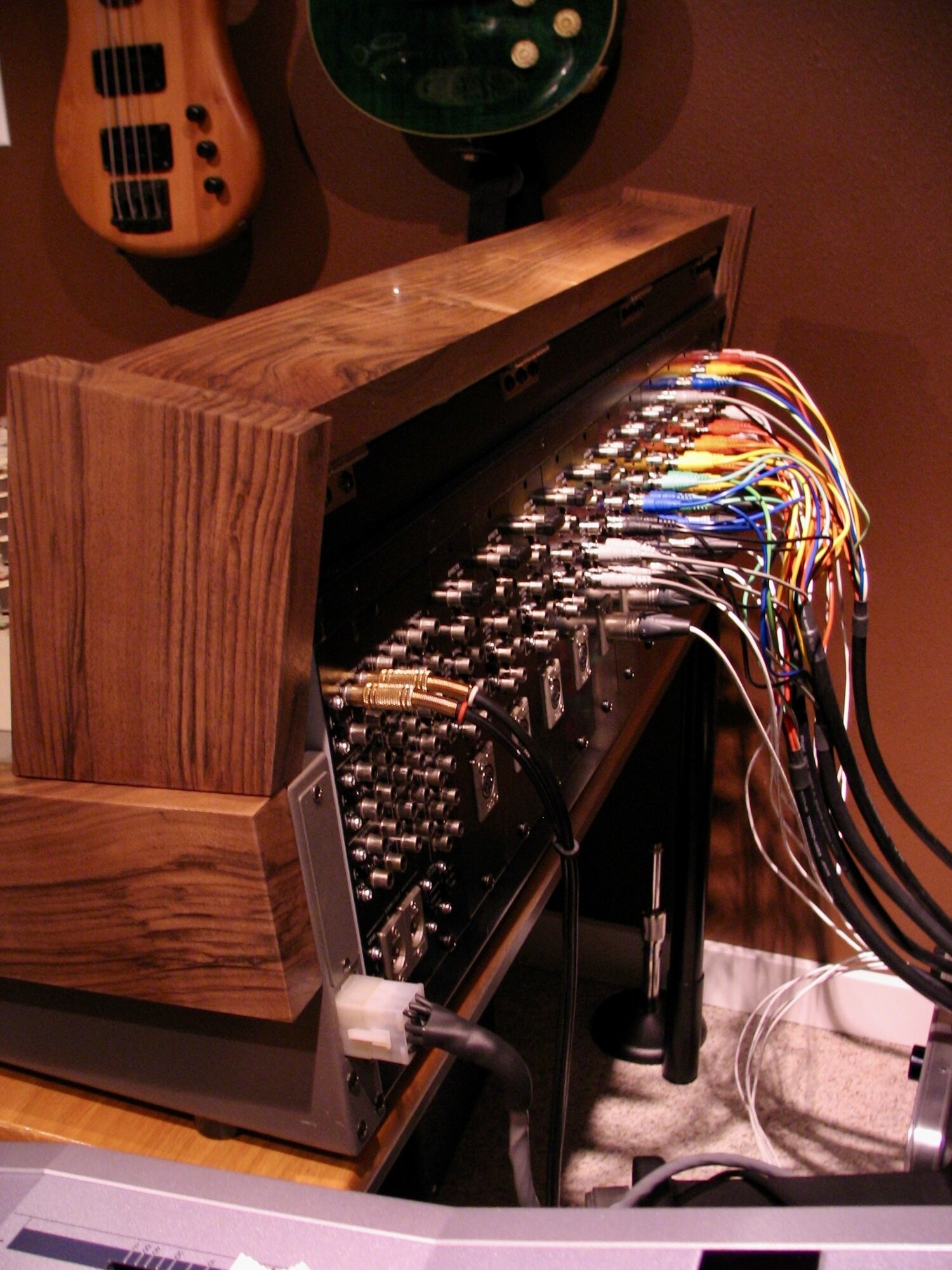

IMG_9256.jpeg


The problem with it was, for some reason, the neck was super unstable…action was all over the place…I could never figure it out but, even if it was in a stable environment, the action and therefore intonation could vary day-to-day. I still used it for a couple decades…eventually giving it to a family member with full-disclosure about the neck issues. It I think it spiked me with the fast neck and comfortable body shape.

In the intervening years I bought a second-hand 5-string Peavey Grind, which I re-sold after not being happy with the sound…I thought a neck-through was the ticket, but it was an early version and the build quality was not that great, and it surprisingly lacked the sustain I expected from the neck-through design. I also picked up a very rare Kramer Pioneer "Double J" bass, with the even more rare interchangeable fingerboard option, as well as a Peavey T-40…both USA-made basses…both needed work. I also picked up, out of the desire to have a bass that just worked, a beautiful Ibanez SRX3EXQM1 in cherry burst…quilted maple top, body binding…it's just a beautiful guitar, and I love the feel of the neck. I refurbished the Kramer, but there are elements that just don't check the boxes for me, so that's going on the chopping block. I've refurbished the T-40 as well and I have to say it is one of the most comprehensively high-quality bass guitars I've ever had my hands on, and it sounds amazing whether plugged in or not…my only issue is I have small hands and the neck is a little chunkier and the nut width wide enough it just doesn't work as well for me. I really do better with a faster J-bass inspired neck, and the SRX3EXQM1 is *so* nice this way…my problem with the SRX is, and I'm probably passing unfair judgement here, but every bass I've encountered that's come out of the Indonesian Cort factory is just relatively dead-sounding compared to something like my Kramer or the T-40…the SRX is a very well-crafted and beautiful instrument, but the sound is just…damped. So I've been kind of longing for a quality instrument with the neck specs that work for my hands, but also has some versatility to the sound and some level of quality pedigree. So I came across the bass below available locally and am picking it up in a week or so…getting back to my Ibanez roots I guess:
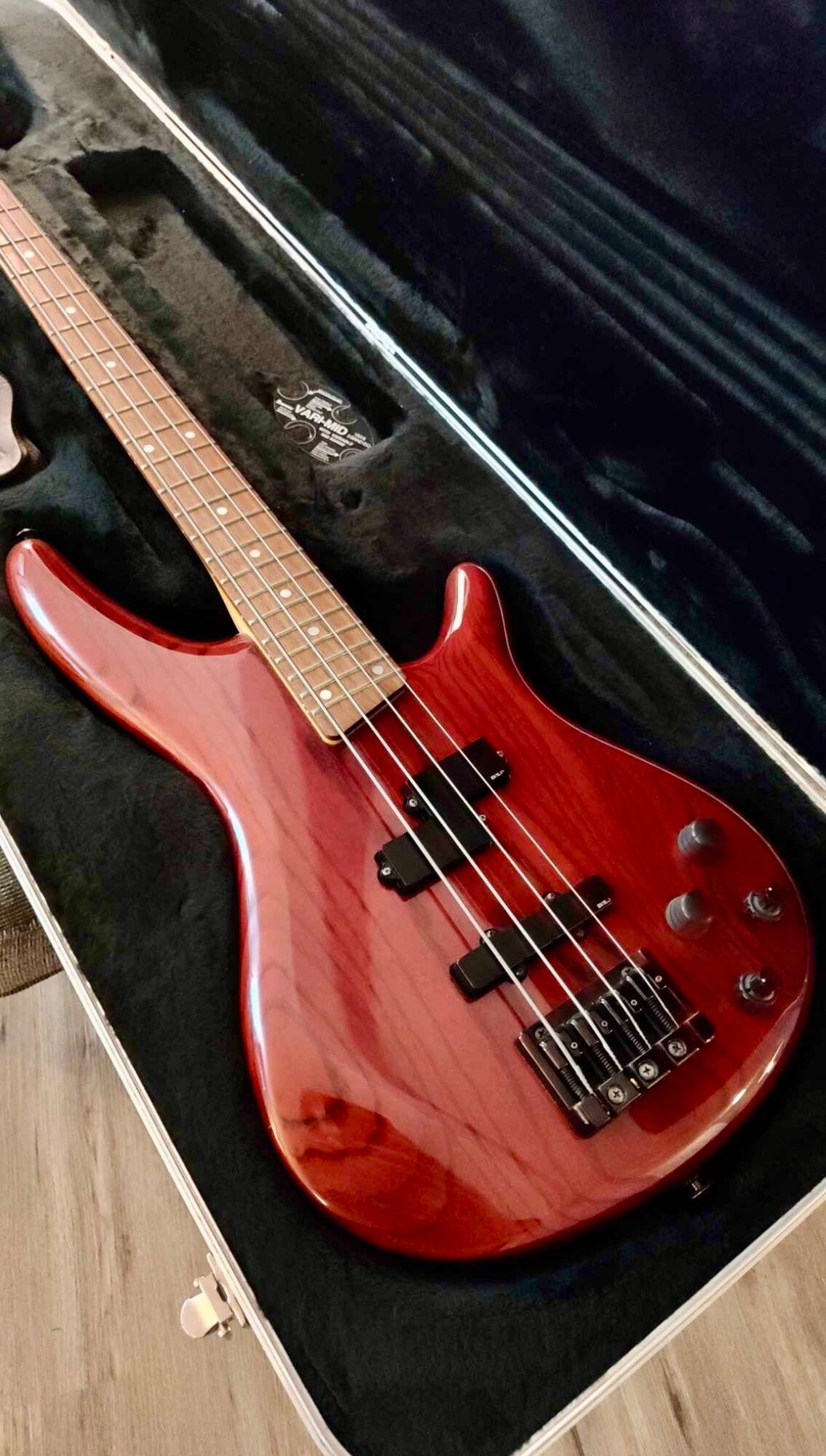
IMG_8489.jpeg


It's an unmolested 2001 SR690…no perceptible wear on the frets, excellent condition throughout, comes with the OHSC and includes the original Ibanez strap…$350. I'm not expecting the sustain and tone and versatility of the T-40, but hoping for a less damped experience compared to the SRX, but still with the fast comfortable neck, and the quality associated with an instrument from the Japan factory…and some versatility from the Vari-Mid electronics. We'll see. But I figured for $350 in that condition in the OHSC it wasn't a bad decision.

That's my SR journey so far.
 
That's my new Ibanez, a SR5PBLT Premium (3,7kg=8,157lbs):

IMG_1944.jpeg

IMG_1952.webp

The bass has the Nordstrand Big Singles, plus the 3-band preamp with passive treble pot in passive mode.

Sounds good quickly in the workshop, but the singles are very sensitive to scattering and the potentiometers really have a barely palpable center click.

Will probably rebuild it after the warranty expires, Nordstrand Big Splits with the 5-Poti Nordstrand Preamp. In the two holes for the switches comes an on/off switch for a passive noload tone potentiometer. Then you have everything you need.
 
Last edited:
Fretless conversion on the lesser of the two SR706 necks is done. This is definitely my best one yet, only the last few frets have some noticeable chip out. Still cant figure out how to avoid the ends of the veneer strips from breaking off and leaving a gap on the side of the fret slot.

Very straight forward, cleaning the slots with a small hack saw got all the strips about the same depth. I used a set of channellock nail puller/end nippers that I ground flat to pull the frets, along with water and a 200w soldering gun. There was a lot of extra titebond sitting on the fingerboard when I installed the veneers but luckily it all appears to have sanded out. I did thin the glue with some water and wood dust from sawing the slots deeper just for color.
IMG_9509.jpeg

Big thanks to everyone in the one luthiers corner thread that explains conical fingerboard leveling. I used a 1" square aluminum stock beam with 120, 220 and 320 double sided taped to 3 of the sides. Had to go down to 120 for the rough leveling, there was a particular low spot on the bass side between the 6/10th frets. Sanded along the (6) string paths, checked with pencil mark Xs and it was perfect. Got the fingerboard edges rolled with the 400 and it feels like it was fretless from the factory.
IMG_9510.jpeg

I read somewhere about sanding up to 400 grit, then "wet" sanding with boiled linseed oil on the front and back using 800 and buffing out with a t shirt. I wish I could find who suggested that as it worked beautifully. I was going to go up to 3000 but it looks and feels so good as is that I'm leaving it. The fretted neck received the exact same treatment along with cleaning up the fret ends and they are both drying in my 15 degree garage now.

More to come on the necks when I go to reinstall the new nuts and tuners. Next is figuring out how to mount the newer Ibanez bridges that are just wider than the flat route in the body for the old bridges.
 
Last edited:
I picked up the 2001 SR690, $350…absolutely everything the seller purported it to be…with OHSC, in beautiful, beautiful condition…I'm not sure there is so much as a scuff or scratch on it. It's 25 years old, needs a little buff and polish and I need to tweak the intonation and action, but seriously after doing a little detailing I expect it will be mint/like new condition. And, compared to my Peavey T-40 the Ibanez is so much more comfortable…works better for my hands…and while the T-40 has a beautiful sound I'm really impressed with the sustain and tone of the Ibanez, and I feel like it's easier, more intuitive and quick, to dial in a tone I want or need on the Vari-Mid control set compared to the T-40…again the T-40 sounds great and is very unique electronically, the Ibanez just works better for me, and I think actually has a very wide tonal range. I'm really pleased with the build quality of the SR690 too. I didn't realize the body was a single piece.

I'm interested in maybe adding a passive switch. Does anybody know where I can find the wiring diagram for the Vari-Mid EQ electronics but with the passive DX pickups? All I can find is the diagram with the AFR pickups.
 
So I got the wiring diagram specific to my SR690 from Ibanez this morning. They asked for my serial number to ensure they sent the right one.

Here is the wiring diagram that is floating around the internet:

IMG_8517.gif


Here is the one they sent me for my SR690:

2026-01-28 14-56.jpeg


Yes, @crazycloud, it is essentially the same, but notice mine doesn't have power to the pickups (passive vs. active…one conductor plus shield vs two conductor plus shield) and the balance and volume pots are 20Kohm parts on the AFR-equipped models and 500Kohm parts on the DX-equipped models like mine. Here's the conundrum for me: what's actually mounted to my bass is a 500Kohm balance pot (which is what should be there) but a 20Kohm volume pot, not correct…for mine…correct for AFR-equipped basses. What's in there in mine looks factory as far as the solder job, etc. I want to replace the volume pot with a push-push or push-pull pot for active/passive switching…super-easy to find 500Kohm pots, not so much 20Kohm. I did find a 25Kohm pot. Does this really matter? What will happen if I put a higher-resistance pot in there for the volume pot?
 
Fretless conversion on the lesser of the two SR706 necks is done. This is definitely my best one yet, only the last few frets have some noticeable chip out. Still cant figure out how to avoid the ends of the veneer strips from breaking off and leaving a gap on the side of the fret slot.

Very straight forward, cleaning the slots with a small hack saw got all the strips about the same depth. I used a set of channellock nail puller/end nippers that I ground flat to pull the frets, along with water and a 200w soldering gun. There was a lot of extra titebond sitting on the fingerboard when I installed the veneers but luckily it all appears to have sanded out. I did thin the glue with some water and wood dust from sawing the slots deeper just for color.
View attachment 7417166
Big thanks to everyone in the one luthiers corner thread that explains conical fingerboard leveling. I used a 1" square aluminum stock beam with 120, 220 and 320 double sided taped to 3 of the sides. Had to go down to 120 for the rough leveling, there was a particular low spot on the bass side between the 6/10th frets. Sanded along the (6) string paths, checked with pencil mark Xs and it was perfect. Got the fingerboard edges rolled with the 400 and it feels like it was fretless from the factory.
View attachment 7417167
I read somewhere about sanding up to 400 grit, then "wet" sanding with boiled linseed oil on the front and back using 800 and buffing out with a t shirt. I wish I could find who suggested that as it worked beautifully. I was going to go up to 3000 but it looks and feels so good as is that I'm leaving it. The fretted neck received the exact same treatment along with cleaning up the fret ends and they are both drying in my 15 degree garage now.

More to come on the necks when I go to reinstall the new nuts and tuners. Next is figuring out how to mount the newer Ibanez bridges that are just wider than the flat route in the body for the old bridges.
Actually, that board is prime for a polish sanding/burnishing. Sand up using the following grits 400/600/800/1000/2000/3000/5000/7000

Board will look like this when you finish …..

IMG_2347.jpeg


No water, no oil. Theres no liquid used. But once you get into the polishing grits, it really transforms the wood.
 

Attachments

  • IMG_2345.jpeg
    IMG_2345.jpeg
    1 MB · Views: 12
Actually, that board is prime for a polish sanding/burnishing. Sand up using the following grits 400/600/800/1000/2000/3000/5000/7000

Board will look like this when you finish …..

View attachment 7424620

No water, no oil. Theres no liquid used. But once you get into the polishing grits, it really transforms the wood.
that does look gorgeous. if i wasnt trying to match the two necks as close as possible I would. otherwise would have to sand through all those grits between the frets. doing the 800 was bad enough.
both necks have been sanded in with BLO and have been drying for at least a week now. the satin finish on the fretboard looks decent enough for now.

i did something similar on the back of an ibanez gio neck, took it down to bare maple and sanded just up to 3000 just to see what would happen. as soon as i cleaned it with denatured alcohol the gloss went away and raised the grain. ill try it then when i eventually end up finishing that neck
 
Last edited:
IMG_9518.jpeg

got both cavities shielded and wired VVT with .022 uF capacitors. i would say within 98% identical to each other: the pickup leads were longer on one and had some more trouble soldering the grounds on the other. this was my first time trying a standard VVT setup with two conductor w/ shield cable, didnt realize I could get away with 1C cable until after i got it. looks cleaner but was a lot more work especially with my soldering iron being kind of crap.

I had them prepped up like this before, literally did both basses side by side.
IMG_9517.jpeg

went vvt as i prefer passive anyway, less stuff to mess with, and wasnt a fan of the range of sounds with the stock preamp. i labeled everything as i took it out so it could easily go back in.

next is making the brass nuts, havent figured out the best way to make them identical yet but the high c nut file did arrive.
almost there
 
So I got the wiring diagram specific to my SR690 from Ibanez this morning. They asked for my serial number to ensure they sent the right one.

Here is the wiring diagram that is floating around the internet:

View attachment 7420439

Here is the one they sent me for my SR690:

View attachment 7420442

Yes, @crazycloud, it is essentially the same, but notice mine doesn't have power to the pickups (passive vs. active…one conductor plus shield vs two conductor plus shield) and the balance and volume pots are 20Kohm parts on the AFR-equipped models and 500Kohm parts on the DX-equipped models like mine. Here's the conundrum for me: what's actually mounted to my bass is a 500Kohm balance pot (which is what should be there) but a 20Kohm volume pot, not correct…for mine…correct for AFR-equipped basses. What's in there in mine looks factory as far as the solder job, etc. I want to replace the volume pot with a push-push or push-pull pot for active/passive switching…super-easy to find 500Kohm pots, not so much 20Kohm. I did find a 25Kohm pot. Does this really matter? What will happen if I put a higher-resistance pot in there for the volume


I have two SR800's..both have stock active pre amps....EQ BII for one and VM 3 for the other..i've put a set of EMG PJA in both basses..EMG pre amps use 25K pots and ive not had a problem with using the EMGs with the Ibanez 20K pre amps if that's amy help
 
Thanks. Yes that does make sense with the active pickups, but the pickups in the SR690 are passive DX pickups. I'm working on adding active/passive switching and when I test in passive mode and the balance knob is centered the output level really drops and loses a lot of definition. I think this is because the balance pot is a A/C log/reverse-log audio taper pot, so is about 75-85% open for each pickup when centered, and I think that lower impedance coupled with the 20K vs 500K volume pot is all just too low impedance for the passive pickups, so I'm going to try the replacing the 20K volume pot for a 500K volume pot as it was from the factory. The 20K seems to work fine when the active EQ is in-circuit, because of the extra drive (the volume pot follows the active EQ…the pickups hit the balance pot first, then EQ, then volume). But the balance/volume controls as-is don't work well in passive mode.
 
  • Like
Reactions: lesliegl
Asking a quick favor here. I'm taking a crack at building my own clone of my long-lost SR800. Having a little trouble finding one key dimension -- the body thickness. Would one of you be so kind, if you have a 1990s-era SR800 or a newer mid-to-high end model (SR600 or higher, or a prestige or premium), as to measure the thickness of the body? Would much appreciate it.
 
In which case, let me clarify: What's the width at the widest point (I'm guessing this would be the very center around the pickups and bridge, and likely extending over to the control cavity.)
Measuring 6 different models in the 3, 6, 7 and 8 ranges (year models from 08 to 23) beside the neck on the bass side they all varied a fraction of a mm, but were all as near as to 42mm or 1.65". That seems the thickest part of the body and my calliper jaws are only short.
 
  • Like
Reactions: TerribleTim68