• TalkBass has been independent since 1998. Add your voice.
    Create a free account to reply to discussions, view embedded media, and browse with fewer display ads.
    Join freeLog in
    Want zero display ads or expanded classifieds tools? Compare plans.

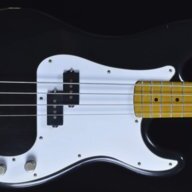
The way a P bass should be

I don't know where this comes from, but that is not science. It may look like science, but it's not until we know all the details of what is being measured and how these were generated. Since nothing you claim fits with everyone else's extensive experience, it's all BS until you can provide real evidence to the contrary.

I didn't seek permission from the YouTube poster who did the comparison video wherein he played the exact same thing without the covers then with the covers so I won't post a link. I did the spectrum analysis because musicians develop hearing loss quite quickly playing, and especially as bassists regularly do, close to drum sets; it really doesn't take long. So if you can't hear the difference the question is moot anyway.
 
As a friend of mine would say, "too much information."

The administrator of a nursing home was visiting with his residents, as was his usual practice before going home for the night. His last stop was with an older lady who had sold her belongings, given the proceeds to her children, and was in the home under Medicare. As he listened to her, he absent-mindedly began eating from a small dish of peanuts next to her bed.

By the time he was ready to leave, he had eaten all the peanuts from the dish. Suddenly he realized that this lady had practically nothing in the whole world. Somehow his finishing off her dish of peanuts took on enormous symbolic importance, and guilt weighed heavily on him all night.

The next day, on his way to work, he stopped and bought a huge can of peanuts. The first thing on his mind when he reached the nursing home was to present it to the older lady, with an apology for eating what little she had left in the world.

"Awww, that's okay young man," rasped the lady. "I really don't even like peanuts," she said. "I just like to suck the chocolate off 'em."

:)
 
”In God we trust. All others must bring data.”
- Dr. W. Edwards Demming.

Or in the words or Lord Kelvin (William Thomson):

"I often say that when you can measure what you are speaking about, and express it in numbers, you know something about it; but when you cannot measure it, when you cannot express it in numbers, your knowledge is of a meagre and unsatisfactory kind; it may be the beginning of knowledge, but you have scarcely, in your thoughts, advanced to the stage of science, whatever the matter may be."
You have to remember that Kelvin was a physicist.
 
  • Like
Reactions: DJ Bebop
The administrator of a nursing home was visiting with his residents, as was his usual practice before going home for the night. His last stop was with an older lady who had sold her belongings, given the proceeds to her children, and was in the home under Medicare. As he listened to her, he absent-mindedly began eating from a small dish of peanuts next to her bed.

By the time he was ready to leave, he had eaten all the peanuts from the dish. Suddenly he realized that this lady had practically nothing in the whole world. Somehow his finishing off her dish of peanuts took on enormous symbolic importance, and guilt weighed heavily on him all night.

The next day, on his way to work, he stopped and bought a huge can of peanuts. The first thing on his mind when he reached the nursing home was to present it to the older lady, with an apology for eating what little she had left in the world.

"Awww, that's okay young man," rasped the lady. "I really don't even like peanuts," she said. "I just like to suck the chocolate off 'em."

:)
I refuse to like this!
 
I have an all origin '69 P that I purchased from a friend of mine (original owner). I plan to sell it when the time is right.
I play only 5er's with a high C, so the vintage P just hangs on the wall. If I were to play it regularly, I would remove the PU cover because that is where I prefer to play. I don't have covers on my Squier P5.

As far as the cover distributing a magnet field, I'd like to see some data on the fields of the PU's and the B-H curve of the material used for the covers.
In theory, magnetic fields go on to infinity, but strength diminishes greatly over distance.
I have several very powerful, large neodymium magnets that don't show any strength over 1 inch away.
There are several studies that show the strings even become slightly magnetized by moving through the magnetic field.
 
  • Like
Reactions: DJ Bebop
You didn't think Fender would say that one of their instruments comes with a dead spot, did you?

Interestingly enough, over the course of the past three (3) years, I have had pass through my hands the following:

1) A Squier PJ Affinity, no chrome jewelry, no dead spots.
2) A Squier CV 70s Jazz, no chrome jewelry, no dead spots.
3) A Fender Vintera 70s Jazz, chrome jewelry, no dead spots.
4) A Fender Player Precision, chrome jewelry, dead spot.
5) A Fender Player Jazz, chrome jewelry, dead spot.
6) A Standard Precision, chrome jewelry, no dead spots when jewelry is removed.

All of this (admittedly) anecdotal information tells me that dead spots are an instrument-by-instrument phenomenon and certainly have nothing to do with the minuscule amount of weight ashtrays and pickup covers add to the body of a bass.
 
I didn't seek permission from the YouTube poster who did the comparison video wherein he played the exact same thing without the covers then with the covers so I won't post a link. I did the spectrum analysis because musicians develop hearing loss quite quickly playing, and especially as bassists regularly do, close to drum sets; it really doesn't take long. So if you can't hear the difference the question is moot anyway.

So, you did a spectrum analysis on a compressed YouTube video from an unidentified source playing in a totally uncontrolled experiment with probable bias on the players part.

No, not even close to science.

The question is moot because what you are saying is baseless.
 
So, you did a spectrum analysis on a compressed YouTube video from an unidentified source playing in a totally uncontrolled experiment with probable bias on the players part.

No, not even close to science.

The question is moot because what you are saying is baseless.
The poster didn't even speak during his video. The point of the spectrum was to show there is a difference between a cover and without a cover. Do your own spectrum comparison.
 
Yes, but the magnetic field doesn't stop at the strings.
As I said in my original reply-in theory, the field goes on to infinity though it diminishes greatly with distance, show me the math l.
Having worked with coils and magnetics, I’d have to see the math.
I doubt the pickup magnets are strong enough to align the magnetic properties of the pickup cover.
 
Simply stated, dead spots are the result of the resonant frequency of the assembled unit.

Does adding and/or removing mass to the assembly change it’s resonant frequency? Yes.
Is this phenomenon easy to recreate and demonstrate?
Yes. It’s called science.
Resonant frequency is also called natural frequency and history proved it can destroy a bridge when not considered seriously.
 
  • Like
Reactions: Thummel
As I said in my original reply-in theory, the field goes on to infinity though it diminishes greatly with distance, show me the math l.
Having worked with coils and magnetics, I’d have to see the math.
I doubt the pickup magnets are strong enough to align the magnetic properties of the pickup cover.
The magnetic field lines converge on the cover which is only 3/8" above the strings.