• TalkBass has been independent since 1998. Add your voice.
    Create a free account to reply to discussions, view embedded media, and browse with fewer display ads.
    Join freeLog in
    Want zero display ads or expanded classifieds tools? Compare plans.

The way a P bass should be

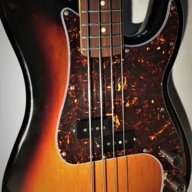
Here's my 2013 Fender American Special P Bass. I have Rotosound Jazz 77 flats on it. I like having the covers on for several reasons: the covers add weight which means the weight distribution of the bass changes to eliminate the famous dead spots on G string, the pickup cover being made from steel helps spread the magnetic field of the pickup to even the volume and the bridge cover keeps the bridge free of dust and junk. I have been playing since 1971 and have read many reasons why ashtray covers were installed on P basses, but now you know why they were put there in the first place. I learned it all from a bass player who had an original 1952 P bass he had purchased new. Remember the metal weight they used to sell that attached to the headstock to eliminate the dead spot? People needed that after they removed the covers! View attachment 5244871
The weight clips on to "increase sustain", on a guitar neck.

The covers act as giant antennas for interference.

The covers block you from being able to play in 2-3 inch areas of your bass, limiting your tonal possibilities. The bridge cover means you can't palm mute...at all. Only fretting hand mutes. Which aren't exactly consistent.

Dust is airborne. It goes in there no matter what, but having covers on means it's much more difficult to clean it off.
 
Last edited:
The weight clips on to "increase sustain", on a guitar neck.

The covers act as giant antennas for interference.

The covers block you from being able to play in 2-3 inch areas of your bass, limiting your tonal possibilities.

Dust is airborne. It goes in there no matter what, but having covers on means it's much more difficult to clean it off.

But Leo put them on and he never added anything if it was an unnecessary cost...now I am confused ;)
 
Here's my 2013 Fender American Special P Bass. I have Rotosound Jazz 77 flats on it. I like having the covers on for several reasons: the covers add weight which means the weight distribution of the bass changes to eliminate the famous dead spots on G string, the pickup cover being made from steel helps spread the magnetic field of the pickup to even the volume and the bridge cover keeps the bridge free of dust and junk. I have been playing since 1971 and have read many reasons why ashtray covers were installed on P basses, but now you know why they were put there in the first place. I learned it all from a bass player who had an original 1952 P bass he had purchased new. Remember the metal weight they used to sell that attached to the headstock to eliminate the dead spot? People needed that after they removed the covers! View attachment 5244871

I read this with interest. I’ve been playing Fender PBs since the mid 70’s, so this is a revelation to me.

Over the years and several basses later, I’ve not had a Fender bass with dead spots, and with rigs that provided more volume that what I’ve needed, I never realized that I was short changing the amount of gain I could get out of my bass. What I did I did realize was the Pick Up Cover and the Bridge Cover as well were in the way.

Thanks for the info.
 
  • Like
Reactions: FRoss6788
The big thing is to make sure the screws don't bite into the holes in the body. You should be able to push the screws through those holes without the neck in place. I like mine where I need a bit of thumb pressure to push them through and a slight tap to push them back out. Failure to do this will result in a less than ideal neck to body join as the screw biting into both body and neck will be pushing the joint apart rather than pulling it together.
That sorta goes without saying - for any bass with a "bolt-on" neck. Sadly, I've had to enlarge the neck pocket holes in more than one of my basses. Basses you wouldn't expect to have to do that to, either. But, my P-Bass is not one of them. The tightness thing is more of an "ideal contact" thing; of course, the neck should be firmly in the neck pocket. But the screw "tightness", while important for holding the neck securely, can also be varied - a little - to control the dead spot phenomenon. The neck screws on my P-Bass are "tight"; the neck certainly isn't moving - in any direction. But, they aren't screwed down so hard, that it takes both hands on the screwdriver to budge them. On the 2 tightest ones? I could probably horse them down, at least another 3/4 of a turn. But, on that bass? I'd have one Hell of a dead spot, if I did (ask me how I know...). That might, indeed, be what it takes to make the dead spot go away on somebody's bass - but, not on mine. Enough pressure to hold the neck securely on all 4 screws - then back the upper 2 off 1/4 turn or so, results in a secure neck - and eliminates the dead spot on my P-bass...:cool:
 
Last edited:
Dead spots on the G string???..............I have more P Basses than you can shake a stick at and I've never had any dead note spots anywhere with any string.

I'd love to be able to transport myself back to a time where I was blissfully unaware of such things. I'm at the stage where I can easily take someone's bass that "has no dead spots"....and find them. Granted, not all of them are pronounced, but every bass has areas of the neck where there is less sustain.
 
The ashtrays don’t weigh enough to make a dramatic difference in balance, on or off. I’ve tested every theory about them.

The one thing I’ve found to be true is that the pickup cover keeps your fingers off the pickups, and the bridge cover just covers the bridge.

But, if you adjust your instrument as often as I do, the ashtrays, other than looking pretty cool, mostly are an impediment to making quick adjustments to pickup height and string height.

I am totally not in love with them for any reason other than general cosmetics.
 
This is the way a P bass should be.

upload_2023-11-8_21-24-14.jpeg