• TalkBass has been independent since 1998. Add your voice.
    Create a free account to reply to discussions, view embedded media, and browse with fewer display ads.
    Join freeLog in
    Want zero display ads or expanded classifieds tools? Compare plans.

The "wood matters! " experiment...

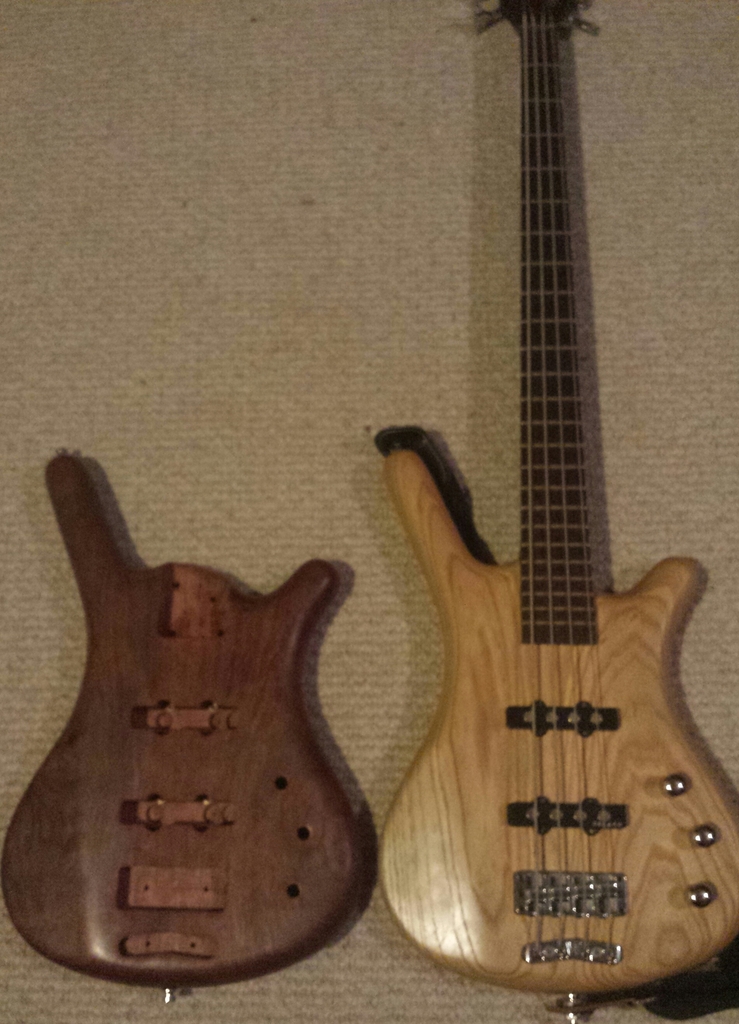
I've always been a believer in wood's effect on tone. Not easy to predict, not consistent, and not worth obsessing over (some people only play certain wood-bodied basses), but IMO it does have the ability to impact tone. To prove to myself what I already know, and to get lighter, I recently purchased an ash body for my Warwick Corvette. Here it is before:
20150504_123313_edit_1449886734809.jpg


And here it is after:
20151211_200719-1.jpg

I used the exact same hardware, neck pickups, pots, and strings. Set everything up to the exact same specs.
Do I hear a difference? Definitely. As I expected, the change is subtle but it's there. I'll post sound clips as soon as I figure out how...
 
Last edited:
I forgot to note that the bubinga bass weighed 10lbs and the ash body brings it down to 8lbs even. I wonder if that is more impactful than the actual woods...

Density is a huge characteristic of any material, so a change in tone by a different wood is most likely linked to a change in density and structure.
 
Its not like one kind of wood sounds like this and the other kind of woods sounds like that. All wood resonates different no matter the species, also density varies and other factors.

Id say wood plays a HUGE factor on resonance, sustain, even tones across the fretboard etc, thats why there are HUGE differences in for example the worst and the best out of 100 different 2014 american standard jazz basses.
 
  • Like
Reactions: Dubsly
Of course it does.

The only argument with any merit saying otherwise is that after you get through the preamp, processing, and amplification stages, that people LISTENING to it won't be able to tell the difference. Duh.
 
I had a similar experience changing the body, and absolutely only the body, on my Steinberger XP from rock maple to mahogany. Hearing is believing, it sounds different, slight loss of sustain in exchange for a less brittle rounder tone. I don't really care if other people believe it, unless they try it on an instrument they are intimately familiar with, they haven't got much to say in my book.
 
Last edited:
This experiment doesn't count for anything. If you had a hundred ash bodies and a hundred bubinga bodies and swapped the electronics, hardware and strings, then the results would mean something. A sample size of one isn't science.
It does mean something. It's much lighter, and it sounds a bit different. That's something. I'm not touting the superiority of either wood, I'm not even attributing tonal "buzz words" like attack, brightness, low-end, etc. I'm also not submitting my results to any scientific journal, just thought it would be interesting. I will however be on the lookout for another 99 ash and 99 bubinga corvette bodies!
 
This experiment doesn't count for anything. If you had a hundred ash bodies and a hundred bubinga bodies and swapped the electronics, hardware and strings, then the results would mean something. A sample size of one isn't science.

Yup, not to mention the fact that even as a single case study this will be meaningless because the OP knows exactly what he is playing through, so we cannot eliminate bias from the equation. Whether it is a single person doing the comparing or one hundred, they would need to be "blind" to what they are playing through.

So not only would we need 100 (or more) bodies, we would also want 100 (or more) testers, and for all of them to be blind to the conditions. Furthermore, we'd want to weight-match the pieces of wood as closely as could be to eliminate that as a potential confound, not to mention ensure that the body dimensions are as close to possible as can be.

It is a neat thing to do, to swap out the body on your own instrument and share what you think of it yourself, but as noted above, from a scientific perspective or with respect to "proving" anything, it is absolutely worthless.