
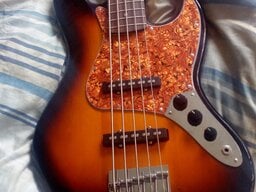
I just bought a new Fender Ultra Jazz Bass with a maple board. I expected it to be a bit brighter than my other non-maple basses. It turns out it is smoother and more mellow than those other basses - In a good way. Pleasant surprise for me!

Enjoy the benefits of a premium membership!
Upgrade Account
-
TalkBass has been independent since 1998. Add your voice.
Create a free account to reply to discussions, view embedded media, and browse with fewer display ads.
Join free Log in
Want zero display ads or expanded classifieds tools? Compare plans.
You are using an out of date browser. It may not display this or other websites correctly.
You should upgrade or use an alternative browser.
You should upgrade or use an alternative browser.
They really do differ from one to another!
- Thread starter SixtyCycleHum
- Start date
More options
Who Replied?
Not only is it possible for two "identical" basses to be noticeably different, it's quite common. Instruments are unique. Out of every ten "off the rack" (mass produced) basses you may get eight that are pretty close. This forms the base line for determining what a model should be like. One of the ten may be garbage (a dog) and the remaining one will somehow exceed the rest making it "THE ONE". Whenever you encounter "THE ONE" buy it. That's why you go shopping and try out a bunch of the same model instrument. It doesn't matter if it's the same color as the rest or is some putrid shade of diarrhea green, if it's "THE ONE" buy it. (Paint is cheap and the SnotGlo finish can be removed as soon as you get it home.) If manufacturers could pinpoint exactly what it is that makes the great basses great they'd make all of their instruments that way. It is still a mystery where this mojo comes from. There are stories of some players getting a stock inexpensive bass that blows away their custom instrument that cost ten times the price. This may be (and probably is) a case of the inexpensive bass being The ONE of it's type and the custom being either the dog or one of the lesser of it's type. One common problem in determining quality is missing how snug the neck is attached. Make sure the screws are tight. If the neck is loose it sucks up the sustain. When you are walking on a paved sidewalk you use less energy than when you're walking in mud or quicksand. The reason is that the hard surface allows your energy to work for you. When you walk in mud you have some of your energy uselessly taken up by fighting off the sloppy surface. The same is true for bass necks. When the neck is firmly attached the notes sing and they sustain. When the neck is loose it vibrates along with the strings and cancels them out. This is a bit off topic, but good advice nonetheless. Hope it helps.
This was true insight that I didn't even consider, and I'm very grateful for it. Thank you. I'm going to take a closer look at his bass. I'm really surprised that the EMG J set isn't absolutely screaming in this thing. I want to know why.
I just bought a new Fender Ultra Jazz Bass with a maple board. I expected it to be a bit brighter than my other non-maple basses. It turns out it is smoother and more mellow than those other basses - In a good way. Pleasant surprise for me!
I'd *love* to lay hands on a maple that is mellower than my rosewood stuff. I don't quite know how I'd feel about it, but that's an experience!
East J Retro is worth the price of admission. It’s bringing a bazooka to a slap fight. No offense, y’all. But a J Retro in any J shaped object is gonna win that fight 100 times out of 100, doesn’t matter what the finger board is.
That’s where the magic happens.
View attachment 4463717
Yessir! I have to agree. My Affinity sounds insanely good for what it is and it's a lot in part to the J Retro. A bit on the expensive side, comparable price wise to what Aggie and co are putting out. But it's a very special flavour..
I'd posit you'd have to put the pickups/electronics in the same bass, then listen for the difference.
I can sometimes hear a fingerboard, but it's a very subtle coloration, and for what you're describing, I'd expect a 1/4 Pounder-loaded bass to indeed sound more agressive than another example of the same bass (albeit, rosewood instead of maple fingerboard) with EMG's, usually for me the essence of a smooth, sophistocated tone. The difference you're hearing is exactly what I'd expect with those two electronic packages.
Either way, glad you're both happy with your axes.
That's actually what swung me about the EMG J set. I've heard some pretty hot output on YouTube clips. I was probably wrong about them from the get go, however. I opted for the QP because I *want* that aggression on tap if I need it, and the ability to dial it back other times. They've become my favourite.
If he's got EMGs in his bass, they really need to be raised up close to the strings. Really, get them as close as he can without the string slamming into them. They're extremely sensitive to the distance they sit from the strings.
I still remember my old Ibanez, which I had routed out and fitted with EMG DCs. With the pickups bolted in, at the same height as the old Ibanez pickups, it sounded kind-of tame. So we quickly raised both the neck and bridge pickups and it opened up significantly. It sounded like a completely different instrument.
Yo! Good advice, Frankie. Another thing I didn't think of. His really are a fair distance from the strings. Factory position, I guess.

No, seriously, I’m not being sarcastic, I mean that if it’s not measurable, it’s not a useful term whatsoever in terms of communicating what it means to anybody else. It’s like calling tone fudgey, or gooey, or sweet, or nice - meaningless. I have no clue what spanky means, and I’ve been playing since 1982, I’ve never heard it before. The word is evocative of nothing for me.Its a descriptive term, a tonal characteristic, an attempt to language tone. Its been an important and legit practice in this industry for years - its not associated with frequency band. I understand the sarcasm and your joke, but with that many sum of components contributing to the fundamental quality of tone, every descriptor helps us in communicating and understanding our preferences.
“Warm” usually means lots of low mids, but even then what people mean by warm differs. Or bright.
Tone is capable of being visualized, with actual measurable characteristics, like decay, sustain of different harmonics for example.
So what does spanky mean?
Last edited:
No, seriously, I’m not being sarcastic, I mean that if it’s not measurable, it’s not a useful term whatsoever in terms of communicating what it means to anybody else. It’s like calling tone fudgey, or gooey, or sweet, or nice - meaningless. I have no clue what spanky means, and I’ve been playing since 1982, I’ve never heard it before. The word is evocative of nothing for me.
Bright. There's a lot of upper mid definition. Growly as hell, but it's a very focused growl.
No, seriously, I’m not being sarcastic, I mean that if it’s not measurable, it’s not a useful term whatsoever in terms of communicating what it means to anybody else. It’s like calling tone fudgey, or gooey, or sweet, or nice - meaningless. I have no clue what spanky means, and I’ve been playing since 1982, I’ve never heard it before. The word is evocative of nothing for me.
By the way, I didn't detect sarcasm. I knew it was a fair question


Action makes one of biggest differences in tone variation. My Geddy at the studio is pretty bowed raising the action a bit, need to set it up again. I lost all the grind and spank and it did add a low fundamental that I don’t usually get since I like low lightly buzzy grindy action.

Well, it's still maple underneath the frets absorbing the vibration of the string.But then a maple fingerboard is almost always coated, and the coating is typically harder than rosewood.
Woods definitely matter, I appreciate that, but I think the common tone woods that are used are very similar to one another, and with a solid body the electronics have the most impact on sound, apart from the strings themselves.

What frequency band does “spanky” live in?
It’s 3 octaves above “punchy”.

No, seriously, I’m not being sarcastic, I mean that if it’s not measurable, it’s not a useful term whatsoever in terms of communicating what it means to anybody else. It’s like calling tone fudgey, or gooey, or sweet, or nice - meaningless. I have no clue what spanky means, and I’ve been playing since 1982, I’ve never heard it before. The word is evocative of nothing for me.
“Warm” usually means lots of low mids, but even then what people mean by warm differs. Or bright.
Tone is capable of being visualized, with actual measurable characteristics, like decay, sustain of different harmonics for example.
So what does spanky mean?
Frequency Band measurement is a minimal and incomplete part of how any tone is achieved or understood. Descriptive terms in the gear industry or tone industry (for basses, amps, preamps, pedals, etc) are both necessary and important for the dialogue to prevail. I understand not everyone has a history or tonal reference points for those terms, that’s OK, still it doesn’t change the industry vernacular and purpose. How long you have been playing has no bearing. Not all tones translate via frequency measurement. ‘Warm’ ‘Fat’ ‘Clear’ ‘Punchy’ ‘Fast’ ‘Sag’ ‘Anemic’ ‘Strident’ ‘Full’ etc… are not frequency descriptors as a whole.
Elementary example in the bass world - People will often say Roundwound Strings are ‘brighter’ than Flatwounds. Yes, True (perceptible) but if ‘bright’ was being measured in terms of ‘frequency bands’ it would not be true. One has a ‘piano’ like clarity, quality and zing with more evident harmonics and one has a thumpy, prominent fundamental, mid forward tonal quality with less sustain but the same available ‘frequency ranges’ for your bass (60-250) or 41 Hz, 55 Hz, 73 Hz, 98 Hz etc...are available with either. You cannot boost the high end harmonics of flatwounds to get the piano quality of rounds. Its all about the material quality and characteristic, not the ‘frequency measurement’ as a whole. The examples are endless when it comes to materials and construction.
While it may not be a very good phrase, it is used alot. For me depends on bass, guitar, pickups etc...Clear, immediate, present, tight tone. But again you can't measure 'clear' or 'tight' etc...either. All the best, RGSo what does spanky mean?
Frequency Band measurement is a minimal and incomplete part of how any tone is achieved or understood. Descriptive terms in the gear industry or tone industry (for basses, amps, preamps, pedals, etc) are both necessary and important for the dialogue to prevail. I understand not everyone has a history or tonal reference points for those terms, that’s OK, still it doesn’t change the industry vernacular and purpose. How long you have been playing has no bearing. Not all tones translate via frequency measurement. ‘Warm’ ‘Fat’ ‘Clear’ ‘Punchy’ ‘Fast’ ‘Sag’ ‘Anemic’ ‘Strident’ ‘Full’ etc… are not frequency descriptors as a whole.
Elementary example in the bass world - People will often say Roundwound Strings are ‘brighter’ than Flatwounds. Yes, True (perceptible) but if ‘bright’ was being measured in terms of ‘frequency bands’ it would not be true. One has a ‘piano’ like clarity, quality and zing with more evident harmonics and one has a thumpy, prominent fundamental, mid forward tonal quality with less sustain but the same available ‘frequency ranges’ for your bass (60-250) or 41 Hz, 55 Hz, 73 Hz, 98 Hz etc...are available with either. You cannot boost the high end harmonics of flatwounds to get the piano quality of rounds. Its all about the material quality and characteristic, not the ‘frequency measurement’ as a whole. The examples are endless when it comes to materials and construction.
While it may not be a very good phrase, it is used alot. For me depends on bass, guitar, pickups etc...Clear, immediate, present, tight tone. But again you can't measure 'clear' or 'tight' etc...either. All the best, RG
Pretty much, yes! To the point where there's a kind of harmonic break-up (bad way of describing the sound, I know) coming from the board itself.
Thanks - but in 30+ years of playing, I’ve never heard the term spanky before, and still have no idea what it means.Frequency Band measurement is a minimal and incomplete part of how any tone is achieved or understood. Descriptive terms in the gear industry or tone industry (for basses, amps, preamps, pedals, etc) are both necessary and important for the dialogue to prevail. I understand not everyone has a history or tonal reference points for those terms, that’s OK, still it doesn’t change the industry vernacular and purpose. How long you have been playing has no bearing. Not all tones translate via frequency measurement. ‘Warm’ ‘Fat’ ‘Clear’ ‘Punchy’ ‘Fast’ ‘Sag’ ‘Anemic’ ‘Strident’ ‘Full’ etc… are not frequency descriptors as a whole.
Elementary example in the bass world - People will often say Roundwound Strings are ‘brighter’ than Flatwounds. Yes, True (perceptible) but if ‘bright’ was being measured in terms of ‘frequency bands’ it would not be true. One has a ‘piano’ like clarity, quality and zing with more evident harmonics and one has a thumpy, prominent fundamental, mid forward tonal quality with less sustain but the same available ‘frequency ranges’ for your bass (60-250) or 41 Hz, 55 Hz, 73 Hz, 98 Hz etc...are available with either. You cannot boost the high end harmonics of flatwounds to get the piano quality of rounds. Its all about the material quality and characteristic, not the ‘frequency measurement’ as a whole. The examples are endless when it comes to materials and construction.
While it may not be a very good phrase, it is used alot. For me depends on bass, guitar, pickups etc...Clear, immediate, present, tight tone. But again you can't measure 'clear' or 'tight' etc...either. All the best, RG
Cool, now you have and now you do. Never too late to expand our knowledge, not to mention it has been mentioned 100s of times here on the forum over the years in relationship to the same tonal quality. Either way its better than buckwheat, stymie or alfalfa but likely equal to porky.Thanks - but in 30+ years of playing, I’ve never heard the term spanky before, and still have no idea what it means.

Cool, now you have and now you do. Never too late to expand our knowledge, not to mention it has been mentioned 100s of times here on the forum over the years in relationship to the same tonal quality. Either way its better than buckwheat, stymie or alfalfa but likely equal to porky.
And definitely a different tone from "Froggy"

You can always trade, right?Heyo!
Just had a blast hanging with a friend of mine, just a couple of long haired ****s messing with each other's basses. The way it should be. Haha.
There's something that I noticed tonight. My buddy also has an Affinity V, but he has replaced his with a maple fretboard and it's beautiful. He's dropped the EMG J set in his where I have the J Retro and Duncan QP's. Both of us have new strings as of less than two weeks ago. Yes I gave him a pack of my Elixirs, I'm an idiot. Haha. My rig sounds a BUNCH spankier and growlier and more articulate with the knobs wide open. He's actually getting this really lush classic tone in that position. It's so strange. His components and the maple neck alone are supposed to leave my Affinity for dead for brightness and sustain, where I was looking to add more warmth.
The active transformation and new pickups has turned mine into a snarling beast that can get "piano-y" and his into one of the easiest basses to dial in I've ever played. Yet, he wants what mine is doing. Is it possible to have two very similar instruments and yet one is just naturally brighter? I'm tripping on this one, tbh.
Thank you for your kind response. Another thing to look for is that the bridge is anchored down tightly. If not, the same cancellation effect will occur. Have a great night!This was true insight that I didn't even consider, and I'm very grateful for it. Thank you. I'm going to take a closer look at his bass. I'm really surprised that the EMG J set isn't absolutely screaming in this thing. I want to know why.
I have a 2014 Affinity Jazz V, and replaced the original neck with a Vintage Modified Maple/Maple Glossed neck. The difference was astounding. The VM neck gave it snap and brightness that it never had before.
I do believe that much tone can be had from the neck as a whole, not just the fretboard. I did feel that the original Affinity neck was kind of “green” where it did flex a whole lot. The VM neck is rock solid.
Apples to Apples, try his neck on your bass and vice versa, see what happens then.
I do believe that much tone can be had from the neck as a whole, not just the fretboard. I did feel that the original Affinity neck was kind of “green” where it did flex a whole lot. The VM neck is rock solid.
Apples to Apples, try his neck on your bass and vice versa, see what happens then.


