• TalkBass has been independent since 1998. Add your voice.
    Create a free account to reply to discussions, view embedded media, and browse with fewer display ads.
    Join freeLog in
    Want zero display ads or expanded classifieds tools? Compare plans.

Thinking in tabs; yay or nay?

On the other hand, music existed for THOUSANDS of years without notation. We have no idea how the psalms were sung or what Roman or Greek music sounded like because there was no way at all to write it. The earliest efforts to record music in the ninth-century were just squiggles that told monks in choir which words to go up or down in pitch on.

There has been notated music found on ancient Greek Urns. It has been recorded. Classical Indian music has been notated for a long time. I'm willing to bet notation has been around far longer than that, in some form in many literate societies. You are correct in the development of modern notation.

Reading music notation is not so difficult or mysterious that it is even a high road to take. It's not the easiest thing in the world, but I've taught everyone from Kindergarden kids (it's rare to get a kid that young, but it's a private school so I'm dealing with the occaissional really bright kid) to old farts to do it, at least at a functioning level. Not professional level but enough to read or write easier standards.

Music notation was taught as a part of regular school curriculum in the dark ages of the 60's I was taught one octave on a cheap xylophone, with the rest of the 2nd grade class, recorder in 3rd or 4th grade and sight singing in 5th and 6th. This wasn't world class learning here, but at one time musical notation was taught to everyone.
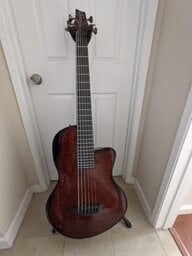
 
I also have slower going because, unlike the sax (or piano, which I did a very little of) I have to figure out which of as many as four different places on my fretboard to use for that note! I suppose just practice is needed to overcome these speedbumps, but did anyone else have similar issues and how did you get through them?

Well, one thing would be to regard that as a feature, not a bug. ;) You have options in this regard that a piano player does not.

You've incidentally hit on one reason why standard notation is especially valuable--it does not ask you to put your fingers at a certain spot (though it can add that if desired), it asks you to produce certain pitches in certain rhythms. That's exactly why I could write a melody for, say, a flute and expect it to be played correctly without having the slightest idea of how the flute player actually produces specific notes. And the flute player could write me a bass part without knowing anything about how I produce notes.

Yes, it can be confusing that certain notes can be played in more than one way. One thing I would suggest that, if it doesn't alleviate the confusion at least shows how you might use it constructively, is to look not so much at individual notes as at groups of notes. Often, fingerings are chosen on the basis of convenience and ease of access, depending on what you've just played or what you'll be playing just afterward. For example, if you can get to a given note either by (a) staying in the same hand position you're already in or (b) only by jumping a lot of frets, you'll often prefer to do the former if you can. If, say, you're playing a lot of high stuff around the 10th to 13th frets, and you get the call to play the Ab that occupies the top line of the bass clef, you won't necessarily want to go all the way down to the first fret of the G string to get it, when you can grab the same note by playing on the 11th fret of the A string.

Another point is that the various fingerings for a particular note won't sound absolutely identical. An open G on your high G string won't have the same sound quality as the same G played by fretting the 15th fret on the low E string. So you may choose a fingering that gives you the specific sound quality you want. This may mean actually using a more difficult fingering, thereby going against what I said in the last paragraph. You can decide which factor (convenience or specific sound) is more important to you on a case-by-case basis.

This tends to be an individualized thing, rather context-dependent, and there's of course more to it than what I've suggested. But the key thing, I'd say, is to look at it as an opportunity rather than a hassle.
 
I'm pretty noob and amateur, but I'll weigh in here. I think the real answer depends on what kind of musician you want to be.

Musical notation is certainly the high road, it's a universal code read by all trained musicians, it can be used to create the song from the notation alone, etc.

On the other hand, music existed for THOUSANDS of years without notation. We have no idea how the psalms were sung or what Roman or Greek music sounded like because there was no way at all to write it. The earliest efforts to record music in the ninth-century were just squiggles that told monks in choir which words to go up or down in pitch on.

Most folk-music traditions were totally by ear and oral tradition until quite recently. I don't remember who it was, but there was an old bluegrass fiddler and band leader whose signature line used to be, "Play it like it's wrote, boys!" -- the point being that NONE of it was "wrote."

So tablature is a kind of hybrid thing, and a product of the age of recording technology, rather like that early medieval notation -- you can't learn a song from a tab alone, let alone give it to a keyboardist to play, you have to listen to the song to know what to play, but there's a system of partial writing that helps you find where each note is on your instrument. It does what it does and it doesn't do any more. If that's enough for you, then I wouldn't stress over it. But if you want to go the high road, then yes -- do what everyone here has said and do the grunt work to learn notation.

Can I just add my own personal issue here? I learned to read musical notation playing sax. I partly just have a running barrier to reading bass music because I'm always catching myself misreading by a line (being used to treble clef), but I also have slower going because, unlike the sax (or piano, which I did a very little of) I have to figure out which of as many as four different places on my fretboard to use for that note! I suppose just practice is needed to overcome these speedbumps, but did anyone else have similar issues and how did you get through them?

Interesting points! I would suggest that what once existed doesn't apply to today's world. If people didn't read notes thousands of years ago, today, all of today's academic music and all of today's reading sideman situations, and all of today's top academic situations exists with music and not tab. Tab is a false method because it has no use, no matter the philsophy to justify its use.

Regarding the above suggestion that it depends on what kind of musicians one wishes to be, it would be a good idea to note that whatever musician that you choose, there will certainly be some kind of major or minor chord in it. Notes that exist in today's tonality will be in action. Common harmonies, similar use of pitch and rhythm with little contrary styles (such as Zappa-esque music, which also used common use of pitch and tonal principles) are in use by nearly every musician in nearly every musical style. Chords, pitches and rhythms that exist in just about every kind of style of music are best represented by the "grammar" that perfectly defines them, especially in an academic setting. Tab cannot help you to acquire the vocabulary to learn content to function in any style. In fact, it can't even help you to play better since one is not reperesenting music either by ear, eye or mind. They are playing via Simon Says methodology. Even a chimp can do that!

The problem is that people sometimes justify the differences in music to allow for different methods to learn them. But what most people forget is that whatever style one chooses and whatever manner one choose to play, two points are irrefutable:
1. Most styles are built upon the exact same factual language, and
2. Nobody, not one person anywhere, can play what they don't know.

Tab can't help you to learn because you are confined to a numerical non-rhythmical approach of a song without musical inclusion, executed by following the numbers, sort of like painting a picture by numbers. They may be fun, but you aren't going to become an artist that way, nor learn how to even express yourself well.
 
For somebody like me who has been playing for less than a year, TAB is very useful when combined with learning by ear. If I want to learn a song then I pull the TAB, listen to the song a few times, walk out the TAB slowly, listen some more then play along till I get it right. I find this is an easy and effective method to learning songs. I do have a rudimentary understanding of scale and basic music theory (I can locate my notes on the fretboard, play major and minor scales, some arpeggios and lydian) and can read simple staff but I dont turn to it to learn a new song just yet. TAB is a great gateway for people to enter a music playing world without getting bored to death with theory. While true, that TAB doesnt give you everything you need, if you dont have a good ear and an internal sense of time then no method will fix that. All that being said, I think it is really imperative to learn to read at some point. When to tackle this is the question. I think it is up to the individual. For the OP, he has been playing for 7 years and I think he knows it is time to learn to read because he is asking the question in the first place.
 
They are both usefull and both should be understood why they exist.
If we take standard notation as the language of music then i don't think none would disagree it covers all points and instruments.
Tab covers (in the case of guitars) a visual numeretical practical application of... if your fingers go here it will sound like this( normaly the player has a audio reference to relate to) this allows them to the information they seek.
If the tab has notation with it then they can relate it to that and try and see the similarities and hopefully learn again how to use notation.

As in language there are different ways to gain information. If one loses their hearing or speech then sign language is used to communicate and for them to gain the knowledge they need. Lip reading is the same principal, recognition of shapes that words and letters have.

So as i see it notation is language in all its glory, emotion, meaning and complication, double meaning, and implications. Tab is sign language or lip reading, mearly a way to gain the information required simply and effectively by a differnt means.

In the end it is the brain that sorts out what is what, so to that end it has to understand what is being said. If you read notation, teach by notation and student comes to you proficient in tab, then who is the stupid one?
That student wants access to what you know but you cannot help him.
What a ridiculous situation that is when we consider it will be the brain that orders the info, its not really bothered how it gets it, so long as it understands it and can make music(nothing to do with reading or writing, but imagination)

1. Most styles are built upon the exact same factual language, and
2. Nobody, not one person anywhere, can play what they don't know.

Agreed on point one, and how do you prove point 2:)
 
... now that i'm trying to sit down and put music to my lyrics i'm finding that I write it out in tabs, or just the chord I happen to be playing while i'm working on a riff. It's not in any real key, nor is it in a scale. Sure it sounds good and I can sing it just fine...


You know, if you're sitting down and writing things out in tab and it "sounds good" then it most likely fits into a common scale.

That being said, it's probably a lot easier and faster to learn scales/keys and write a song that way, then it is to write a bunch of tabs down and hope it sounds good, then try to explain it to someone later.
 
They are both usefull and both should be understood why they exist.
If we take standard notation as the language of music then i don't think none would disagree it covers all points and instruments.
Tab covers (in the case of guitars) a visual numeretical practical application of... if your fingers go here it will sound like this( normaly the player has a audio reference to relate to) this allows them to the information they seek.
If the tab has notation with it then they can relate it to that and try and see the similarities and hopefully learn again how to use notation.

As in language there are different ways to gain information. If one loses their hearing or speech then sign language is used to communicate and for them to gain the knowledge they need. Lip reading is the same principal, recognition of shapes that words and letters have.

So as i see it notation is language in all its glory, emotion, meaning and complication, double meaning, and implications. Tab is sign language or lip reading, mearly a way to gain the information required simply and effectively by a differnt means.

In the end it is the brain that sorts out what is what, so to that end it has to understand what is being said. If you read notation, teach by notation and student comes to you proficient in tab, then who is the stupid one?
That student wants access to what you know but you cannot help him.
What a ridiculous situation that is when we consider it will be the brain that orders the info, its not really bothered how it gets it, so long as it understands it and can make music(nothing to do with reading or writing, but imagination)


Agreed on point one, and how do you prove point 2:)

I don't see how your analogy works out. People turn to sign language and lip reading out of necessity; most people only learn it because they lost their primary method of communication. Most people who learn tab do it because it's faster, when they can still learn to read (i.e. it's convenient). Also, learning sign language and lip reading can be rather complex and obviously don't com naturally to most people; and, in the case of sign language (not to belittle it, it's a wonderful language that I hope to learn in the future) it really only helps with other people who know how to sign.

Actually, now that I think about it tab is sorta like sign language; but if you can learn to communicate in a way that lets you communicate with many other people, and there're nothing stopping you from learning it, why not learn?

With the student/teacher dilemma, to depends on what the student wants to get out of lessons. If the students want to really learn music they'll have to learn to read and the teach will probably teacher them.
 
I don't see how your analogy works out. People turn to sign language and lip reading out of necessity; most people only learn it because they lost their primary method of communication. Most people who learn tab do it because it's faster, when they can still learn to read (i.e. it's convenient). Also, learning sign language and lip reading can be rather complex and obviously don't com naturally to most people; and, in the case of sign language (not to belittle it, it's a wonderful language that I hope to learn in the future) it really only helps with other people who know how to sign.

Actually, now that I think about it tab is sorta like sign language; but if you can learn to communicate in a way that lets you communicate with many other people, and there're nothing stopping you from learning it, why not learn?
Tab is no different if you understand it, it is a tool and a two way street.:)

With the student/teacher dilemma, to depends on what the student wants to get out of lessons. If the students want to really learn music they'll have to learn to read and the teach will probably teacher them.

What i say is not about why, but about the fact it works. If a parent has a deaf child, it is the parents interest to learn to sign if they want to communicate with the child, learning is about communication not how or why. How will anyone who does not know how to sign ever know what is being said to them or the information on offer from someone who's only means of communication is sign. Writing will do the same thing, as will these days of digital recognition software, and digital auidtory software.
Steven Hawkings gets his message across and struggled to write his best selling book, his problems were never about thinking but in communicating his thoughts.
Julia Brace, Helen Keller, Laura Bridgman, just three who suceeded in education through profound difficulties of being deaf and blind. It was never about the information, but getting it to them in a way they could understand.:)
 
Actually, now that I think about it tab is sorta like sign language; but if you can learn to communicate in a way that lets you communicate with many other people, and there're nothing stopping you from learning it, why not learn?

.

Tab is not like any langauge. Language is used to convey the full meaing of an idea. Tabs give you nothing more than a fret to put your finger on. Hand anyone a piece of tabbed out music, with no audible reference music and what have you got? Numbers on lines.
 
Tab is not like any langauge. Language is used to convey the full meaing of an idea. Tabs give you nothing more than a fret to put your finger on. Hand anyone a piece of tabbed out music, with no audible reference music and what have you got? Numbers on lines.

Well said! And true! It is odd how music is sometimes an avoided topic by some bass players who say that they wish to play better. Tab doesn't work because it isn't a musical principle. Forget it and go toward music itself! Good job Bill!
 
Tab is not like any langauge. Language is used to convey the full meaing of an idea. Tabs give you nothing more than a fret to put your finger on. Hand anyone a piece of tabbed out music, with no audible reference music and what have you got? Numbers on lines.

Then i have to conclude you have the wrong idea of the purpose of language. Laguage is not to convey the full meaning of anything, that is the brains job to work out through association.:)

There are many languages around the world that are no where near as expressive as English because the do not give a full meaning compared to English. By virtue of being a once colonial power, England had interests world wide and as a result absorbed words form other countries in to its volcabulary.

If a tab shows a player to play a C major scale and notaion shows a player to play a C major scale then please tell me, what is the difference.? :confused:
 
Well said! And true! It is odd how music is sometimes an avoided topic by some bass players who say that they wish to play better. Tab doesn't work because it isn't a musical principle. Forget it and go toward music itself! Good job Bill!

Sad thing here is that Jeff has one of the best musical minds in the world, but his opionion is so biased, so narrow, that any real comment from him is wasted on the subject.:(

Tab doesn't work because it isn't a musical principle.

Who says tab is not a musical principal?
I open up most guitar mags and tab is there being used to explain or show musical things.
If a guitar is a musical instrument and anyone learns say an arpeggio by tab, they have learned a musical principal...end of any argument.
Argue the hows whys, wheres, the implications, the dissadvantages, etc but the fact is a musical principal was learned.:)
 
OP, i think you should learn standard notation, not because anybody in modern rock uses it (most don't), but because doing so is probably the most complete and effective way to understand basic musical concepts.

i can read music (poor sight reader though) and sometimes transcribe my compositions in standard notation (more to keep from forgetting them than anything else). but i have never needed it in a band situation, and despite what some people in this thread are telling you, most alt-metalheads are not readers and you would probably be better off giving them a demo + a tab. however, understanding the underlying concepts that are illustrated by learning music theory through standard notation is a priceless skill and will improve your playing and writing even if you go years without using the notation itself.

there's nothing inherently wrong with tabs and i wouldn't be shy about using them if it's the fastest way to communicate. i read music and would still rather learn a new song by listening + using tab. but when i read tab i am not just thinking "first finger on fifth fret, durrrr." i know the notes, keys, scales etc, it just happens that i find i learn the song faster through tab and it also tends to be more readily available in tab for free on the internet. the problem with tab is that people use it as a substitute for musical concepts just to learn a song by rote. i think of it this way... using tab is like copying a beautiful poem out of a book. you can now reproduce that poem on demand, but it doesn't teach you to write poetry.
 
After you know and have memorized the alphabets, it's just using that improves your ability. It's really not that hard to memorize few things, like which note is which line and gap. And rhythmically notation is better than tab. You can also add tabs to standard to show people how & where it should be played (eg. open string vs fretted) . I'm not an expert in reading but I have the basic knowledge what everything means so I can figure out the songs from notation, it just takes time. So all I gotta do now is to read it, write it and play it... No learning anymore, just trying to get faster and the only way to do that is to do notation.

Note places are easy to memorize, there's tons of mnemonics, little games online or flash cards, whatever. 5-10 minutes everyday at lunch break for a couple of weeks is what it takes... Rhythms can get complex but just take it slow first. It's less work than learning a new Green Day song.
 
If a tab shows a player to play a C major scale and notaion shows a player to play a C major scale then please tell me, what is the difference.? :confused:

Among other things, standard notation can convey to a musician, without regard to a specific instrument, (1) what notes are in a C scale; (2) when to play them; (3) how loud to play them; (4) how fast to play them; and (5) how to articulate them.

Tab can do none of those things. It is true that you can derive the names of notes from a tab, but only by reference to an specific instrument with a specific tuning, not in the abstract.
 
There has been notated music found on ancient Greek Urns. It has been recorded. Classical Indian music has been notated for a long time. I'm willing to bet notation has been around far longer than that, in some form in many literate societies. You are correct in the development of modern notation.

Thanks BillNC, I hadn't known about Greek notation before now. I'll yield that point, but it is still a discontinuous tradition; in the Middle Ages a new system of notation had to be developed from scratch, much of it (especially in the early stages) in a form which is so capable of alternative interpretations that it can only have been aide-memoire to a basically oral tradition. I suspect the same was true of the Greek notation, though I know little about it. Musicians in pre-modern societies were generally low-status individuals whose literacy is doubtful ("flute girls" doubled as prostitutes, often at the same parties they played for), so I doubt the majority of actual performers relied on it much.

Reading music notation is not so difficult or mysterious that it is even a high road to take. It's not the easiest thing in the world, but I've taught everyone from Kindergarden kids (it's rare to get a kid that young, but it's a private school so I'm dealing with the occaissional really bright kid) to old farts to do it, at least at a functioning level. Not professional level but enough to read or write easier standards.

Music notation was taught as a part of regular school curriculum in the dark ages of the 60's I was taught one octave on a cheap xylophone, with the rest of the 2nd grade class, recorder in 3rd or 4th grade and sight singing in 5th and 6th. This wasn't world class learning here, but at one time musical notation was taught to everyone.

All true, but I think slightly off the point. I don't think the original question was about whether one could recognize a staff or a quarter note. Tab is a visual depiction of fingerings on a fretboard. It seems to be that the question is whether a player has to think in terms of the bass clef or if it's "ok" (whatever that should mean) to think in terms of notes in one's head and fingers on the fretboard. My response was that it seems to me that, as far as I can see, lots of illiterate musicians over the centuries must have learned to play their lyres or viols or bouzoukis or whatever by an older musician showing them how to finger the neck and pluck the string, not by sitting down to read a piece of papyrus or parchment or an urn or whatever. Tab puts that on paper, relying on an auditory component (listening to a recording of the song) in combination with the written fingerings to show how the song is played.

I am curious what all the critics of tablature would say about illiterate musicians who play entirely by ear and by what their daddy showed 'em?

Having said all that, I'll reiterate: I AGREE that formal notation is superior to tab. I am aware of all the things that a written score can communicate that a tab cannot. I agree that, especially in modern societies with near-universal literacy etc., that anyone who really wants to advance as a musician on any instrument should learn notation. I am working on it myself (the "speed bumps" I mentioned were not reasons NOT to learn notation, just some peculiarities I've noticed about translating notation to bass playing that have slowed me down, even though I can still sight-read sax music after all these years). All I'm saying is that I don't think that our original poster needs to hide his face in public because he thinks in tab. He may turn out to be an excellent musician anyway.

In a way tab reminds me of Wikipedia. It is not the best resource. It is unreliable, and anyone who really wants to learn a subject properly should read a book or at least a proper encyclopedia entry that's been through double-blind review, etc. On the other hand, if your needs are not that involved, there is no denying that Wikipedia is usually an ok way to get basic information quickly. I tell my history students all the time that if they want to check wikipedia to help get some quick background information on their readings, fine. If they want to use it in a research paper, they're dead. Both wikipedia and tabs, products of our internet age, are like this. It is what it is, good for what it's good for and not for what it's not, no more, no less.