Enjoy the benefits of a premium membership!
Upgrade Account
-
TalkBass has been independent since 1998. Add your voice.
Create a free account to reply to discussions, view embedded media, and browse with fewer display ads.
Join free Log in
Want zero display ads or expanded classifieds tools? Compare plans.
You are using an out of date browser. It may not display this or other websites correctly.
You should upgrade or use an alternative browser.
You should upgrade or use an alternative browser.
This one is for the unlined fretless players...
- Thread starter radioripster
- Start date
More options
Who Replied?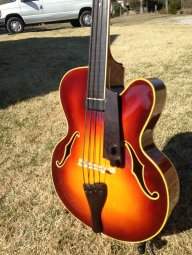

Many have an extension which holds the ball end of the string and can be adjusted just like a bridge saddle. Look it up.
I have looked it up. I don't see how fine tuners at the tailpiece behind the bridge can adjust for intonation.

Put in the work. It takes time to build up muscle memory. Remember you play fretless with your ears, as much as your hands.
I started on a lined fretless then got one with a blank board because I like the look better. The side fret markers can help if you get a little lost and the rest is pretty easy. Just listen when you play and correct your pitch as needed, but make it seem like you were doing a sweet slide into the note haha.

I usually cringe when I hear my upright solos on recordings, but in a jazz setting it seems to be accepted that the upright bass won't be pitch perfect.
Check this out:
Check this out:
I haven't played fretless for a few years but I used to only play fretless. Don't think I ever had a lined one. Anyway I play upright too and in all honesty intonation on the upright is so much easier just because you've always got the same frame of reference; the bass stands there on its own, you stand there with it and nothing moves. Practise the shifts and muscle memory will get you there eventually, even if you can't hear yourself well live.
With fretless bass guitar there are way more variables. It's genuinely difficult I think. I think that's why glissandos and OTT vibrato have become very much part of the language of fretless bass - not out of novelty so much as necessity!
Edit: Although the ease of amplification certainly helps your ear on fretless.
With fretless bass guitar there are way more variables. It's genuinely difficult I think. I think that's why glissandos and OTT vibrato have become very much part of the language of fretless bass - not out of novelty so much as necessity!
Edit: Although the ease of amplification certainly helps your ear on fretless.
Last edited:
I have looked it up. I don't see how fine tuners at the tailpiece behind the bridge can adjust for intonation.
Correct. The fine tuners on the tail piece are to adjust the open strings. They do not change the vibrating string length of the instrument.
It has been, however, a very long time since I've had my hands on a cello, so if someone has come up with a gizmo that sits on the bridge and adjusts tuning from that point, I stand corrected, and post a link.

I've been practicing on my two fretless basses seriously for about five years now.
The better I get, the more I notice when I am off; consequently the less anybody else notices.
I guess my point is, those perfect playing cellists probably kick themselves in the pants for the two or three errors they made... Not that anyone else noticed.
The better I get, the more I notice when I am off; consequently the less anybody else notices.
I guess my point is, those perfect playing cellists probably kick themselves in the pants for the two or three errors they made... Not that anyone else noticed.

I played violin as a kid. Intonation on a 34 inch scale instrument is a relative breeze. Not a fan of lined fingerboards - I don't even like position markers on the front of my fretted basses - just on the side. If you're looking at the fingerboard from the front, you're way out of position ergonomically.
I don't see what all the fuss is about. To me, fretless unlined bass guitar is easy. I am accurate in my intonation because, I want to be accurate and practice. If I am ever a bit off on a note, I don't beat myself up with self loathing. I don't make excuses for my abilities like I have so often read on talkbass. If a person chooses to play a fretless bass guitar, eub, or upright well, they will with great pleasure, pursue said instrument until they reach a point in life when, they can no longer play.
Lines are irrelevant. If you're depending on you eyes to tell you the pitch, you'll never get there.
I picked up fretless a week ago. Seriously. My daughter plays violin (pretty darn well) and has perfect pitch--seriously, she tunes me without a tuner. Regarding intonation, I see her work on it every day she practices and I will continue to do so also. Her violin instructor is a seasoned performer and is fluid, clear, and in tune. But she's been doing it for around 30 years. Anyway, playing unlined fretless is a hoot. Glad I picked it up--even if I'm out of tune more than 50% of the time. Did I mention it is also humbling?

No need to apologize!I have no problem with people playing a lined or unlined fretless. It's all about the unique sound of the fretless. I've had both, but at this point in time my favorite playing and sounding necks just happen to be unlined.
I'm with you on not looking at the fretboard , that comes with time and developing a very good sense of pitch.
I made an apologetic reply earlier and clarified the intended point of this thread being about having the bass's intonation adjustment properly set with regard to strength length and how much does if have to be off before you can detected it. I made the reference point with an unlined fretless because it doesn't have an real visual ques except for some spaced dots at the top of the board.
It was my fault for sure for not being more specific.
Once again I apologize for any confusion.
You're right about the intonation. On a fretless, you're able to set the intonation the way you like it, since there're no frets. I mean, if you like a certain left hand position on the octave (that would be around the 12th fret) that's a little bit before or behind the fretline or the side dot, you can choose to put the octave exactly where you like and feel it. So setting intonation on a fretless can be much more personal and difficult... FWIW that's how I look at it.

No need to apologize!
You're right about the intonation. On a fretless, you're able to set the intonation the way you like it, since there're no frets. I mean, if you like a certain left hand position on the octave (that would be around the 12th fret) that's a little bit before or behind the fretline or the side dot, you can choose to put the octave exactly where you like and feel it. So setting intonation on a fretless can be much more personal and difficult... FWIW that's how I look at it.
I appreciate that. I wish I had presented my question in more detail..that's all. Thanks.
I learned on my own to set the intonation on a fretless by ear using the edge of a guitar pick.
Hit the open string 12th "fret" harmonic with the guitar pick instead of your finger when it rings the truest, push the pick down on the string and hold it there, while you're doing that, make a mark on the finger board with a sharp pencil.
Hit the harmonic again and while it's ringing, put the side edge of the pick on the same place that you made the pencil mark. Keep ringing the harmonic and move the pick around until the pick edge and the pencil mark lines up.
If it's not in tune with each other and you'll hear it, then you'll have to turn the adjustment screw until they are both in the same pitch.
It works beautifully for me.
It might sound a little confusing ,but it really isn't.
After you do it once or twice, then you'll figure it out and you won't have to bother with the pencil mark.
Last edited:

I was always fascinated with the sound of fretless bass since I started playing back in the 80's. I finally put together a Warmoth unlined fretless when I started playing again about 12 years ago.
Like everyone else has already said, muscle memory and playing in position is a big help. One thing that helped me was playing songs I knew that you wouldn't normally play on fretless, like Seek and Destroy or Jungle Boogie.
Like everyone else has already said, muscle memory and playing in position is a big help. One thing that helped me was playing songs I knew that you wouldn't normally play on fretless, like Seek and Destroy or Jungle Boogie.
I was always fascinated with the sound of fretless bass since I started playing back in the 80's. I finally put together a Warmoth unlined fretless when I started playing again about 12 years ago.
Like everyone else has already said, muscle memory and playing in position is a big help. One thing that helped me was playing songs I knew that you wouldn't normally play on fretless, like Seek and Destroy or Jungle Boogie.
One of my favorite fretless exercises is The Star Spangled Banner.
I like to start with G harmonic and then play it with my eyes closed until the very end. And only then, check where my fingers are.
I'm always a tiny bit sharp...damn it! Lol