• TalkBass has been independent since 1998. Add your voice.
    Create a free account to reply to discussions, view embedded media, and browse with fewer display ads.
    Join freeLog in
    Want zero display ads or expanded classifieds tools? Compare plans.

Thorough Shielding Job

So I'm working on shielding my P bass.

Here's a look: (sorry but my cell phone is the only camera I own)
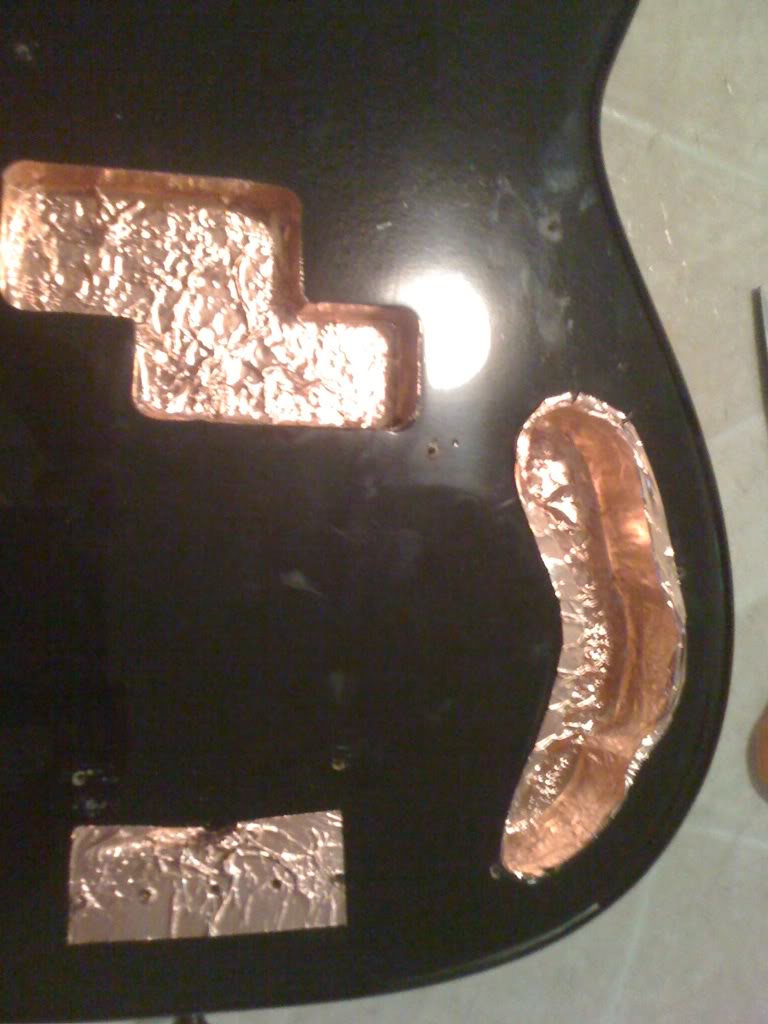
IMG_5907.jpg


I want to do a really thorough shielding job. I want no noise, or as little as possible.

Any tips? Is there a way to check and see if my shield is complete? I've checked with my multimeter and every part that has foil on it shows 0 ohms, but that's to be expected because it's metal...
 
Ok, so here's what I've done so far:

Photo011.jpg


Photo012.jpg


Photo013.jpg


Complete with a shielded tunnel leading from the pickup cavity to the control cavity.

Anything else I can do?

Looks pretty good!

Remember shielding in all cavities must be connected together. So don't forget to solder wire tube to cavities at both ends to make a good connection.

The key to connecting to the foil on the back of the pickguard (or a control plate) is to note nearby screw holes that hold the pickguard down. Run a "tab" up from the cavity and over top of the hole. This way, the pressure of the screw will pull the copper on the back side of the pickguard down onto the "tab" making a decent connection between the two.

The idea is that when you are done, you'll want a "water-tight" copper box that encloses the electronics where the only "leakage" into this box would be hole in the jack and the tops of the pickups. The closer you can get to that ideal, the better. All the copper must be connected together! And personally I tack all joints and pieces with solder because over the years the conductive glue (if you use that) will tend to dry out and lose conductivity. A solder tack will last forever.

And remember to ground the bridge too. The strings over top of the pickups tend to provide a bit more shielding of the open tops.
 
You could try the old star grounding concept to connect all the pots together.
Impressive and thorough job on the foil I might add, should be a nice silent axe when done. I'm assuming you also were planning on passive pickups and electronics correct?
Dirk
 
Yes passive P pup. I just tack soldered all the shielding tonight so everything should be golden *fingers crossed*.

Thanks for the compliment on the shielding job, I just read a thread on how to do it here and copied what I saw.

I wired the pots the traditional way, from what I've read, star grounding gains you nothing.
 
Yes passive P pup. I just tack soldered all the shielding tonight so everything should be golden *fingers crossed*.

Thanks for the compliment on the shielding job, I just read a thread on how to do it here and copied what I saw.

I wired the pots the traditional way, from what I've read, star grounding gains you nothing.

It's true on a passive bass star grounding does nothing. But just for drill I'd note that if one wanted to do star grounding the proper way to do it is not the usual back of the pots, but to run all grounds to the grounded jack shell or a bunch of solder lugs nearby that connect to it.

Some of my basses came from the factory with this kind of star grounding but I never noticed that it did anything more than any other grounding scheme.
 
Very good job! I recently did exactly the same thing with one of my p basses and I'm doing the exact same thing with another p bass next week. It seems we've done the same things and I got a great result. I also soldered a wire from the copper shielding in the cavity to ground on the volume pot.
 
I wired the pots the traditional way, from what I've read, star grounding gains you nothing.

It's true on a passive bass star grounding does nothing.

True indeed. Star grounding does nothing for a bass (active or passive) that other comprehensive grounding strategies don't do.

Why do some advocate it? Well, in theory there's a difference. You can induce a potential difference between different parts of the shielding if it's not star-grounded and therefore reduce its effectiveness as a noise screen.

However, in reality, the only situation in which you'd get appreciable potential differences across non-star-grounded shielding in a bass are situations where you, the bassist, would be standing in an electric field so strong that it would give you more to worry about (i.e. impending death) than your tone.

That being said, I star grounded my bass when I replaced the electronics in 2008 because it was darned convenient just to bring everything to one lug screw. I didn't need to try and remember whether each component had a valid path to ground through other components. The mental model of what's going on is simpler, which reduces screw-ups. :)

Take care,
-4st
 
This is very good. Just be sure (as stated above) to make sure each cavity is grounded also. I run a wire from the pup cavity to the main one and solder it on. ALSO the tab is necessary to be sure the pickguard shield is grounded, but use only ONE tab. Also - place the tab around a screw hole so you get good contact.

I also do the star ground where ALL the grounds come to a screw in the main cavity - pickup, pot grounds and output jack - all to the same spot. If you REALLY want it as quiet as possible - this is what you do. Multiple ground points can cause ground loops and actually increase noise in the right circumstance. We are dealing with such tiny voltages in our instruments that it is easy to cause an audible ground loop.

The first time I did this, when I plugged the bass in and turned it on, it was SO QUIET that at first I though it was dead!
 

Attachments

  • IMG_3879.jpg
    IMG_3879.jpg
    44.6 KB · Views: 135
Doesn't seem normal, no.

There are several ways to wire a p bass, but I've followed Seymour Duncans vintage wiring and I'm happy with it.

I have started to take one of my other p basses apart as we speak to do a thorough shielding job myself