Just because it was brought up, I'll go a bit into violinists and the complexities of the violin playing positions, and some of the myths about it.
violinists (like myself) hold our instruments how we do for a combination of the physics needed to play the instrument and for the most relaxed use of our muscles.
holding it with the chin against the shoulder is actually extremely comfortable and relaxed once you are used to it. Like most things that require muscle strength, it takes a while to build and train the correct muscles. However it isn't an unnatrual position for the head/chin/shoulder or left arm... just requires muscle to hold it there.
The right arm must draw the bow straight across the strings, not at an angle, which again takes tons of practice and training and observation and muscle memory and muscle building. But it also is completely natural... nothing weird there.
Holding the bow is basically - take your hand and drop it onto the bow and hold it. mostly the thumb squeezes on one side against your index and middle finger, for strength, and 4th and 5th finger (or 3rd and 4th if you count fingers separately from thumbs) rest on the bow and control it's vertical and lateral movement. Index finger controls downward pressure. It's way more complex than that, but this is the basics. It is a natural hand position, jsut with a heck of a lot of very complex training to learn how to do all of that intuitively.
Left hand, the thumb goes under the neck, either slightly around it, or if you have a big/long thumb then right around it, or as you move the neck positions directly under it or even almost off of it as you go up to very high positions (although rarely if ever do you need to remove it from touching the neck completely).
The physics of the left hand also MUST be relaxed, although again you cannot relax until you build the muscles and train the muscle memory.
The only rough part about the violin is the damage to skin on left side of neck, although that can be minimized.
The most unnatural player is the fiddler who holds it again their chest... it's incredibly painful and limits how much bow you can use and how much you can move your left hand around for playing up the neck... but neither of those things is needed for that genre anyway.
So I get what you are saying.... it's awkward for sure. But you don't do anything too weird with your thumbs fingers....
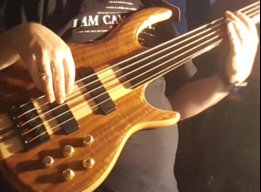
And by that same token, for bass or guitar, your thumb should be able to be relaxed, however you hold it. There are reasons to move it and hold it certain ways, ideally, but some of the world's greatest violinists have their left thumb sticking out way around the neck, while others (like me) keep their thumb tip under the neck mostly. Whatever works, and it comfortable, and doesn't cause YOU tension or limit your mobility and doesn't limit you by, for example, becoming a crutch (like holding the weight of the violin with your left thumb). I mean, we hold the violin wiht the left thumb a bit, but not much, and as we shift the weight is held with the chin. I can play (open strings only of course), with my left arm hanging down. So can any classical violinist. So it is about relaxation AND muscle training.
All that being said, there are bassists and guitarists who stick their left thumbs towards the headstock... and again whatever works is fine if it isn't affecting you badly. Generally for me, on bass, my thumb is to the LEFT (closer to headstock) of the index finger, or vaguely behind the index finger. And I'm fast with my left hand and it doesn't inhibit anything. Individual requirements are I think unique to the player and the goal they are trying to acheive.
Another violinist here. Yeah, what this guy said lol. I also play mandolin, and I think the way I position my hand on all my instruments is influenced by being a violinist first. Which I don't think is a necessarily a bad thing.
In this oft-posted video, Adam Neely explains why having the thumb to the left of your fretting fingers is the "natural" position:
I really like this Adam Neely video because it also gave me some confidence that I'm not "doing the wrong thing." I happen to use a similar left hand position to the one he describes, but regardless I think the point is to focus on the ideas he stresses here (strain reduction, maximizing movement/dexterity) rather than copying any one "right" technique/position.