• TalkBass has been independent since 1998. Add your voice.
    Create a free account to reply to discussions, view embedded media, and browse with fewer display ads.
    Join freeLog in
    Want zero display ads or expanded classifieds tools? Compare plans.

Thumb Behind Middle Finger

I know nothing of physiology, but ask if variation among our thumbs accounts for some of this. I don't recall where I read this, but did once read that variation exists as to thumb resting postiions, and ability to stretch thumb back toward the wrist. At the time, I seemed to be on the "stretchy" side of the spectrum. If I make a fist, my thumbs want to be at a 45-degree angle to the knuckles, and I have consciously tamp it down to complete the fist. At rest, the thumbs are 45-degrees off from the fingers. Bending toward the wrist I can get around 110 degrees from the fingers.

And yes, on bass, once I'm past the first four frets my left thumb is often more than an inch to the left of my index finger.

So perhaps what's right for you is a function of how your own hands work?

 
Last edited:
I know nothing of physiology, but ask if variation among our thumbs accounts for some of this. I don't recall where I read this, but did once read that variation exists as to thumb resting postiions, and ability to stretch thumb back toward the wrist. At the time, I seemed to be on the "stretchy" side of the spectrum. If I make a fist, my thumbs want to be at a 45-degree angle to the knuckles, and I have consciously tamp it down to complete the fist. At rest, the thumbs are 45-degrees off from the fingers. Bending toward the wrist I can get around 110 degrees from the fingers.

And yes, on bass my left thumb is generally more than an inch to the left of my index finger.

So perhaps what's right for you is a function of how your own hands work?

Don't know, have to get a protractor to check it out...
 
My thumb tends to be in different places depending on what I need to do.
IMG_0467.jpeg
20180801_064841_Original.jpeg
86EA5A27-832F-40D3-987D-CB0DDCEF0E87.jpeg
IMG_0093.jpeg
 
Last edited:
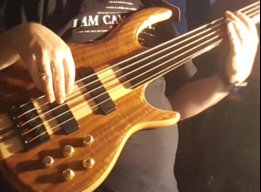
Here are some pics @ThudThudThud , @Les Fret , and anyone else interested.

I normally play fretless but since it’s unlined, I thought it would be easier to show on a fretted. I try to keep my technique identical between them.


View attachment 4965019
View attachment 4965020
View attachment 4965022

Fretless makes sense now for some reason, as you need the anchor point .
My assumption was incorrect, but valid as long strap, low hung bass playing forces the hand into that position.
 
  • Like
Reactions: Matthew_84
I used to be a firearms instructor in the Marine Corps. I had a saying, "Comfort equals consistency." If you can get a grip on the weapon that is comfortable for you that allows you to get a good sight picture and sight alignment with your particular hands & arms & body, you have a far higher chance of being able to repeatedly get that same grip, which will allow you to shoot better and more consistently.

Same thing here. Whatever hand posture allows you the most freedom of movement with the most comfort, that is what you should go with. There are things you can do, like hand stretches and other exercises, that will increase what you are able to do over time. But pain is nature's way of saying you're doing it wrong, and IMO it's folly to fight it or ignore it.
 
Well, another possible insight. Letting my thumb slide to the left permits a straight left wrist when focused on the upper strings, particularly as I strap the bass a bit on the high side, and favor a neck angle about 1/3 up from horizontal. When I learned floating thumb (a few lessons with Todd Johnson, a long time ago), Todd stressed that the keeping the right wrist straight would maximize finger leverage and minimize wrist problems over time. Wouldn't that straight wrist thing also apply to the left hand?
 
  • Like
Reactions: Matthew_84
Well, maybe, maybe not.

Sure, confort is clearly an important consideration, but it cannot be the only one.
If it would be, do you think violin players would hold their instrument the way they do?

In particular, one also needs to consider whether the OP's posture enables a good finger mobility on the fingerboard. In the end this is ability to play the music that matters most.

Just because it was brought up, I'll go a bit into violinists and the complexities of the violin playing positions, and some of the myths about it.

violinists (like myself) hold our instruments how we do for a combination of the physics needed to play the instrument and for the most relaxed use of our muscles.

holding it with the chin against the shoulder is actually extremely comfortable and relaxed once you are used to it. Like most things that require muscle strength, it takes a while to build and train the correct muscles. However it isn't an unnatrual position for the head/chin/shoulder or left arm... just requires muscle to hold it there.

The right arm must draw the bow straight across the strings, not at an angle, which again takes tons of practice and training and observation and muscle memory and muscle building. But it also is completely natural... nothing weird there.

Holding the bow is basically - take your hand and drop it onto the bow and hold it. mostly the thumb squeezes on one side against your index and middle finger, for strength, and 4th and 5th finger (or 3rd and 4th if you count fingers separately from thumbs) rest on the bow and control it's vertical and lateral movement. Index finger controls downward pressure. It's way more complex than that, but this is the basics. It is a natural hand position, jsut with a heck of a lot of very complex training to learn how to do all of that intuitively.

Left hand, the thumb goes under the neck, either slightly around it, or if you have a big/long thumb then right around it, or as you move the neck positions directly under it or even almost off of it as you go up to very high positions (although rarely if ever do you need to remove it from touching the neck completely).

The physics of the left hand also MUST be relaxed, although again you cannot relax until you build the muscles and train the muscle memory.

The only rough part about the violin is the damage to skin on left side of neck, although that can be minimized.

The most unnatural player is the fiddler who holds it again their chest... it's incredibly painful and limits how much bow you can use and how much you can move your left hand around for playing up the neck... but neither of those things is needed for that genre anyway.

So I get what you are saying.... it's awkward for sure. But you don't do anything too weird with your thumbs fingers....

And by that same token, for bass or guitar, your thumb should be able to be relaxed, however you hold it. There are reasons to move it and hold it certain ways, ideally, but some of the world's greatest violinists have their left thumb sticking out way around the neck, while others (like me) keep their thumb tip under the neck mostly. Whatever works, and it comfortable, and doesn't cause YOU tension or limit your mobility and doesn't limit you by, for example, becoming a crutch (like holding the weight of the violin with your left thumb). I mean, we hold the violin wiht the left thumb a bit, but not much, and as we shift the weight is held with the chin. I can play (open strings only of course), with my left arm hanging down. So can any classical violinist. So it is about relaxation AND muscle training.

All that being said, there are bassists and guitarists who stick their left thumbs towards the headstock... and again whatever works is fine if it isn't affecting you badly. Generally for me, on bass, my thumb is to the LEFT (closer to headstock) of the index finger, or vaguely behind the index finger. And I'm fast with my left hand and it doesn't inhibit anything. Individual requirements are I think unique to the player and the goal they are trying to acheive.
 
If your technique isn't holding you back from playing what you want to play then keep doing what you're doing.

Love when people will tell you the way that your comfortable is the problem not the way that is painful.

Adherence to 60 year old "standards" is weird. Everything in the damn world has progressed except bass playing?? Nahh

And if people have enough time to worry where a left hand thumb is at moment to moment then they aren't playing enough music
 
Everyone's anatomy is different, position your digits according to how they are ergonomic to you.

This is how I do it..... And I suppose it is not normal either? Maybe? I can get my thumb on both hands to bend like this. My right hand is always positioned like that. My left changes from what you see, to wrapping around the top of the neck, to anything in-between. Been playing this way for 30+ years....

PXL_20230211_011005170.jpg
PXL_20230211_011025709.jpg
PXL_20230211_011158794.jpg
 

Attachments

  • PXL_20230211_011158794.jpg
    PXL_20230211_011158794.jpg
    441.2 KB · Views: 21
Last edited:
  • Like
Reactions: Matthew_84
I play with my left thumb (fretting hand) to the left of the index finger. It is the most relaxed position to me.

That's where mine usually sits as well.

Two things you have to achieve with your left hand on a bass; hit all the notes right and be comfortable. If you are meeting those requirements then your technique isn't wrong.

I just tried to play with my thumb behind my middle finger and that doesn't work at all.

Stick with what works for you and ignore so called "experts".
 
  • Like
Reactions: Matthew_84
I don't even know where exactly my thumb sits normally. Not without thinking about it or picking up a bass to see how I hold it, anyway. And frankly, it's not worth the effort. I don't see where I gain anything by knowing that.

I do know that I use my thumb to pivot my whole hand when I'm playing certain lines that require movement.