• TalkBass has been independent since 1998. Add your voice.
    Create a free account to reply to discussions, view embedded media, and browse with fewer display ads.
    Join freeLog in
    Want zero display ads or expanded classifieds tools? Compare plans.

Thunderbird Club

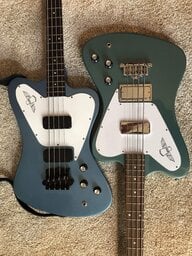
That's because it is the same bass made in the same factory, branded St George. "St George" was branded by Fujigen for Anthony George who had music stores in NY and CA called "Georges Music" in the '60s. The Japanese factories cranked out thousands of guitars/basses then and branded them with many different names for distribution throughout the world.
In my parents house, they did an extension/renovation when I was about 8 or 10 yo, and the electric stove and oven were all branded St. George. Which is a Parish area within Sydney.

It suited us because

94AE235D-79E4-49DB-8FC9-7C5F9D91DBB8.jpeg
 
I have two "Reuther" drum kits. The shells are three ply Luan mahogany, just like a whole lot of other drums made back in the 1960s and 1970s. Pearl and Tama probably used the same shells. Mine are officially Taiwanese, but the shells are probably Japanese. They were intended to be cheap junk, but they sound great to me. They are easy to tune, stay tuned, and project as they should. I love 'em and have no urge to play anything else. Same kind of thing as Japanese made guitars and basses from the same period.

Luan mahogany was indigenous to Japan and the (Far) East so was the wood of choice in the '60s for all wooden instruments, including drums and guitars. My Teiscobird Teisco Del Rey body from '65 is luan mahogany and it rocks. Luan was considered 'cheap' then but tone-wood is tone-wood and the older it is the better it sounds. (not myth-fact) Your drums stay in tune and project because the once living organic wood has stabilized and dried-out over 50+ yrs.
 
In my parents house, they did an extension/renovation when I was about 8 or 10 yo, and the electric stove and oven were all branded St. George. Which is a Parish area within Sydney.

It suited us because

View attachment 5034887

Yah, it's a universal symbol - "St George the dragon killer". Being a George and brought up Catholic - I was made aware of that at an early age. :) But didn't St George ride a white horse?
 
Last edited:
Many Japanese guitar making factories in the '60s were originally furniture makers and many were connected in one way or another making guitars/basses starting in 1960 producing/supplying parts, pu's, bodies, necks etc to each other. Branding was only a distribution need unlike Fender, Gibson, Guild, Gretsch, Rickenbacker etc. So most '60s Japanese guitars/basses were branded with multiple names. The one I just bought (w/o a hs badge) was sold under multiple brand-names, including St George. I think mine was called a "Stadium" (no pics - only going by memory) - but I found a nice chrome "Tempo" badge on eBay (like this one) - so it'll be a Tempo!

View attachment 5034846
Did they make coffee table basses?
 
Yah, it's a universal symbol - "St George the dragon killer". Being a George and brought up Catholic - I was made aware of that at an early age. :) But didn't St George ride a white horse?
Yes I’d say so but facts make way for design sometimes lol

it’s the logo of the footy team the family supports, being the local team when they moved to Sydney from the bush. We moved away from area when I was a young bloke but the footy team stuck.

They wear a white jersey with a Big Red Vee.
 
As an eBay Associate, TalkBass may earn a commission from qualifying purchases.
You probably see cool vintage Manton's in your neck of the woods right?
Matons, yes. But not the vintage ones, few and far between. The “Jumbuck” JB IV are around both 70s and reissue. That would likely have been my target but then I was introduced to Thunderbirds.
The JB IV is a PJ style with:

The original DiMarzio passive pickups (P-bass neck pickup and J-bass bridge pickup) are wonderfully powerful yet warm, and allow a very useful blending of Precision and Jazz bass tones. Factory-fitted brass nut and Badass bridge on a Rock Maple/Black African Ebony neck-through construction with an Australian Sassafrass body give great sustain and tone.
Link Removed


BTW I don’t think it is neck through but set neck. Some of the originals had a mic style output on them. For studio work I assume.

I’d still have one if I tripped over one at the right price.

The 2010 reissue has some changes.

Invalid Link Removed
 
Last edited:
Hipshot USA all the way. I put them on my MIM Mustang. It’s a fabulous little bass now. I could barely stand it before the swap.

l’m still shocked that Gibson used licensed Hipshots instead of USA Hipshots on the ‘21 NR. Luckily, I haven’t had issues. But @Instagator certainly encountered some. He has the patience of Job. Thankfully, it appears he finally got all of that sorted.
I'm sure the bad luck started with the installation process. My '22 NR with the non USA tuners works just fine. I don't see a reason to replace those. Having said that, the USA equivalent is far superior.
 
I bet they did the guitars and basses for Lafayette Electronics, as well. I always wanted one of those.
I recall the Lafayette store in Santa Maria having a couple guitars when I was around ten. But I think they stopped carrying them in that store shortly after that. I bought their Criterion speakers for my first “real” stereo. I still use them in the home office. I loved that store. It was sad when it closed; late seventies IIRC.
 
Yes I’d say so but facts make way for design sometimes lol

it’s the logo of the footy team the family supports, being the local team when they moved to Sydney from the bush. We moved away from area when I was a young bloke but the footy team stuck.

They wear a white jersey with a Big Red Vee.

Now I see. :)