
- Mar 13, 2008
- 18,894
- 142,211
- Disclosures
- Endorsing Artist Mike Lull T Bass pickups, The Bass Shop, Seattle WA.
So glad I have Frank to help me,

TalkBass has been independent since 1998. Add your voice.
Create a free account to reply to discussions, view embedded media, and browse with fewer display ads.
Join free Log in
Want zero display ads or expanded classifieds tools? Compare plans.
I don't like to work that hard. And I don't want to add much to my risk of the tailpiece pulling out again. I don't think that will happen but don't want to add any more lbs than absolutely necessary. I did take your advice and put some SIT Powersteels on it. Went from 100-40 Fenders to 105-50. I can't tell that it changed anything according to the tuner. But I'll leave them on for tomorrow. The flats really sounded good, but the SITS do as well.Try a set of 50-110s.
Briefly, assuming another has answered by now--I can tell that I likely need to have this instrument setup properly. My intonation needs quite a bit of work (all twelfth frets are sharp) but in looking at the bridge I have some questions. I’ve already got plans to have my PBass worked on, so I’ll adjust the TBird myself for now. But, I have questions as it’s an odd (T)bird.
1. To adjust the saddle location, looks like I have to loosen the string, move it aside, adjust saddle, reset string, retune. Is this correct or is there a way to turn that screw without moving the string?
2. And, do I have to loosen the nut on that saddle adjustment screw first, and retighten it after I’m happy with the intonation?
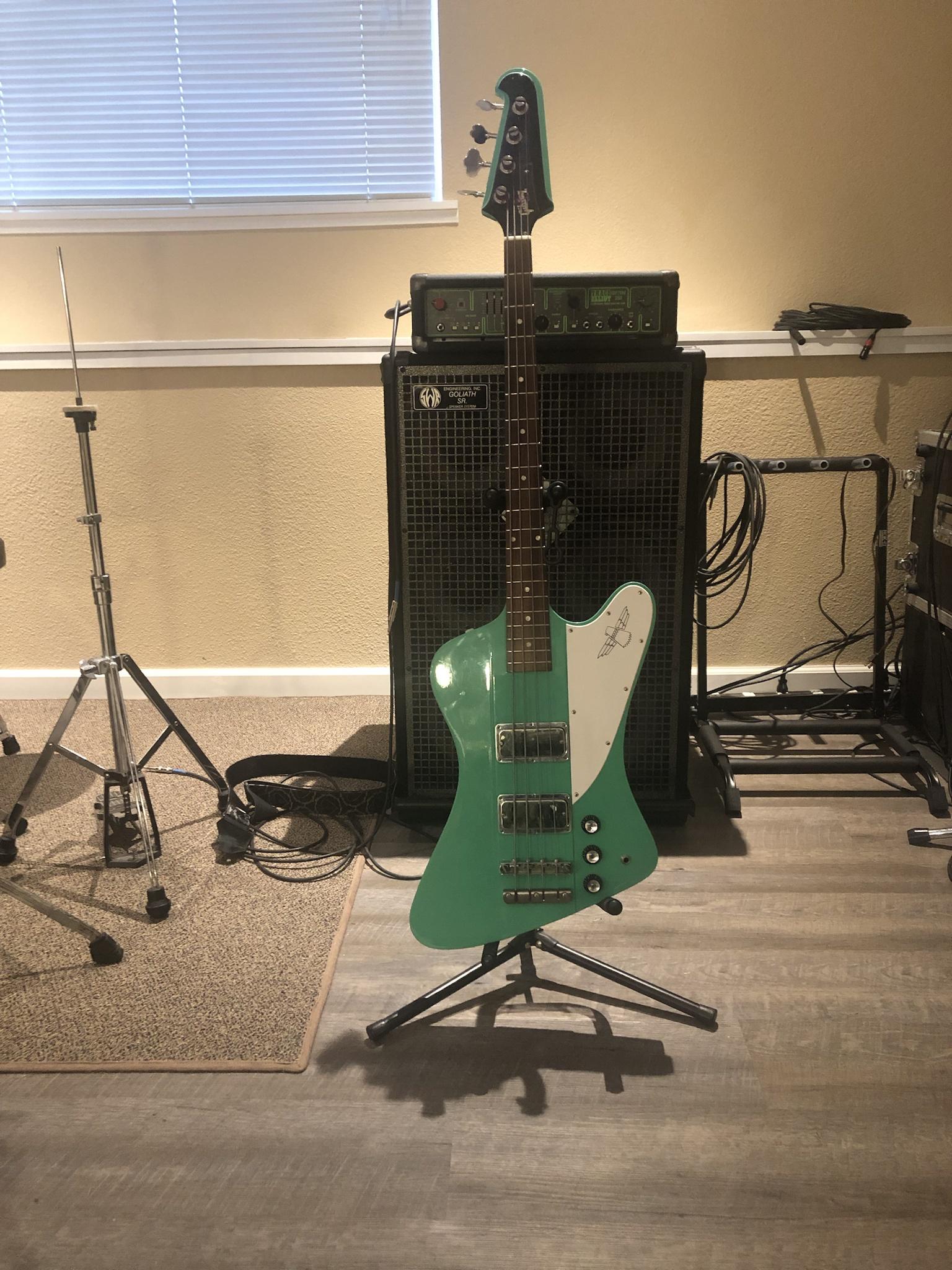
3. The height of my current bridge setting seems REALLY high. Is this typical for the model? (See picture.) It seems odd to have a bridge that has to extend so far away from the body floating in the air like that.
4. What’s the neck supposed to be like in terms of flatness? I know on my Ric, it’s supposed to be dead flat from the first fret to the last. Other instruments seem to want a bit of curve to the neck to allow for string vibration. It seems to me that if there was some curve to the neck on this instrument that the bridge wouldn’t have to be raised so high to allow for a reasonable action height.
I’ll be getting some good use out of my Petersen HDStomp tuner this today!
Thank you all for helping out a new Tbird caregiver. This place looks like a fun club to be a part of.
Yes. And You may find like me that VPs are unique and can sound well with a wide range of strings. I don't think I have found one yet that didn't sound good on a VP. That's unheard of given how OCD I am with tone.Are these the flat wound string of choice amongst many TB TBird members?
View attachment 7170424
Interesting.The V3 Rumble line is part of the Genz-Benz design lineage from when Fender purchased GB and shut down the brand. They do not use the typical Bassman tonestack.
I’ve heard mention of a “Tbird Setup” thread here. Does anyone have a link to it, or is it a pinned thread???
You will fit in well here. You are one of us.Only about 30% of what I ever say should be taken seriously.

Help you spend money?So glad I have Frank to help me,

Thanks George.That is a pretty bass. Now I see why you’d hate to part it out. If it were mine and I wanted to keep it I’d consider two options.
1) research different two point bridge suppliers to see if one has a bit more travel than the others.
2) remove the bridge, plug the holes, touch up the plugs as best you can knowing you’ll never match a metallic flake paint job, and then move that bridge forward as far as you can while still covering the plug and paint job. You might only get a quarter inch or maybe 3/8 ov an inch if you’re lucky, but that and a string change will probably be enough to get you in acceptable intonation territory.
I like it!Bridge cover!
if you’re using it this soon after fixing the claw, it sounds like you used CA? If so, It’s unlikely to come loose, even if you want it to. That’s why I prefer Titebond and a several day cure.I don't like to work that hard. And I don't want to add much to my risk of the tailpiece pulling out again. I don't think that will happen but don't want to add any more lbs than absolutely necessary. I did take your advice and put some SIT Powersteels on it. Went from 100-40 Fenders to 105-50. I can't tell that it changed anything according to the tuner. But I'll leave them on for tomorrow. The flats really sounded good, but the SITS do as well.
Well, I’ll be the heretic here. I tried EBCFs on it and didn’t care for them.Yes. And You may find like me that VPs are unique and can sound well with a wide range of strings. I don't think I have found one yet that didn't sound good on a VP. That's unheard of given how OCD I am with tone.

Go to the Thunderbird Club FAQs and look for “setup” near the bottom. Then look over the rest!I’ve heard mention of a “Tbird Setup” thread here. Does anyone have a link to it, or is it a pinned thread???

Maybe that'll work. But I don't want an amp switcher. All Markbass all the time for me. All LittleMark IIs or IIIs.Cabinet switcher? I use a Radial Engineering amp switcher (A, B, Y) for running to amps together and it allows switching from one to the other or using both. The top head is an Ampeg V2 into an SVT 48E (4 x 8”) and the bottom is an Ampeg V4BH (AV version) into an SVT212AV.
View attachment 7170661
If you want the Angry Piano sound, Rotosound 66LS strings on a VP are as good as it gets without buying a 64 Gibson.Yes. And You may find like me that VPs are unique and can sound well with a wide range of strings. I don't think I have found one yet that didn't sound good on a VP. That's unheard of given how OCD I am with tone.

It's also a little random as far as which line he plays. Sometimes he goes up to the octave.The timing takes a lot of concentration. I can see how singing could take a lot of practice. Fortunately, I can’t sing. At all.
My thoughts:Thanks.
There's a little chipout going on (mostly on one side; result of grain direction?), but I pressed each bit back down where it came from.
Once my teflon glue dam arrives, and before I resand, I'll use some thin CYA to lock them back down.
Considering the amount I have to sand off to correct the machining error and get the new radius, the chips would probably be gone anyway, but Im trying to learn as I go for future projects. Never messed with fret removal before. Or radius sanding.
Decisions coming up:
1) install veneers before or after rough radius sand? (Leaning toward after)
2) use CYA or Titebond for veneers? On the fence because CYA penetrates more, could impact density/tone?
3) finish board with CYA or just oil? (Probably will leave oil only. CYA over rosewood, concerned it'll sound too bright)
4) with the truss rod slack, the neck has a tiny amount of back bow. Not clear if that was by design or just due to fretting. I'm assuming I should set the rod to "just touching" on the takeup direction, then sand flat. That should give the rod maximum adjustment capacity to counteract string tension later?
Fun puzzles.
A cheap cabinet switcher is not worth the risk of damaging your amp(s). You have to turn off the amps anyway, just run a cord from each cab to the amp.A question for the group. Has anyone seen or used a cabinet switcher at a minimal cost ($100 or less. I'll probably only use it twice, or price wouldn't be an issue)? I do want a push button switch, and function for A, B, or both.
I have a Markbass CMD112h with a 210h at practice, and a CMD 210h with a 112h at home. At the same amp settings they sound different with the same bass (but through different pedalboards). I want to figure out which (if any) head unit sounds better as a stage monitor.


