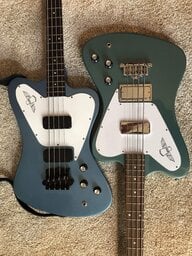
No, I just meant VISUALLY how do you adjust. That thing’s HUGE. If it was a person, they would be a bobble head. It’s kinda like the clown shoes of machine heads.
No matter how hard you try, you’re not going to be able to talk yourself out of being a Tbird player if this bass has chosen you.

Reverie played in Providence last night, and now I'm looking for a bass amp. The bass player in the second band, whom I used to work with several years ago, had a 2x12 Markbass combo and extension cab. Sounded great! Fat and lots of good, solid punch, really nice and solid in the upper registers. My Eden WT405 and mutt 15s (w/Kappalites) were anemic in comparison... I have to get my act together. I'll be looking for amplification stuff for a while. I'm open to recommendations...
One of the best small combos I’ve ever played through was a compact Markbass 12”. I think it had cab extension capability, so adding an additional 112 or even a 212 Markbass cab would probably sound killer.
https://reverb.com/item/87442595-markbass-mini-cmd-121p-iv-bass-combo
You’d need to confirm it’ll take an extension cabinet if that’s the direction you want to go.
View attachment 7170350
Yes, it's dusty. Been getting it playable not cleaned up yet.
Fender flats for now because I had some and they seem to sound good (at home), the green silks are a bonus if they work out.
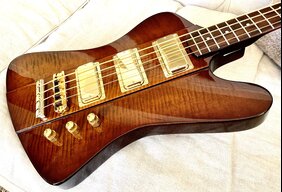
I do like the color. It's much better looking than the typical pics online.
View attachment 7170353
That is a pretty bass. Now I see why you’d hate to part it out. If it were mine and I wanted to keep it I’d consider two options.
1) research different two point bridge suppliers to see if one has a bit more travel than the others.
2) remove the bridge, plug the holes, touch up the plugs as best you can knowing you’ll never match a metallic flake paint job, and then move that bridge forward as far as you can while still covering the plug and paint job. You might only get a quarter inch or maybe 3/8 ov an inch if you’re lucky, but that and a string change will probably be enough to get you in acceptable intonation territory.
I can tell that I likely need to have this instrument setup properly. My intonation needs quite a bit of work (all twelfth frets are sharp) but in looking at the bridge I have some questions. I’ve already got plans to have my PBass worked on, so I’ll adjust the TBird myself for now. But, I have questions as it’s an odd (T)bird.
1. To adjust the saddle location, looks like I have to loosen the string, move it aside, adjust saddle, reset string, retune. Is this correct or is there a way to turn that screw without moving the string?
2. And, do I have to loosen the nut on that saddle adjustment screw first, and retighten it after I’m happy with the intonation?
3. The height of my current bridge setting seems REALLY high. Is this typical for the model? (See picture.) It seems odd to have a bridge that has to extend so far away from the body floating in the air like that.
4. What’s the neck supposed to be like in terms of flatness? I know on my Ric, it’s supposed to be dead flat from the first fret to the last. Other instruments seem to want a bit of curve to the neck to allow for string vibration. It seems to me that if there was some curve to the neck on this instrument that the bridge wouldn’t have to be raised so high to allow for a reasonable action height.
I’ll be getting some good use out of my Petersen HDStomp tuner this today!
Thank you all for helping out a new Tbird caregiver. This place looks like a fun club to be a part of.
1) you can move the saddles that way if you want, certainly less stress on the strings and adjustment screws, but I’ve always just used a screwdriver while under tension.
2) no, the nut will free spin on the screw and not come off. You don’t need to turn the nut for anything. It’s just there to keep the intonation screw in place on the bridge. Other manufacturers use a spring to do accomplish the same thing.
3) I don’t recall what year your bird is. The early VP basses had a shallow neck angle in relationship to the body, so the bridges sat relatively low. The new VP equivalent (called a ‘64 Tbird) has a much steeper neck angle and the bridge sits quite a bit higher than the older VP. One is no better than the other, they both play and sound great.
4) whenever I do a setup on a newly acquired bass I always completely loosen the strings to remove all tension. Then I adjust the neck bow a little bit at a time until I have a visible back bow. Then I bring the strings up to proper tuning, which creates tension on the neck and pulls it slightly forward. Then I further loosen or tighten the truss rod and raise or lower the bridge as needed to eliminate fret buzz. There’s a wiki on how to do this with a three point bridge, the two point follows the same concepts but obviously is built and adjusted a bit different. Not rocket science.
@bylar13 , I've messed around a minute at GC with one of those. I liked it... have you got a sound clip by chance, with a live band mix? What are you running it into for a cab?
@MCF , there's a TT-800 (right?) locally for about $1,000.
I think I need something that punches like Mike Tyson and stays clean when you push it. Reverie is a dense mix with two active guitars and a drummer who likes to lean hard over the edge, so I think clean and powerful is the way to be.
I have an Old Terrace Elliot Mk IV, basically it needs to be rehab'd and a box built for it. It might actually be my answer...
That Markbass combo I mentioned does just that and would do it in spades with a 212 extension cabinet. Alternatively, I have a Mesa Walkabout head in mint condition (gobs of bottom end, punch and clarity at all volumes) I’m not using it anymore, if interested make me an offer I can’t refuse and it’s yours. Paired with a Bergantino 212 cab this thing would be the bomb!