
Although it may look out of place, the 2015 with the EB core taps can fit in nicely in a country band.
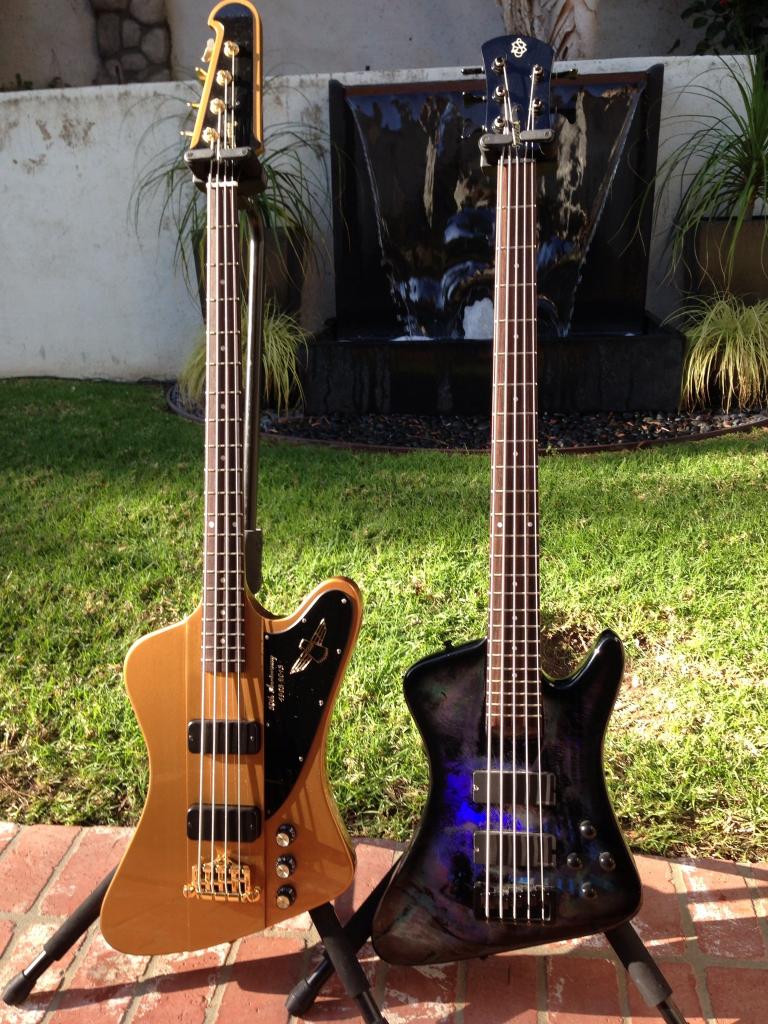
Before I met you guys, i was talking' to bunch of folks who kept going on & on about Spectors. I would LUUUUUUUUV to get to spend some time with them. They get nothing but the highest praise. My biggest issue, is a commonality they share with Warwick... tiny bodies. I was wising I could see exactly what you show in your photo. I wanted a side by side comparison of those 2, to compare the body sizes. Does that Spector "feel" small in comparison to the 'bird?I'll second the Warwick note. Mine all fit beautifully in alternative rock, metal and grunge. Not so well in classic, punk or heaven forbid - country. On the other hand, my Spector bird fits in just about anywhere my Gibson bird fits. Until I get my hands on a Five string Gibson bird the Spector will do. Here's the flock at my house...

Enjoy the benefits of a premium membership!
Upgrade Account
-
TalkBass has been independent since 1998. Add your voice.
Create a free account to reply to discussions, view embedded media, and browse with fewer display ads.
Join free Log in
Want zero display ads or expanded classifieds tools? Compare plans.
You are using an out of date browser. It may not display this or other websites correctly.
You should upgrade or use an alternative browser.
You should upgrade or use an alternative browser.
Thunderbird Club
- Thread starter TBird1958
- Start date
-
- Tags
- club thunderbird
More options
Who Replied?

hillerup
There are basses, and there are Thunderbirds!
The non-goth ones are what I have played. Beats me why they would be different though. It doesn't make any sense from a production standpoint.
They aren't....
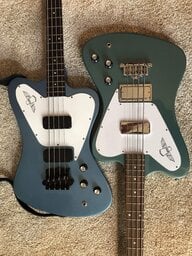
Meh, it's nothing, Larry Hartke had his way with some MIM's.
His signature touch I guess.
Personally I wouldn't do it, but to each their own I suppose.
I'm a fan of his amps and cabs. But his modding? I don't get it. At all.

*OOPH*... Allow me to apologize for my generality. I certainly didn't intend to offend anyone. I meant that... in comparison to the Thunderbirds, Rickenbackers, Fender Americans, etc., that have passed through my hands recently... how funny is it that I'm going home with a Squier Affinity series 5 string Jazz bass. I don't think that too many folks would argue that the Squier Affinity series is the first wrung on the ladder of mass produced instruments that are of sufficient quality to be playable by musicians... not like something out of the Walmart catalog (well... maybe Ibanez is first... but you get my point). Kinda like... compared to a Ferrari, a Chevy is a piece of crap. Does that make the Chevy bad? Nah. There's a LOT more Chevys on the road than Ferraris!
Squier is not a defined rung on a ladder. Squiers vary from being the first japanese made fenders (branded fender for domestic Japanese consumption, and squier for us import), highly valued, to some of the lower lines offered such as the affinity, and the squier II which were known to have plywood bodies, but nice necks (Korea), to the CV line which is well regarded now that China can make just about any quality level.
A dose of xenophobia can lead one to older peavey basses. Perhaps a T series would suit you if you can handle the weight. Or the original slant pickup fury. Most others might have too skinny a neck for you. But the quality is better than squier, and there is no need to upgrade any parts to get it to "pro" level.
Kindof a bummer they didn't make a bird during the.USA made period, and their Asian made "tragic" bird-ish model has a highly offensive headstock shape.
A big guy with a T40 is probably a good fit, if you can handle a HEAVY bass.
Absolutely. Take the Mopar Challenger for example. Stunning looks in it's day. Absolute POS from a reliability standpoint. And try to corner in it? An adventure every time. The current iteration is so music better, almost to the point of being boring.As a person who has had a '68 Camaro convertible since it was just a rusty old Chevy, I sure don't get all misty eyed over stock old cars. They were lousy and needed a whole lot of messing with to be adequate for my purposes. Even almost 40 years ago, they needed modification to be worth two pins.
hillerup
There are basses, and there are Thunderbirds!
Incase you had noticed... I'm pretty big on metaphors. When it comes to metaphors, I'm like a... uuhhh... like a... hmm...
Yep, and YELLING too...

THAT sir... is a fine looking' fiddle! I don't recall having seen covers on a fiver before. Are those readily available these days?Nothing wrong with that choice.
I made a similar choice years ago. Squier puts out some pretty neat stuff and a great side benefit is the low initial cash outlay leaves plenty of money for modding at a later date if so desired.
This one started out life as a $220 Squier Affinity Jazz 5 that played better than any Jazz I've ever owned or played. After a couple of years (I started leaning heavily towards Gibsons) I decided to convert it into a '62 jazz in look and sound, so I replaced all the electronics with vintage reproductions (including custom wound 5 string jazz pups) and added some chrome covers. It's still my favorite Jazz to play and I only have about $500 in it.

Enjoy the toy and good luck with the ongoing quest for a TBird soul mate.
PS - I noticed early in your posts a real fixation on wide necks. I was going to suggest you look at 5 string Bird variants (non Gibson/Epiphone as well as the real deals). I have a Spector TBird (called a Rex 5 pro) that would probably meet a lot of your neck criteria. I play as many fivers as I do four string basses and there's some real advantages to that low B in certain genres of music.
*UGH* So I apologized for my generality, with a generality. Grrreeeeeeaaattt... I can't seem to get outa thisSquier is not a defined rung on a ladder. Squiers vary from being the first japanese made fenders (branded fender for domestic Japanese consumption, and squier for us import), highly valued, to some of the lower lines offered such as the affinity, and the squier II which were known to have plywood bodies, but nice necks (Korea), to the CV line which is well regarded now that China can make just about any quality level.
A dose of xenophobia can lead one to older peavey basses. Perhaps a T series would suit you if you can handle the weight. Or the original slant pickup fury. Most others might have too skinny a neck for you. But the quality is better than squier, and there is no need to upgrade any parts to get it to "pro" level.
Kindof a bummer they didn't make a bird during the.USA made period, and their Asian made "tragic" bird-ish model has a highly offensive headstock shape.
A big guy with a T40 is probably a good fit, if you can handle a HEAVY bass.

I'm familiar with the T-60 and the T-40. "Heavy" is indeed the first word that comes to mind!
With regards to this Affinity 5... I'm not making any plans on upgrading it. I just need for it to get me by for a little while until I gotta few bucks. Right now... I've only spent about an hour with it, and it's the first time I've ever spent time with a 5 string, so I have some acclimating to do. The pickups are noisy & weak, but produce a pleasing tone. The tuners are sub-par. The bridge is adequate. The action is pretty good right off the rack, & I'm loving' the neck. If I fall in love with her... I'll buy here some jewelry & doll 'er up. If not... it will have been a good tool to get me where I'm goin'. I call that a win/win!
I'd be lyin' if I said that I hadn't found a few places where that B would be handy. I just gotta work with it some moreYou could always string it EADGC instead...
I kinda hava tendency to type how I speak... 'case ya hadn't figgerdat out alreadyYep, and YELLING too...
Squiers are fine. All Fenders are parts basses after all.
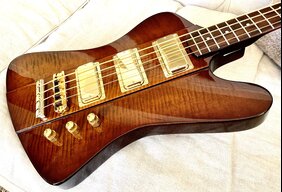
I have a few Spectors and this one (the REX 5 Pro) is by far the larger body style. It's virtually the same physical size body as a Gibson bird except it has a cutout on the lower horn to allow better fret access. The Rex has thicker body wings and is a 35" scale vs 34" on the Gibby. It looks and feels a bit bigger than the Gibson but not by much. When strapped on, the Rex feels a bit heavier but again, not by much.
Both are through neck basses but the construction similarities stop there. The Rex is a maple wing and three ply maple neck bass vs the mahogany construction of the Gibby. The Rex is also an active two band preamp vs the passive Gibby. The woods, pups and preamp all combine to give the Spector a more aggressive tone. More grit and growl and a brighter top end along with a bolder deeper bottom end. It really is a beast and a bit less refined than the Gibson. Actually it's a bit more like a Warwick in sound than a Gibson and because of that I find it better suited to heavy metal, grunge, hard rock and some progressive rock.
I only play finger style with no slap or pop technique and have a tendency to favor the neck pup and play mostly above the neck pickup or more towards the neck vs the bridge. With my style of playing and settings I find the Gibson sets in very nicely in the mix as a solid foundation that can come forward in the mix when called upon. The Rex is just the opposite, it's normally more forward in the mix and can be downright in your face when you dig in. Because I'm more of a laid back bass line kinda guy and not really focused on grabbing the spotlight very often I find the Gibson to be the better overall bass for me. But if you want to stand out and be seen and heard in a hard rock setting the Spector might be a better choice.
Note the Rex 5 pro is now discontinued (the similar looking Spector Legend is a totally different animal) but you can still find the Rex used for around $600 with or without the crazy love it or hate it Holoflash finish. Here's a better shot of the wild finish that constantly changes as the light hits it from different angles...
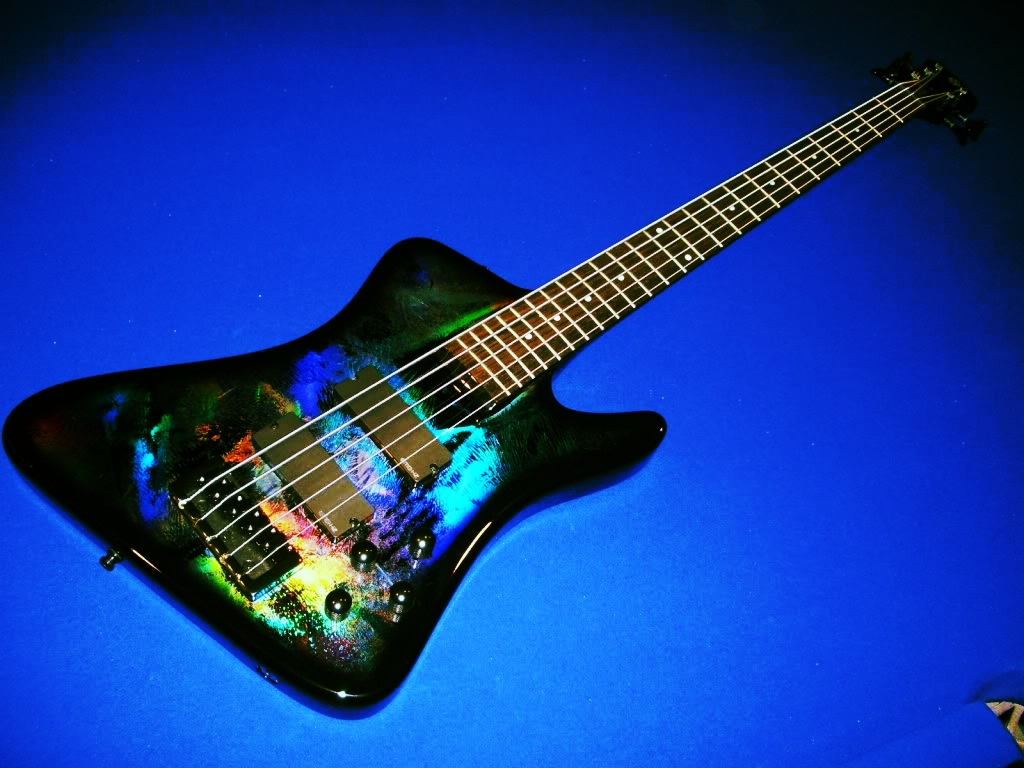
Again, it's a love it or hate it finish but under stage lights it puts on a real show.
Both are through neck basses but the construction similarities stop there. The Rex is a maple wing and three ply maple neck bass vs the mahogany construction of the Gibby. The Rex is also an active two band preamp vs the passive Gibby. The woods, pups and preamp all combine to give the Spector a more aggressive tone. More grit and growl and a brighter top end along with a bolder deeper bottom end. It really is a beast and a bit less refined than the Gibson. Actually it's a bit more like a Warwick in sound than a Gibson and because of that I find it better suited to heavy metal, grunge, hard rock and some progressive rock.
I only play finger style with no slap or pop technique and have a tendency to favor the neck pup and play mostly above the neck pickup or more towards the neck vs the bridge. With my style of playing and settings I find the Gibson sets in very nicely in the mix as a solid foundation that can come forward in the mix when called upon. The Rex is just the opposite, it's normally more forward in the mix and can be downright in your face when you dig in. Because I'm more of a laid back bass line kinda guy and not really focused on grabbing the spotlight very often I find the Gibson to be the better overall bass for me. But if you want to stand out and be seen and heard in a hard rock setting the Spector might be a better choice.
Note the Rex 5 pro is now discontinued (the similar looking Spector Legend is a totally different animal) but you can still find the Rex used for around $600 with or without the crazy love it or hate it Holoflash finish. Here's a better shot of the wild finish that constantly changes as the light hits it from different angles...
Again, it's a love it or hate it finish but under stage lights it puts on a real show.

- Jun 30, 2010
- 49,588
- 221,966
- Disclosures
- musician/artist/owner - Gildaxe
What's that bridge pickup??? Ric?
I installed it in '87 - it's a Seymour Duncan "Hawkbucker" - a pu he made expressly for a T-bird.
Nope. It's a four string bridge cover. I modified the bridge to fit the cover and wrote a short tutorial on TB on how to do it. The pup cover is also a four string model but it easily fit over the five string pup without modifying.THAT sir... is a fine looking' fiddle! I don't recall having seen covers on a fiver before. Are those readily available these days?
Warning to the currently cover less but cover curious jazz 5 crowd - they add noticeable weight to the bass and aren't readily reversible when done. The bridge is permanently modified and the body is drilled into. I wasn't worried about hacking into a $250 bass but I sure would think twice before ever doing it to my American Deluxe Jazz 5.
WOW! I'm surprised (pleasantly so) that the Spector is larger! The only photos I have seen, haven't contained a comparator. It just kinda impressed me as being smaller. I definitely want to look one up! How would you describe the neck profile on the Spector?I have a few Spectors and this one (the REX 5 Pro) is by far the larger body style. It's virtually the same physical size body as a Gibson bird except it has a cutout on the lower horn to allow better fret access. The Rex has thicker body wings and is a 35" scale vs 34" on the Gibby. It looks and feels a bit bigger than the Gibson but not by much. When strapped on, the Rex feels a bit heavier but again, not by much.
Both are through neck basses but the construction similarities stop there. The Rex is a maple wing and three ply maple neck bass vs the mahogany construction of the Gibby. The Rex is also an active two band preamp vs the passive Gibby. The woods, pups and preamp all combine to give the Spector a more aggressive tone. More grit and growl and a brighter top end along with a bolder deeper bottom end. It really is a beast and a bit less refined than the Gibson. Actually it's a bit more like a Warwick in sound than a Gibson and because of that I find it better suited to heavy metal, grunge, hard rock and some progressive rock.
I only play finger style with no slap or pop technique and have a tendency to favor the neck pup and play mostly above the neck pickup or more towards the neck vs the bridge. With my style of playing and settings I find the Gibson sets in very nicely in the mix as a solid foundation that can come forward in the mix when called upon. The Rex is just the opposite, it's normally more forward in the mix and can be downright in your face when you dig in. Because I'm more of a laid back bass line kinda guy and not really focused on grabbing the spotlight very often I find the Gibson to be the better overall bass for me. But if you want to stand out and be seen and heard in a hard rock setting the Spector might be a better choice.
Note the Rex 5 pro is now discontinued (the similar looking Spector Legend is a totally different animal) but you can still find the Rex used for around $600 with or without the crazy love it or hate it Holoflash finish. Here's a better shot of the wild finish that constantly changes as the light hits it from different angles...
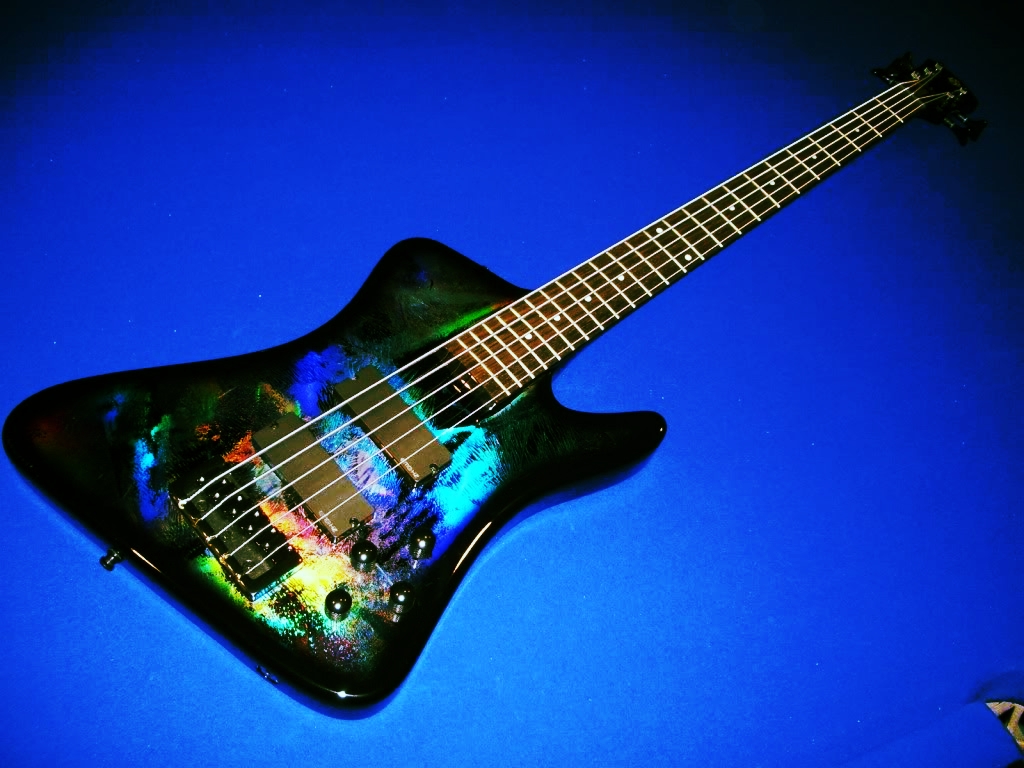
Again, it's a love it or hate it finish but under stage lights it puts on a real show.

- Mar 13, 2008
- 18,897
- 142,234
- Disclosures
- Endorsing Artist Mike Lull T Bass pickups, The Bass Shop, Seattle WA.
Anyone ever replace the pickup covers on their bird? Is it hard?
Yes, I have.
It's not difficult at all, you take the pickups out of the bass and using a pair of Xuron cutters you "peel" the black plastic outer casing off - Then you can pot them into the covers of you choice. I have some pics of the process somewhere on Photobucket, if you're really wanting to see them, let me know.
I kinda tried to avoid a direct comparison in neck sizes between my Spector Rex and my Gibson Thunderbird because of the apples and oranges of comparing a 5 string size neck to a 4 string size neck. But since you seem genuinely interested I'll run up to the studio and grab some quick measurements of the two necks.WOW! I'm surprised (pleasantly so) that the Spector is larger! The only photos I have seen, haven't contained a comparator. It just kinda impressed me as being smaller. I definitely want to look one up! How would you describe the neck profile on the Spector?
I'll measure the width of the nut, the thickness of the neck at the first fret, the width and thickness of the neck at the 12th fret the width of the neck at the 20th fret and the centerline to centerline of the outside strings at the bridge and string spacing at the bridge of each bass.
If someone with a Five string Thunderbird can chime in with actual dimensions of the same spots on their bass it would be very helpful.
Here ya go...
Spector Rex 5 Pro data first vs 4 string Gibson Anniversary Issue Thunderbird data
Nut width: 1.75" vs 1.5"
Thickness of neck at fret 1: .75" vs .75"
Thickness of neck at fret 12: .875" vs .875"
Width of neck at fret 12: 2.375" vs 2.125"
Width of neck at fret 20: 2.75" vs 2.25"
Centerline to centerline of Outside strings at the bridge: 2.75" vs 2.125"
String spacing at bridge: just shy of .75" vs just shy of .75"
Apparently both basses have the same string spacing and both basses have roughly the same neck thickness. The widths of the two basses fret boards is obviously different because of the number of strings. Both necks have a similar contour - D shaped vs a more rounded C shape.
Just to give you another point of reference - my Squire Affinity Jazz 5 has a 1.875" nut, is 2.5" across at the 12th fret, is 2.875" across at the 20th fret and is about the same thickness at the 1st fret and 12th fret as both the Spector and Gibson with a more rounded almost C shaped neck.
Hope this helps.
Last edited:
Im a little late to the party but did anyone notice the color of the VSB on the Sweetwater pic looks way different than the one on the "leaked" pdf?
only the cover!? i change the whole.
(sorry but i can't stand the modern cheap ass tbird pickups)
Oh i have the epiphone classic wirh gibson pickups so id like to keep them!

Just buy the neck ?So... I DID something today. I went to literally every guitar shop in town (so like...3) & grabbed every bass neck I could lay my hands on. I just wanted to compare 'em & stuff (Fender changes neck profiles like most people change their clothes!). The KSD Burner has actually been causing me pain in my left hand from playing. Though it's 1 5/8" at the nut... it was really quite slender all the way up. That was the only real dark spot. It was a really nice bass otherwise. My quest for a more functional neck, led me somewhere I never expected...
View attachment 1156101
It's a brand new, bottom of the barrel, piece of crap... but... it had a better feeling neck than everything else I picked up (and I picked up some nice stuff!). I have pretty much no idea what to do with that 5th string. I suppose it could come in handy if I need to tow a car or something... but right now, it's just in the way! The thing is... I was able to come home & play for nearly an hour before my hand bothered me at all! Hopefully I have somethin' here that'll keep me playin' & smilin' for a little while longer, 'till I can get my "real" bass. I'm just not sure what to do 'bout that LOOOOWWW BEEEE. I don't know whether to take it off & LOOK stupid, or leave it on & FEEL stupid!


