• TalkBass has been independent since 1998. Add your voice.
    Create a free account to reply to discussions, view embedded media, and browse with fewer display ads.
    Join freeLog in
    Want zero display ads or expanded classifieds tools? Compare plans.

Thunderbird Club

I noticed the TRC as well, possibly someone broke it and just rounded it off. As far as the brown trim on the HS around the black vs all all black, I've see a number both ways (not always from a repair). Mine is also trimmed in the brown, but I'm not certain Gibson was consistent in how that did that. After all, we're talking Gibson! However it is, it's fantastic! That Bird is going to rock!
The 67 NR was all black from the get-go.
 
And a certain 67 NR.:bag:

When I first got my '63 II (in '74) I started meeting people/players that had a gen1 T-bird with the repaired hs break. Both that '63 and my '64 luckily were spared of that 'trauma', but it clued me to the fragility of the bass I owned. I mean, I saw a few locally (in Omaha Nebraska no less!) that were broken and repaired. (some, not so well repaired ~) My '64 has toppled to the floor a couple of times over the years but the hs is still intact and stable. There is some fb/neck seam 'finish separation' near the nut area - but it's been like that for decades now with no ill effect. But it's no joke that gen1 T-birds (and apparently later '60s NR's also - wasn't aware of that) were prone to neck breaks - a honkin' huge hs and a narrow nut are bitchin' cool looking... but, because of that is firmly in the "handle accordingly" category.
 
Last edited:
You're very welcome. Glad you dig the Boomers!

What tapes are you using? I've been thinking/reading about them. Some say they sound plastic in some way. I'm not sure what to expect, don't want just dead sounding rounds.
I use LaBella Black tapes on a number of my basses. My experience (finger style) is that they sound deep and full, very rounded and somewhat woody. Directionally more towards an upright sound. Occasionally I’ll detect a slight clack from them as I lift off the fret, but others have said they didn’t hear it, so might just be me. I Really like how they sound and have them on my Jazz basses as well as my 2015 bird and my FrankenGoth. Worth a try, but beware, standard tapes are likely larger than the grooves in your nut and may require a file job on the nut to sit properly. Light gauge tapes are roughly the same diameter as standard strings no no nut work needed fort them. Also, I found drastic differences in the sound and feel of different brands of tapes, don’t like the Roto tapes at all - way too stiff and more thud than note.

I’d be interested to hear Chuckys take on the tapes, I’m sure he runs them through their paces and puts them to a better use than I do.

William Blake - https://en.wikipedia.org/wiki/William_Blake My undergraduate art school major was lithography so I was well aware of WB at an early age. Some metaphysically surreal shït.

View attachment 4543042
I’ll have to check it out. So where did you go for your art schooling?
 
Last edited:
I use LaBella Black tapes on a number of my basses. My experience (finger style) is that they sound deep and full, very rounded and somewhat woody. Directionally more towards an upright sound. Occasionally I’ll detect a slight clack from them as I lift off the fret, but others have said they didn’t hear it, so might just be me. I Really like how they sound and have them on my Jazz basses as well as my 2015 bird and my FrankenGoth. Worth a try, but beware, standard tapes are likely larger than the grooves in your nut and may require a file job on the nut to sit properly. Light gauge tapes are roughly the same diameter as standard strings no no nut work needed fort them. Also, I found drastic differences in the sound and feel of different brands of tapes, don’t like the Roto tapes at all - way too stiff and more thud than note.


I’ll have to check it out. So where did you go for your art schooling?

Kansas City Art Institute - 4 year undergraduate degree (printmaking/filmmaking) and The School of the Art Institute of Chicago - 2 year graduate degree (painting/film history). Early on I focused primarily on art - but from 13 on I was also developing my skills as a musician/bass-player. The two have been insparable since then. These days music is in the drivers seat, but my art background is the navigator of my life. What's your art/design background?
 
I use LaBella Black tapes on a number of my basses. My experience (finger style) is that they sound deep and full, very rounded and somewhat woody. Directionally more towards an upright sound. Occasionally I’ll detect a slight clack from them as I lift off the fret, but others have said they didn’t hear it, so might just be me. I Really like how they sound and have them on my Jazz basses as well as my 2015 bird and my FrankenGoth. Worth a try, but beware, standard tapes are likely larger than the grooves in your nut and may require a file job on the nut to sit properly. Light gauge tapes are roughly the same diameter as standard strings no no nut work needed fort them. Also, I found drastic differences in the sound and feel of different brands of tapes, don’t like the Roto tapes at all - way too stiff and more thud than note.

I only use La Bella 750n black tapewounds except for my Mikro as only 750ts whites were available. The only issue I have seen is bridge holes may need some filing to get the silk through on the E snd A strings. TUSQ XL nuts seem to handle the 50-105 size fine. I haven’t put those on my IV as the current setup is too nice. Call me :chicken:
 
Kansas City Art Institute - 4 year undergraduate degree (printmaking/filmmaking) and The School of the Art Institute of Chicago - 2 year graduate degree (painting/film history). Early on I focused primarily on art - but from 13 on I was also developing my skills as a musician/bass-player. The two have been insparable since then. These days music is in the drivers seat, but my art background is the navigator of my life. What's your art/design background?
Very cool! Sounds like you’re living the dream I’ve had most of my life.

My art background isn’t as formal as yours. Basically I focused on mechanical design and graphic arts all through my 6 years of Junior and Senior high school and did summer intern work for three years while in high school for Pacific Telephone and Lockheed Martin in their Graphic design departments. Mostly logo and branding artwork for PacBell and tech illustrations for Lockheed.

My non intern graphic artwork (pre computer art era) revolved largely around the automotive subject matter and consisted mostly of ink and vellum or multi media and was featured in many exhibits in the Bay Area from 1975 to 1978 with a large number of the works purchased by dealerships and auto enthusiasts. In 1978 I ended up with a fully paid Associate degree scholarship at the San Francisco Academy of Art in the Industrial Arts school. At the same time I was getting married and expecting a kid, so needing the money, I instead went to work full time for General Electric in San Jose in the mechanical design department designing power plants. The logic at the time was I thought I could make more money as a designer in a corporation with full benefits than a free lance artist.

I did in fact go on to have a very successful and lucrative career in the mechanical design field and on up through management but will never really know how far I could have gone in the more creative world of art. I do envy and admire people who have taken the opportunities to follow a dream and leverage their talents.
 
Very cool! Sounds like you’re living the dream I’ve had most of my life.

My art background isn’t as formal as yours. Basically I focused on mechanical design and graphic arts all through my 6 years of Junior and Senior high school and did summer intern work for three years while in high school for Pacific Telephone and Lockheed Martin in their Graphic design departments. Mostly logo and branding artwork for PacBell and tech illustrations for Lockheed.

My non intern graphic artwork (pre computer art era) revolved largely around the automotive subject matter and consisted mostly of ink and vellum or multi media and was featured in many exhibits in the Bay Area from 1975 to 1978 with a large number of the works purchased by dealerships and auto enthusiasts. In 1978 I ended up with a fully paid Associate degree scholarship at the San Francisco Academy of Art in the Industrial Arts school. At the same time I was getting married and expecting a kid, so needing the money, I instead went to work full time for General Electric in San Jose in the mechanical design department designing power plants. The logic at the time was I thought I could make more money as a designer in a corporation with full benefits than a free lance artist.

I did in fact go on to have a very successful and lucrative career in the mechanical design field and on up through management but will never really know how far I could have gone in the more creative world of art. I do envy and admire people who have taken the opportunities to follow a dream and leverage their talents.

Any serious involvement with creativity is a plus, at any level. A creative life = a full life. Stay connected with your creativity regardless of anything.
 
Yes, the redundant/dead-horse debate of a one pu bass vs a two pu bass. (Gibson, Fender, whatever) You are absolutely correct about the simplicity of magically transforming that pesky 2 pu bass into a 1 pu bass, but you'd never know if if you spend any time on a P/J related thread. But, I get the look thing - it's like a track bike vs a multi-speed road bike... there's an elegant simplicity to a 1 pu bass (and especially if it sounds killer!)

I also use both pu's most of the time, favoring the bridge pu by a varying degree. (depending on the song) I also use finger-style when appropriate, but mostly favoring a pick. I arrived at this after many years playing the opposite (occasional pick - mostly finger-style) and again - these days in servitude to the songs we play in my band. (where Carol Kaye is queen) Please google and watch YouTube vids of the East Bays very own Bobby Vega - the hands-down master of funky pick-playing if you have any doubts about the effectiveness of the mighty plectrum!

Hell - here's one to watch right here! (no slap)


I've seen and met Bobby on a couple of occasions - a super sweet guy!

View attachment 4543034

pretty awesome…..plays 361s…toured with TOP, heck of a nice guy…what’s there not to like?…
 
Yes - it looks cool! As I said - I very much like the way checking looks. Natural flexing/movement of aged lacquer has a way of creating beautiful filigree. It can be created on a new lacquer finish - MJT des a nice job of it. (BMM J) Then there is craquelure (my finish on a '68 Silvertone Hornet) and (original) on a late '60s Dano 12-string. This is caused by shooting lacquer over a 'false dried' lacquer base colour. (in my case red over black) It becomes this while you watch (pretty cool) and can be accelerated by forced air. (hair-dryer set on 'air' - or a compressor) Depending on how the top coat is sprayed - you will get fine texture or a more open texture. (as the two examples illustrate)

View attachment 4542303 View attachment 4542298 View attachment 4542300
amazing….your work rules.
 
You're very welcome. Glad you dig the Boomers!

What tapes are you using? I've been thinking/reading about them. Some say they sound plastic in some way. I'm not sure what to expect, don't want just dead sounding rounds.
LaBellas….i swore to myself 40 years ago that i would never use tapes as the old timers used them but i always liked them…. hate to admit it but they are forgiving and very effective and versatile with the right plucking technique…love the hefty bottom…..folks were praising the boom factor tonight….
 
The 67 NR was all black from the get-go.
weird….the 68 hs rear is dark but not quite as much as the front…hard to tell without decent lighting……
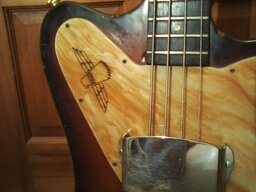
my repair…..:rollno:

5210196B-FC45-4930-A7F3-7081F0E72DD1.jpeg

95D1B1F7-E422-44F5-8C46-A23B2D034B5F.jpeg
 
One reason you're not getting high output out of the neck pu is because the strings are not over the poles. You can get away with a slight off-center but the further away, the less the string-magnet correlation. It's why 'bar' magnets have a broader range and are generally hotter output.

I'm not sure in what this response relates to a collective thunderbird poll, please excuse my lack of understanding the correlation.

However, i do agree with your statement about the whole bar magnet vs pole magnets output characteristic.