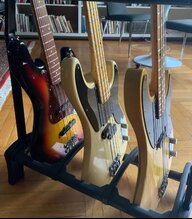
The first set I put on took about a week of playing to settle in. They had been quickly losing tune. Next set I put on I’ll stretch before tuning.
Before going crazy with this stretching thing, make sure the witness points are set properly first.

TalkBass has been independent since 1998. Add your voice.
Create a free account to reply to discussions, view embedded media, and browse with fewer display ads.
Join free Log in
Want zero display ads or expanded classifieds tools? Compare plans.
The first set I put on took about a week of playing to settle in. They had been quickly losing tune. Next set I put on I’ll stretch before tuning.
Be prepared that the strings speak to a lot of players, but the A string in particular is flimsy and is not balanced to the rest of the set; it is as loose as a bad rubber band.As a member of TB and a long-time bass player, I've heard about Thomastik Infeld flat wound strings too many times to count. But I've never used/played them.
According to their website, they have two types of flat wound strings: "Infeld" and "Jazz Flat Wound". Which of these are the more popular - which type are people referring to when they mention "TI Flats"??

I play with both fingers and a pick, and love the tone and the supple feel (I'm no fan of high tension strings.)Not to hijack the thread, but I’m contemplating these for my Ric as well. What do you like about them?
Before going crazy with this stretching thing, make sure the witness points are set properly first.

Right on. Thanks man3-6 mths for the initial break-in, then they naturally mature into "vintage fine wine" for the next 10 yrs.

Be prepared that the strings speak to a lot of players, but the A string in particular is flimsy and is not balanced to the rest of the set; it is as loose as a bad rubber band.

Good to know.Be prepared that the strings speak to a lot of players, but the A string in particular is flimsy and is not balanced to the rest of the set; it is as loose as a bad rubber band.
Please elaborate.
This should help: What Is a Witness Point and How Do I "Set" It?
I've never been in the habit of manually stretching new strings. But once I learned about the importance of "witness points", tuning stability on new strings has greatly improved.
I've stretched every set of strings that have ever been on my instruments. From bridge to nut on every string. Tune, stretch, tune, set points. They stay in tune after that.Heavens, don't *stretch* strings before tuning.Every manufacturer of bass strings will warn you against that. It doesn't speed up the realignment mechanism associated with "settling in" and it can certainly damage the strings.
Watch the video and see where she performs that task. It is after light stretching.
I've stretched every set of strings that have ever been on my instruments. From bridge to nut on every string. Tune, stretch, tune, set points. They stay in tune after that.
My point being proper witness points have more bearing on tuning stability of new strings than stretching. I'm not against "light stretching"; all I'm saying is I've never had to stretch any new strings to achieve tuning stability.

I've tried TI JF's on my basses; I've played them on friend's basses; this includes both 4-in-line and 2+2, flat and angled back headstocks; and I have been wrapping strings properly all the way down tuning posts since 1976. I'll be blunt: in my 45+ years of playing bass, TI Jazz Flat A strings suck. Even La Bella found that out. The first iteration of their LTF's were to compete with TI's. So they copied them, albeit in stainless flat wrap instead of nickel, including making a similar loose A string. It was so bad that after a couple of years La Bella reformulated the A string from a 70 to a 75 to better balance the set. TI needs to do the same thing.0.o You sure you wrapped it far enough down the tuning peg? Notorious Fender headstock break angle requiring at least 3 or 4 wraps down the A string peg if not all the way down to the bottom of it? Or lacking that, a string tree for the A string?


Less IME ...3-6 mths for the initial break-in, then they naturally mature into "vintage fine wine" for the next 10 yrs.

Lol this video is worthy of a thread of its own, no way I would ever do that with any of my basses

It dominates the early part of this otherwise extremely useful thread.Lol this video is worthy of a thread of its own, no way I would ever do that with any of my basses