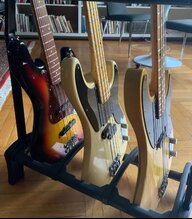
I just got my first set of these (JF344) in May for $68.99, now I looked them up they're $59.99. Ugh. Anyways, I installed them on my Acoustic Bass Guitar and they feel and sound amazing, IMHO.

TalkBass has been independent since 1998. Add your voice.
Create a free account to reply to discussions, view embedded media, and browse with fewer display ads.
Join free Log in
Want zero display ads or expanded classifieds tools? Compare plans.

The "honky growl" of the TIJF A on my fretless was increasingly bothering me, so I decided to experiment a little by replacing it with A strings from other flatwound sets.I definitely notice the tension difference between the A and the others with TIJFs. Fortunately, it doesn't bother me much, but it's clearly noticeable.
What DOES bother me some is the tonal difference of that string (and actually of the D, as well, but in different ways). The TIJF A sounds a little weird, especially on my fretless, but also noticeably on fretted basses as well. It has a unique kind of growl that has a honky kind of quality (is that even possible). On the fretless, the mwah on the A string is unusual and a bit disconcerting until you get used to it.
As for the D, once it breaks in, it sounds noticeably deader/darker than the other strings. The overtones aren't as rich, and you can notice this even unplugged. I've had a couple of TIJF sets that had dead D's right out of the box (TI replaced them graciously), so there may be something about that string that lends itself to deadening, I dunno. Good ones aren't dead, per se, but the tone isn't quite as rich and vibrant as that of the other strings.
And yet ... and yet ... I still really like the TIJFs, more than any other string. The clarity, the singing quality, the midrange, the lovely G ... even with the A & D quirks, they're really enjoyable.
As always, YMMV.

The "honky growl" of the TIJF A on my fretless was increasingly bothering me, so I decided to experiment a little by replacing it with A strings from other flatwound sets.
I started out with a .070 string from a light EB Cobalt Flat set and the feel was pretty good (a little stiffer than the TI A), but not a good match with the other TI strings tonally at all, too bright and jangly.
Next up was a .075 from a LaBella Low Tension Flat set, and it felt like it has the stiffness that the TI A should have (with a smoother overall feel), but again, not a good match tonally -- darker, duller, thumpier.
Next was a Fender .080, which was quite a bit stiffer but closer tonally, with some of the TI mids, but not as much of the tonal sweetness. It still sounded out of place relative to the other TI strings, so not close enough, considering how stiff it was.
Finally, I tried a Sadowsky Blue Label .080 (recent version), and although it's noticeably stiffer than the other TIs, it's not as stiff as the Fender. Those who are sensitive to lack of balance in this area would likely not like it with the other TIs for the same reason they don't like the TI A. But I'm not very sensitive to that (though maybe sensitive enough that I wouldn't like the Fender), so it doesn't matter much to me. However, none of that would be important if the tone weren't a good match. But it is. It sounds like it could have been designed as part of the TI set, at least more so than the TI A does (caveat: on MY fretless; your fretless may vary, and also, I don't have nearly as much of an issue with the TI A on fretted basses). I was going to try a Dunlop A, but I'll probably just leave the Sadowsky on for a while.
Interestingly, I tried other strings from the Sadowsky 40-100 set with the TIs, and none of them were as good a match. But the A seems like a pretty decent alternative if you can tolerate the extra stiffness. Also, I'm curious about how the old Blue Label flats that Sadowsky will be resurrecting will compare.

Losing tune for a steel string or cable depends the composing steel’s properties which undergoes relaxation under constant loading .. it’s normal and it will happen again during the strings lifespan although at lower rates after the first one .. how stretching may cancel this property is not clear to me.The first set I put on took about a week of playing to settle in. They had been quickly losing tune. Next set I put on I’ll stretch before tuning.
Losing tune for a steel string or cable depends the composing steel’s properties which undergoes relaxation under constant loading .. it’s normal and it will happen again during the strings lifespan although at lower rates after the first one .. how stretching may cancel this property is not clear to me.
It should be a sort of dynamic loading of the strings exceeding their tuning load accelerating the above process which, however, happens statically and under constant loading conditions .. uhmm

25765634[/URL], member: 284122"]Losing tune for a steel string or cable depends the composing steel’s properties which undergoes relaxation under constant loading .. it’s normal and it will happen again during the strings lifespan although at lower rates after the first one .. how stretching may cancel this property is not clear to me.
Well .. I’d prepare the instrument half a day ahead of the gig and I’d then re-tune it just before it .. that’s all .. sounds rather easy IMOYou’re right, it doesn’t. The reason people think you shouldn’t stretch strings is due to lack of understanding of how a string works.
There are 3 factors involved in why you should stretch a string rather than playing out of tune constantly for several days.
1. The wire the string is made of is drawn at a considerably lower tension than what the string is at when tuned on an instrument. When you tune it will stretch to where it wants to be at that tension. You are not decreasing the lifespan of the string by gently helping it get to a point of stability. It was going there anyway.
2. The string will seat on the post of the tuner. Stretching it will seat it better onto the post.You are not decreasing the lifespan of the string by gently helping it seat on the post. It was going there anyway.
3. Strings are made of multiple wraps of different wire and/or tape. On the heavier gauges there is often a taper so the fattest part is not wound onto the post of the tuner. There is also a ball at the end which the core of the string passes around and twists back on itself. All these components need to settle together before the string will stay in tune. Again, helping this process by stretching it will not damage the string. It was going there anyway.
4. Ok I said 3 factors but there’s a 4th one for professional stage techs. If you’re stupid enough to hand your boss an instrument with unstretched strings it will go out of tune over and over and you will get fired. Which I guess will be ok…..you were probably going there anyway.
Well .. I’d prepare the instrument half a day ahead of the gig and I’d then re-tune it just before it .. that’s all .. sounds rather easy IMO
Just don't do it like this guySomeone who knows how stretch strings in two minutes or less can easily deal with the luxury of having two days to get the instrument to stay in tune.
Someone who needs two days to get the instrument to stay in tune but only has two minutes is going to be thinking maybe that obnoxious jerk on the interwebs had a point.


As a member of TB and a long-time bass player, I've heard about Thomastik Infeld flat wound strings too many times to count. But I've never used/played them.
According to their website, they have two types of flat wound strings: "Infeld" and "Jazz Flat Wound". Which of these are the more popular - which type are people referring to when they mention "TI Flats"??

For me, that's one of their qualities.I found them way too light and floppy like playing elastic bands

I found them way too light and floppy like playing elastic bands
Ya, me too. Turns I like light and floppy, just not TI's version of it. I like light and floppy and low action, too. What string rattle? I don't hear any string rattle, do you?For me, that's one of their qualities.


They sound great through my 410, or the SVT810 speaker sim in my line 6 pod go. Not so much through just about anything else I have. Compared to say Rotosound Jazz Flats that after a year I could plug directly into an interface with no EQ and be in love with what I was hearing.
I personally love the feel of playing the Ti Flats. Took some getting used to but I would have yanked them off and gone back to my Rotosounds and pure bliss for tone if not for how much I enjoy the feel of playing them.
I'm able to get somewhere usable with the help of some EQ through less warm sounding cabinets and speaker sims.. but not something I'm quite in love with.
But through my 410 they sound like absolute yum.

Ya, me too. Turns I like light and floppy, just not TI's version of it. I like light and floppy and low action, too. What string rattle? I don't hear any string rattle, do you?


Ya, me too. Turns I like light and floppy, just not TI's version of it. I like light and floppy and low action, too. What string rattle? I don't hear any string rattle, do you?