• TalkBass has been independent since 1998. Add your voice.
    Create a free account to reply to discussions, view embedded media, and browse with fewer display ads.
    Join freeLog in
    Want zero display ads or expanded classifieds tools? Compare plans.

Tips on making a balanced bass?

TTA

Jun 10, 2021
2,283
4,547
Preamble: So next year i will likely have a custom bass made for me. It will be a ric 4003 with some unique features regarding the neck (wenge for starters, maybe multiscale).

i will review details with the builder when the time comes… but in the meantime i was hoping to learn a few things for my own curiosity. I figure the more informed i can be, the more realistic i can be in what i am looking for.

- are there any tips to building a custom bass that is balanced on your knee? Rules of thumb… etc… or is it all experience and trial and error?

obviously wenge is typically heavier than maple in my case, and i will be going for a chunkier neck. neck dive.

typical stuff will be assessing weight that can be saved with tuners, weights of a possible new bridge… bead strings, thicker wenge neck, a bit of wood removed from the upper horn (80-90’s fat horns to 4003s style body)….

how does horn length effect things? More mass moving to the neck end… and with a strap, longer horn = shifting more weight to the body side.

Strap anchor on the bridge end can be moved up or down the body to shift more or less weight to/from the body (with strap)

Ooh… and i like a bass that balances at roughly 30 degrees above horizontal (sitting), and more 45 degrees standing.

Any other thoughts/considerations?
I know i am being vague, but i am curious how others approach the issue of building a balanced bass.

To me, strap balance will be easy and can be adjusted with the strap anchor on the bridge side. Balancing on the knee seems like the bigger challenge.
 
Last edited:
  • Like
Reactions: JamesDeGrandis
Rics are naturally pretty well balanced, enough so that putting a brass vs. aluminum Hipshot on one can tip it one way or the other. The headstock size and shape has changed subtly over the years, so there is no “correct” version, maybe go with the smaller versions. Maple is pretty dense and heavy, which has at least something to do with tone and balance. I can’t say what wenge will do to balance, but neck heavy sounds right. Hipshot makes some very nice tuners, the HB-5, that are slightly lighter than standard Fender Style, which look Jug-eared on a Ric. The standard Ric tuners are made by Schaller, and have shorter tuner posts than Fenders, hence slightly lighter already. Anything you can do to lighten the headstock will have a lot more effect than weight at the bridge. Your builder can probably “tune” proportions a little for balance, make sure they know it’s a high priority.
 
A couple of "rules of thumb" I've come up with over the years for balance include many of the factors listed already, but these are the ones I prioritize:
  • Avoid ridiculously heavy woods for the neck, stick with stiff but lighter woods (high modulus of elasticity)
  • Smaller headstock (Ric headstocks are not so great in this department, but can be made a bit smaller and thinned down a bit.
  • Lightweight tuners (I like Gotoh lightweight tuners)
  • Extended upper horn (I go to the 10th-8th fret)
  • Bridge as close to the end of the body as possible (Ric bridges suck for this)
  • Lower body relief curve (treble side) no further into the body than the 24th fret. This one is essential to keep things balanced on one's knee, as if this curve is closer to the bridge, the whole bass sits further towards the headstock over one's knee and affects balance. I want the bass into my body more.
I've built some sub-7lb 6 stringers, so I know it's workable (barely sub 7lb :D). The first one I ever built had the upper horn reach to the 11.5 fret and it had some neck dive. The next one with the same overall design had the upper horn reach to the 10th fret and neck dive disappeared and balance improved.
 
A couple of "rules of thumb" I've come up with over the years for balance include many of the factors listed already, but these are the ones I prioritize:
  • Avoid ridiculously heavy woods for the neck, stick with stiff but lighter woods (high modulus of elasticity)
  • Smaller headstock (Ric headstocks are not so great in this department, but can be made a bit smaller and thinned down a bit.
  • Lightweight tuners (I like Gotoh lightweight tuners)
  • Extended upper horn (I go to the 10th-8th fret)
  • Bridge as close to the end of the body as possible (Ric bridges suck for this)
  • Lower body relief curve (treble side) no further into the body than the 24th fret. This one is essential to keep things balanced on one's knee, as if this curve is closer to the bridge, the whole bass sits further towards the headstock over one's knee and affects balance. I want the bass into my body more.
I've built some sub-7lb 6 stringers, so I know it's workable (barely sub 7lb :D). The first one I ever built had the upper horn reach to the 11.5 fret and it had some neck dive. The next one with the same overall design had the upper horn reach to the 10th fret and neck dive disappeared and balance improved.


thanks for the info!

If i go multiscale my bass will be have a bridge as close to the end of the body as possible. But i would also likely be taking a inch (diagonally) into the headstock, and a multiscale bridge would likely be lighter. If not multiscale i may try to extend the scale to 35. The latter is probably the most realistic option if i opt to keep the original ric electronics. I do want BEAD.

i just googled gotoh tuners. They had me at carbon fibre! 35g each!! I dont even care what the cost is. I will guess that is good for 250g on one very extreme side of the bass.

C74959AA-6EF5-44F4-844E-DD8386F43AB3.png

Gotoh cbt-01
 
Last edited:
  • Like
Reactions: Beej
Notice though, those have the longer tuner posts, not short like Ric label Schallers or the HB-5's. It tried Fender style on my Ric builds, looked just wrong on the headstock.
Yeah i was planning a workaround. I could mount them inboard more. Or hunt down some carbon fibre experts to shorten them. I know some people in the automotive and cycling world that do a lot of custom work. Pretty easy mod.
 
Yeah i was planning a workaround. I could mount them inboard more. Or hunt down some carbon fibre experts to shorten them. I know some people in the automotive and cycling world that do a lot of custom work. Pretty easy mod.

The round parts (posts, gears, key shafts bearing blocks, etc.) on those tuners are aluminum. They can be easily sawn, drilled, modified, if you like. The only "carbon fiber" parts are the base plate and the ear of the key. And they aren't super hard Carbon Fiber Reinforced Structures, like airplane parts and bicycle frames. They are pressed or laser-cut from plastic laminate sheet. They can also be easily drilled, filed, modified, if you want to.
 
Last edited:
The round parts (posts, gears, key shafts bearing blocks, etc.) on those tuners are aluminum. They can be easily sawn, drilled, modified, if you like. The only "carbon fiber" parts are the base plate and the ear of the key. And they aren't super hard Carbon Fiber Reinforced Structures, like airplane parts and bicycle frames. They are pressed or laser-cut from plastic laminate sheet. They can also be easily drilled, filed, modified, if you want to.

ahh yes… could machine and re adhere…
Keeping the black anodizing clean… tough.

or… make it true to what ric did…
28019014-C3A1-4862-B03D-49D103550FB4.jpeg

I think the answer might be to move them slightly onboard. But then you need a reshaped tr cover. I should compare specs with my fenders to evaluate options. A cf shaft would have been the easiest to work with.
 
Last edited:
Thats what I'd refer to as one of the "smaller" era headstocks, smaller than the ones I did on the Hossenfeffer builds, but they still balance nearly perfectly. Surprising how much they have changed from year to year, so pick the one you like. The walnut one I did is ever so slightly neck heavy. The bodies and other dimensions are identical, the only difference being walnut is slightly lighter than maple. Post some photos of whatever your builder comes up with so we can nitpick it. :D Multiscale Ric is gonna be cool!
 
Thats what I'd refer to as one of the "smaller" era headstocks, smaller than the ones I did on the Hossenfeffer builds, but they still balance nearly perfectly. Surprising how much they have changed from year to year, so pick the one you like. The walnut one I did is ever so slightly neck heavy. The bodies and other dimensions are identical, the only difference being walnut is slightly lighter than maple. Post some photos of whatever your builder comes up with so we can nitpick it. :D Multiscale Ric is gonna be cool!
It is like second quarter 2023 so i have time. For now i am planning, Brainstorming. Like the carbon tuners… many factors to include. Good to identify possible issues now.

So when 2023 arrives i can be like “boom!” But i will run things by him when the time comes also. He needs to be comfortable, and often dreamers like me need a dose of reality.
 
Rule of thumb... Don't build a 7 string.
Trust me.
Hahaha. Well i have a dingwall 6 string custom build arriving in april. I think that will be as much stretch as i can manage for the higher notes on the lowest string.

I plan for this one to be a BEAD bass with as much extra scale length as i can manage. I am just not sure i am ready to ditch all the ric hardware yet (look) in the name of multiscale. So it will be 35 normal scale, or 34-36ish multiscale.

With multiscale I could use the standard pickups/etc… but the treble side strings would become “very treble”. The visual effect will be the key. It 100% needs to look good.
 
Last edited:
A couple of "rules of thumb" I've come up with over the years for balance include many of the factors listed already, but these are the ones I prioritize:
  • Avoid ridiculously heavy woods for the neck, stick with stiff but lighter woods (high modulus of elasticity)
  • Smaller headstock (Ric headstocks are not so great in this department, but can be made a bit smaller and thinned down a bit.
  • Lightweight tuners (I like Gotoh lightweight tuners)
  • Extended upper horn (I go to the 10th-8th fret)
  • Bridge as close to the end of the body as possible (Ric bridges suck for this)
  • Lower body relief curve (treble side) no further into the body than the 24th fret. This one is essential to keep things balanced on one's knee, as if this curve is closer to the bridge, the whole bass sits further towards the headstock over one's knee and affects balance. I want the bass into my body more.
I've built some sub-7lb 6 stringers, so I know it's workable (barely sub 7lb :D). The first one I ever built had the upper horn reach to the 11.5 fret and it had some neck dive. The next one with the same overall design had the upper horn reach to the 10th fret and neck dive disappeared and balance improved.
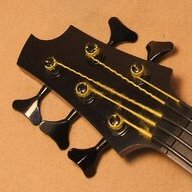
Don't want to derail the thread, but would be curious to see that sub-7lb 6!
 
  • Like
Reactions: TTA and Beej
Don't want to derail the thread, but would be curious to see that sub-7lb 6!
Maple core, top and back, but they are thin and heavily chambered out. The walnut pickup covers are also mostly hollow, it has jazz pickups (which are smaller and lighter compared to many), and the bridge is aluminum. These photos are before I put GB350s on it which pushed it down to 6.9 lbs. :D
 

Latest posts