• TalkBass has been independent since 1998. Add your voice.
    Create a free account to reply to discussions, view embedded media, and browse with fewer display ads.
    Join freeLog in
    Want zero display ads or expanded classifieds tools? Compare plans.

Double Bass "To Cut, or Not to Cut. That is the Question"

It sounds to me like the shoulder cut is the only option that really fixes the problem, the rest only kind of seem to address the problem. You could try the other ideas, but I suspect you'll have the rib cut performed eventually. Not only will it have a more friendly string length, but the shoulders will be a little more accesible. As much as I hate to see such an old bass getting cut up, I would hate it more if no one used it because it was too awkward an intrument. I wouldn't say I'm very qualified to make such a recomendation, but you asked for our opinions...
 
JoeyNaeger said:
It sounds to me like the shoulder cut is the only option that really fixes the problem, the rest only kind of seem to address the problem. You could try the other ideas, but I suspect you'll have the rib cut performed eventually. Not only will it have a more friendly string length, but the shoulders will be a little more accesible. As much as I hate to see such an old bass getting cut up, I would hate it more if no one used it because it was too awkward an intrument. I wouldn't say I'm very qualified to make such a recomendation, but you asked for our opinions...
+1
In the end, Ken, it is your bass. From what I can tell by the postings here it will come out quite managable and I'm betting it will sound heroic whichever way you go.
 
JoeyNaeger said:
It sounds to me like the shoulder cut is the only option that really fixes the problem, the rest only kind of seem to address the problem. You could try the other ideas, but I suspect you'll have the rib cut performed eventually. Not only will it have a more friendly string length, but the shoulders will be a little more accesible. As much as I hate to see such an old bass getting cut up, I would hate it more if no one used it because it was too awkward an intrument. I wouldn't say I'm very qualified to make such a recomendation, but you asked for our opinions...


Yes, I did ask and I like hearing all sides of the argument. That was the reason I posted this in the first place. I know there are 4/4 Basses sold new today with 44" string lengths but I doub't anyone is buying them to play in an Orchestra Professionally.

In my opinion, the only way to make this a playable under 42" SL Bass IS to cut the shoulders and re-bend the Ribs to match the new Top and Back cut/curve. My intention at this point is to do as much as possible to make it playable to a degree so it CAN be Cut in the future if the Bass passes on to someone else. There are some big guys out there and maybe one will knock on my door looking for a Bass like this at the time I decide it's too much for me to handle. That person will appreciate that fact that I didn't cut the Bass. As I stated earlier, it was my only old Orchestral sized bass when I first bought it and I wanted it to be right for me and my hands. Since then I have bought some other Basses that I like better as-is for all around playing. This would become my big Plush Orchestral Bass for when I don't need to play up high and don't need a low C extension either. Just a big fat plush sounding Orchestral bass to play and have fun with. I can manage a SL over 42" for those occassions but prefer not to for my everyday use.

I recently when thru 3 other biggies while this one has been in restoration. The Dodd was big to play but the SL was only 41.5". The Morelli was close to 42.5" and the Prescott just under 42". All three had their challenges to play them. The Morelli was long and slightly big at the shoulders. The Dodd was shaped like a Violin and getting over the shoulders was not so easy for me. the Prescott is just HUGE all around. If I didn't have this Bass, I would probably keep the Prescott but there is only room for one Biggie in my rack. With 2 of the 3 gone, the Prescott will go up to Arnolds shortly and look for a new home to be welcomed in. The Mystery Bass, now believed to be Olde English, will take its place as my 'Big Gun' when the Buffalo come to town so to speak.

I want to make it somewhat playable now and preserve it for those times a big Bass is needed or wanted. Now that my Gilkes is near completion and the Fendt in the wings, I no longer need to cut this bass down to a smaller bass and do the Dragonetti on it. If I can reach the D or and play Ottello or Lt. Kije on it, I will be happy.
 
Ken McKay said:
I vote to preserve all that is original or altered on any bass that comes in your possession. I know it is tempting to make it playable to your specs but this is history and too much of it is already gone. I say don't cut it, re-bend it. Some day the bass world will thank you.

So what are you saying then?

Being it is a Mystery Bass to all that have seen it, please help me out with the History on it if you know something.

I am trying to make it playable again. I don't know anyone who would use it as it was. it layed in a basement for most of the 20th century because it was unplayable. It fell apart, ribs peeling off the blocks, coal dust filling the cracks... etc..

No one I know will or can play a Bass this size in a modern Orchestra with a 46" Top (up to the neck only, 47" to the tip) and upper bouts almost 22" with high shoulders and a 44" string lenght. these measurements ARE the reason why it was not played much in the last 100 years. I plan on changing that.
 
KSB - Ken Smith said:
it layed in a basement for most of the 20th century because it was unplayable. It fell apart, ribs peeling off the blocks, coal dust filling the cracks...

Well its a no-brainer then. There is no conservation argument, as the bass's pedigree and potential is unknown, it does not have history that anyone knows about, and an unplayable bass is pretty worthless other than as a curiosity. You have a fine luthier working on it, you are taking a punt on a mystery and pouring your good money into it, you have the right to do what you will!

When you think about it, the odds of some big great big chap coming along 50 -100 years hence and spending good money to make the bass virtually unplayable again, even by putting the neck back into its original depth and overstand, is pretty slim! Whatever you do to it, I think it will stay like that; I reckon it won't be put back back to what it was before.

Possibly the only real risk is that you do something to it that ruins it, and that's pretty unlikely ...
 
Ken,

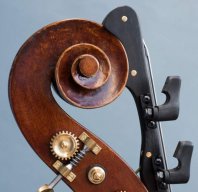
You know what I also really wanted to see on your name that bass thread... A nice side profile of both sides of the scroll, you didn't give me one to look at on that page. Thats one of the most important pieces in the puzzle. I want to see it, email me [email protected]

This does not really do the job Invalid Link Removed
 
Sink her deep IS the Block cut I have been talking about but with also fitting a new Block when the old one won't work because you have to sink the Block deep itself first. I think about 40mm of neck stand will also be best for this shoulderly beast.

As far as the Scroll goes, didn't you see the page I have on this Bass? It shows a few shots of the head in progress as I shape the new Cheeks I made to cover up all the plugs from the previous gears, screws and extension, about 72 in all. The old Cheeks were a bit thin and with all the holes looked like Swiss Cheese so I made some plates with matching figure to the back and ribs to strengthen them as well as beautify. The Scroll is NOT from this Bass so while you are at it, can you tell me the maker of this Scroll? I know who it is because I saw an exact one on a Bass in repair at Biase's shop about 2 years ago but I will let you have your Guess first.

My Bass page here with Scroll pics; [Invalid or Expired Link Removed]

Just look at the Pics because I mention who made the Scroll in the text. No cheating now...
 
Ahh sure cut the block....not the neck.

I did see the page, what I would like to see are some nice big shots like these below showing the whole profile in relation so I can see the cant of the box, depth of the throat and relation of the turns in the scroll from a dead on angle. Not saying the pics are bad just a bit more artisitic than technical.

I did miss the statment that the scroll was not orig...Ken your being a smarty pants again :spit:

Invalid Link Removed

Invalid Link Removed

Invalid Link Removed

Invalid Link Removed

Invalid Link Removed
 
uptonbass said:
Oh boy I better shut up, I have more questions. What can you tell about the blocks and the linings? Maybe I should read your page now

Ok Gary, you may go and read now. Take a 'time out' and read some..lol

The Varnish on the Scroll IS way different. Next time I am at Pauls' I can take pics but we know who made the Scroll anyway.

The Top is about the strongest I have seen with no sinkage at all and having about 350 growth rings from the center seam to the outer edge of the lower bout, hence 'iceage wood'. You will need a magnifier glass, flash light and pencil to mart the groups of 10 when you count the rings. Almost as fine as a ream of paper, thick paper I mean..lol

The Bass bar is not the original but it is at lease from the early 20th century if not before. It is tiny, short and shallow. It looks to have some holes in it like nail holes as if the wood came from a door frame or something. Some of the old Dodd Bows had holes as well from barrels he salvaged for the Pernambucco. It's not at all unheard of for makers/restorers to use old wood when they find it even with holes and defects.

The corner blocks are odd in that the inner side of each block is shallow but elongated as it rides up the bout a bit. The lower bouts are very soft as well. The lining is tiny as well and is mostly getting replaced. The neck block is not the original as we believe this was blockless at the start. The bottom block may be original but who knows or who cares!

As far as cutting the Block and not the neck.. ahh.. too late. I cut the neck in half about 2 years ago to work on the scroll/pegbox. The neck was spliced in the center as well as other repairs. I have a new block in storage for the graft. It will be a D-neck and Paul will make it as comfortable to play as possible.
 
KSB - Ken Smith said:
No one I know will or can play a Bass this size in a modern Orchestra with a 46" Top (up to the neck only, 47" to the tip) and upper bouts almost 22" with high shoulders and a 44" string lenght. these measurements ARE the reason why it was not played much in the last 100 years. I plan on changing that.

My $0.02: a 22" upper bout is bigger than average, even for large basses, but not by much. That shouldn't make it unplayable unless you play with a really vertical stance. Players who lean the bass back for thumb position, Petracchi-style, should probably be able to get around it as is.

I once played a weird Prescott at Hammond Ashley that was really cello-shaped - an early instrument, I think, with a thick, unpurfled top. Didn't look like it had ever been cut down. The friend I went with, who was a student of Gary Karr's, wouldn't even go near that bass ... so, uh, naturally I had to play it. I could get around it in TP, and I'm not a really tall guy (6') - if I really loved that bass, I could have learned to work with it. It sold soon after, so obviously someone did.

But a 44" string length is just impractical, and I don't see any reason to keep it. I'd say sink the block but don't touch the shoulders, and some long-armed player will thank you in the future.
 
the_other said:
My $0.02: a 22" upper bout is bigger than average, even for large basses, but not by much. That shouldn't make it unplayable unless you play with a really vertical stance. Players who lean the bass back for thumb position, Petracchi-style, should probably be able to get around it as is.

I once played a weird Prescott at Hammond Ashley that was really cello-shaped - an early instrument, I think, with a thick, unpurfled top. Didn't look like it had ever been cut down. The friend I went with, who was a student of Gary Karr's, wouldn't even go near that bass ... so, uh, naturally I had to play it. I could get around it in TP, and I'm not a really tall guy (6') - if I really loved that bass, I could have learned to work with it. It sold soon after, so obviously someone did.

But a 44" string length is just impractical, and I don't see any reason to keep it. I'd say sink the block but don't touch the shoulders, and some long-armed player will thank you in the future.


Thanks for your comments. Yes, I plan on only sinking the block, the neck into the sunken block and trimming the ribs at the neck just a little to make it work. Wide Shoulders, Long Top and long string length = Museum piece. I want it to be an Orchestral Bass. I too am 6ft tall and can get over almost any shoulder but reach is another thing with extra long Basses. This will NOT be a soo Bass to play the Dragonetti on except for stretching practice in the morning.. lol

The Shoulders however are similar to my Prescott but a hair wider and the length of the top and reach about 1" longer than the Prescott as well. After the Block cut, this should be as easy or easier to play as the Prescott.
 
KSB - Ken Smith said:
The Varnish on the Scroll IS way different. Next time I am at Pauls' I can take pics but we know who made the Scroll anyway.

I would still like to take a look at the scroll.

Again the pictures on the site don't really let me see into the depth of the wood....to get a possible feel of its (wood only) origin

Did you suspect at any time that the entire bass was American?
 
uptonbass said:
I would still like to take a look at the scroll.

Again the pictures on the site don't really let me see into the depth of the wood....to get a possible feel of its (wood only) origin

Did you suspect at any time that the entire bass was American?

Yankee? No, not at all but it has come up. The Scroll is by Isa/Jay White, Boston 1840s as is the X-brace possibly but this is about the 3rd crossbar system we see in the Bass already and is not the original at all. The Scroll/pegbox is made of plain grained Sugar Maple. The Bass is made with extreme fine grained european Spruce. The Back and Ribs are English Sycamore, Quartered. The back Billet was about 15" wide before it was split. The Back has a few spots left of painted purfling that was identified by Paul Biase as 'English Ink'. The Purfling is from Northern Europe as used only in England and France c.1800. The Back had twin rails at the lower section as did the 16-18th century English Gambas in place of the bottom cross bar. Left glued to the back was a small piece of wood from an old blockless neck as used by the early English. The bend of the upper back may or may not be original but bends from just above the upper corner block to the neck gradually without any angle break at all. This was used in London c1800 by George Corsby as mentioned in this UK 'site; http://www.contrabass.co.uk/2488.htm

Everything about this Bass on the inside points towards England right down to the size of the Bass. I have heard of but not seen any of the Gamba shaped Basses from the Dodd shop. Fendt Sr. along with his student Lott Sr. made Basses for Dodd from 1798 to about 1809 leaving Lott alone with Dodd 'till about 1823 when Dodd died. I believe Lott may have taken over the shop after Dodd's death. Fendt went to work for Betts in 1809. Fendt trained for years with his Uncle Francois Fent in Paris. Both were born in the Tyrol by the way. Fent worked first at Innsbruck until he left for Paris and worked there from 1769-1791. It seems that Bernhard stayed until his move in 1798 to London finding work at the Dodd Shop.

This Bass has 3 flavors. The Tyrol or Germanic as some call it, French as in the upper bouts, the bend and the Shoulders like the late 18th century French and English from its Gamba construction and English componants. Does this Bass have its roots with Fendt at the Dodd shop? That is the only connection I can make currently having this trio of fine flavors. What's your thoughts on it?
 
KSB - Ken Smith said:
So what are you saying then?

Being it is a Mystery Bass to all that have seen it, please help me out with the History on it if you know something.

I am trying to make it playable again. I don't know anyone who would use it as it was. it layed in a basement for most of the 20th century because it was unplayable. It fell apart, ribs peeling off the blocks, coal dust filling the cracks... etc..

No one I know will or can play a Bass this size in a modern Orchestra with a 46" Top (up to the neck only, 47" to the tip) and upper bouts almost 22" with high shoulders and a 44" string lenght. these measurements ARE the reason why it was not played much in the last 100 years. I plan on changing that.

I can't help you much as I don't have anywhere near the knowledge for that. And you are doing the job perfectly well as far as I can see of identifying it's history.
I think there is tremendous value in keeping it original or as it was altered previously. This is clearly the trend in violin, viola, cello restoration at this time. Your mystery bass is only a mystery until the mystery is solved. But altering anything even if they were repairs is not a good idea in a historical context. I am not approaching this as a player.

You asked, Ken. I don't see any damage has been done from a historical point of view yet and I am not acousing you of anything. I would have liked for you to keep the peg box original if it were not structurally iffy. Those old filled holes are history and great to see!