• TalkBass has been independent since 1998. Add your voice.
    Create a free account to reply to discussions, view embedded media, and browse with fewer display ads.
    Join freeLog in
    Want zero display ads or expanded classifieds tools? Compare plans.

Double Bass To Dot or not to Dot? That is the question.

Using a fingernail polish, I applied a 2mm dot at the location of the natural harmonics when I was adjusting to a new setup and going from Evah Pirazzi to Spirocore weich and I haven’t bothered scraping them off. The acrylic is durable but I prefer to be able to scrape them off.
 
  • Like
Reactions: Michael F Clef
I use a stick-on dot at the octave and high D (17th fret equivalent). I don't think I could possibly care less what anyone thinks about it. Just make sure your position markers are there to help and not to dictate. It can be creatively stifling if you're using markers in the lower positions and need to reference them while playing, even more so if you're playing improvised music.
 
  • Like
Reactions: Michael F Clef
My vote is for temp side markings for the lower positions. I've seen temp dots in the face in thumb position, which makes sense, but it's a look.

IOW if you need them and don't care about the look, put them where you can see them. I prefer the clean look and don't play much up the neck, so I've got some side dots in the lower positions.
 
  • Like
Reactions: Michael F Clef
Why just DOT when you can BEDAZZLE?
One for each note on each string! Color-coded by Key Signature!
Then pour the remainder in both of your earz! You'll look Fabulous!
Yer' Welcome!
Sheesh....
1737229067147.png
 
Last edited:
Good point. What is the conventional terminology when referring to a fret position in the Double Bass?
Usually we just refer to the G string note. Hence why we talk about "D necks" and "Eb necks" rather than "7th fret necks" and "8th fret necks."

Speaking of which, I would find a dot at the G string D ("7th fret") superfluous. You already have the neck heel as a tactile guide there.
 
Black sticky dots designed for covering the cameras on phones and laptops have proven useful in my experience; I've put one in the middle of the fingerboard on the octave and one a 5th up from that. I could probably get away without them but value the utility of a visible reference in case something goes wrong during a gig. Being black, they are fairly subtle.
This reminds me of a time I used someone else's bass at a jam. They found it difficult to hit the Ab on the E string and so had a dot inlaid into the side of the fingerboard out that point. The dot was visible out of the corner of my eye. I'd expect to see a dot on G (I started bass on an unlined fretless BG) and so this threw me out horribly.
 
  • Like
Reactions: Michael F Clef
I was at a recording studio some years ago, and another (much better-known) bassist also there saw the black vinyl pinstriping across my fingerboard. I sheepishly admitted I don't play string bass much. This guy (who gets recording gigs on string bass on the regular) immediately showed me the pencil marks on the side of his fingerboard. He said "I'd rather be known as the guy who plays in tune than as the guy who plays with no visual markers but misses a note once in a while."

My pinstripes are still on.
 
Last edited:
Many moons ago, when I asked Pop why double basses lacked the position markers common to electric basses, he ran a thin strip of masking up the edge of the neck of my bass and marked the positions in pencil - where only I could see them.

Within several months, my ears and Simandl training made the marks unnecessary.

Good luck! :)
 
Another good reason for adding at least a few subtle side markers (I use the Gollihur stick-on type): if you have basses with different mensures, string heights, etc.

I learned that to my chagrin recently, when my pickup stopped working at a gig. No problem, I thought—I pulled out the Yamaha Silent Bass I brought as a backup and carried on.

But the string length is a good 1.25 inches shorter, the strings are a different thickness and the bridge is much lower with a more shallow radius. It was a challenge enough adjusting for the last two factors (especially when bowing), but the different mensures meant the notes were literally in different places. I didn’t do my best playing.

I’ve used the Silent Bass as my primary player for months at a time, and I didn’t have a problem. But you don’t switch over to a new set of muscle memory, just like that. A few side-placed position stickers are going on and staying on.
 
Usually we just refer to the G string note. Hence why we talk about "D necks" and "Eb necks" rather than "7th fret necks" and "8th fret necks."

Speaking of which, I would find a dot at the G string D ("7th fret") superfluous. You already have the neck heel as a tactile guide there.
"D on the G String" seems a bit cumbersome. I'm surprised to discover that there is no real convention for not saying "fret."
 
  • Like
Reactions: Lee Moses
just to offer additional perspective, i used side markings for awhile after vehemently avoiding them in my first few years on the instrument. observations:

-i did find that i was looking at the neck of the bass more than i would like and felt dependent on the markings
-i felt i was looking more and listening less
-i felt i was looking more and FEELING less, ie feeling in my hands where i was on the neck
-trying to sight read a chart or sheet music was not fun since you can only look at one thing at a time
-the positive; i had something to fall back on when i was on a gig with bad sound where i could barely hear my bass

I now no longer have markings on my basses.
 
Something I don't believe has been considered here is ergonomics. I'm not a marker person and one reason is that the relationship between where I'm comfortable standing while playing( I don't sit even in orchestra) would be compromised if I had to look at markers on the side of the neck or on the fingerboard. I occasionally see players who I can tell are looking at something on the neck and the ways they're distorting good posture makes me hurt. I teach students to use good body mechanics and the use of markers can be counterproductive to this IMO. It can be so easy to develop habits that can cause injury or discomfort that anything that does should be avoided.
 
Up to the fifth you might want to mark the side. From the octave upward beneath the G string.
It is Ok to use them in the beginning, but only as a rough orientation. The ear needs to correct your position.
You won’t need the side markers after a while, but if you seldom play down the fingerboard the ones beneath the G string can be helpful even later.
 
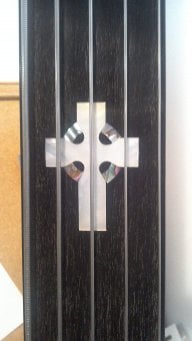
I'm considering having a luthier add tiny dots to my fingerboard of my Double Bass. Maybe at the 7th fret, 12th, 17th, and 24th. Please don't report me to the admins. Whatcha think?
IMHO I would take some time for practicing position and shifting. Musclememory is the way to go in my opinion and you will profit in the long term much more then from visual hints. Please don't report me too for that answer.

But i would stay away from dot inlays, i think you would regret it at one point for the reasons other members mention above.
 
Last edited:
  • Like
Reactions: Michael F Clef
IMHO I would take some time for practicing position and shifting. Musclememory is the way to go in my opinion and you will profit in the long term much more then from visual hints. Please don't report me too for that answer.

But i would stay away from dot inlays, i think you would regret it at one point for the reasons other members mention above.

I use stick-on dots because to make up for my own deficiencies (not practicing enough). I believe Edgar Myer has dot inlays (or did on his performance bass for a long time), but I'm pretty sure he doesn't need them! I haven't read anything on the history of his bass.
If I switched to an E-flat neck then I'd really be in trouble. 😄