• TalkBass has been independent since 1998. Add your voice.
    Create a free account to reply to discussions, view embedded media, and browse with fewer display ads.
    Join freeLog in
    Want zero display ads or expanded classifieds tools? Compare plans.

Double Bass To Dot or not to Dot? That is the question.

I don't much like the idea of permanently embalming the Januray 2025 setup forever in my fingerboard.
1737137101676.jpeg
 
i dont recommend dots unless you are a classical soloist playing alot in the upper register. if you really do want some sort of marker, you can mark the side of the neck with a pencil for a temporary marking. it can then be rubbed off when you feel like you no longer need/want it. in addition, i am also just not a fan of the look of the dots and prefer the look of a clean fingerboard.
 
  • Like
Reactions: Michael F Clef
I use a bronze metallic Sharpie to make small dots in a couple spots (octave, high B, and high D on the g string) on the front of the board and 5th “fret” on the side of the board. It lasts about 2 months before needing to be reapplied and can be wiped off anytime with some spit on the thumb.
It's been probably 15 years since I seriously played electric bass. There are multiple competing systems for position nomenclature on the bass, and I can't remember any of them (I know where all the notes are, my brain skips past terms like "3rd position"), so if I need to describe a location like that I either mention the name of the note on the G string that would be played there, or I just fall back to frets. To be honest, I've also forgotten what's under the frets above about 12, though, so now I'm hopeless.
 
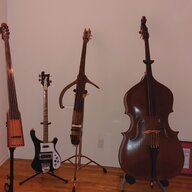
Confession time: I put a pencil mark on the side at every semitone position on my acoustic upright bass, at the first 12 positions. I put a small dot of white paint on the side of my Yamaha Silent Bass EUB in the first 7 positions, and white paint dots on the fingerboard between the D and the G strings at the next 7 positions.

I started playing late in life (age 61, about 8 years ago). I don't play thumb position at all, other than just goofing around. The marks help me stay in tune. When I was less experienced, I looked at the neck a lot. At this point, when I notice I'm a little out of tune I glance at the neck and adjust based on my visual reference. Some of the side dots have worn off my EUB, but I haven't felt the need to replace them yet.

Before I picked up the upright, I played fretless bass guitar, with lines. I've fallen out of practice, so now I have trouble staying in tune even with the visual aid. When I occasionally play bass guitar recently, I alway use one with frets, and isn't that why they invented the bass guitar?

Do I have an unhealthy dependency? Maybe, but I get to play in a variety of ensembles and do my job, hitting the right note at the right time almost all the time.
 
There is one tiny dot at the 5th fret on the side now. But I'm considering adding them to the front. I don't think it would bother me if the intonation changes slightly due to string changes, as I rely on my ear anyway for precise tone, I just need a general target to shoot for.

Use temporary dots of some kind. Put 'em on the side. Once you start "knowing" the hand positions the dots will be less important. You can always leave them on anyway. A DB should be ... clean-looking... and I will put a dot or two on the positions past 9th "fret", as I don't spend as much time in the higher end as I do down low. But when I practice, I try to NOT put the dots on, because I need to become fluent on that song where I go up the fingerboard. AT the gig though, just for confidence, I'll put a dot here or there, just as a reference. Do whatever aids you in the moment. Enjoy that DB!
 
  • Like
Reactions: Michael F Clef
Use whiteout and add the dots to the side of the fingerboard where basically only you will ever notice them.

Also, whiteout will not damage the wood. So you never, ever need to google whiteout on ebony at work without the safe filters on. That is unless you would like to talk to HR. Don't ask me how I know.
 
  • Like
Reactions: Michael F Clef
Confession time: I put a pencil mark on the side at every semitone position on my acoustic upright bass, at the first 12 positions. I put a small dot of white paint on the side of my Yamaha Silent Bass EUB in the first 7 positions, and white paint dots on the fingerboard between the D and the G strings at the next 7 positions.

I started playing late in life (age 61, about 8 years ago). I don't play thumb position at all, other than just goofing around. The marks help me stay in tune. When I was less experienced, I looked at the neck a lot. At this point, when I notice I'm a little out of tune I glance at the neck and adjust based on my visual reference. Some of the side dots have worn off my EUB, but I haven't felt the need to replace them yet.

Before I picked up the upright, I played fretless bass guitar, with lines. I've fallen out of practice, so now I have trouble staying in tune even with the visual aid. When I occasionally play bass guitar recently, I alway use one with frets, and isn't that why they invented the bass guitar?

Do I have an unhealthy dependency? Maybe, but I get to play in a variety of ensembles and do my job, hitting the right note at the right time almost all the time.
Who's to judge "what" you do! You are playing bass!!! That's the best, no matter what accommodations you use to keep going at it!
 
Good point. What is the conventional terminology when referring to a fret position in the Double Bass?
People will sometimes talk about positions but there are different systems for positions on the bass and I don’t think it’s very useful. Saying the D on the G string works or just say the 7th fret because people will know exactly what you mean.

Nothing wrong with how you phrased your question imo, was just replying tongue in cheek because sometimes people get strong reactions when asking questions that sound like you may be approaching the DB like a bass guitar.
 
I used to be adamantly opposed to any dots on my DB fingerboard, mainly due to ego. Then I realized that as much as I would love to spend all my time practicing so that I had inherently perfect ear-muscle coordination in even the worst conditions, I just didn't have the time to be "that guy". I was having other work done on my bass and decided to have dots added to the octave and 5th above octave (19th "fret") positions.

No, I didn't suddenly become Edgar Meyer, and I don't spend much time up there, anyway, but it certainly didn't hurt anything (ego included), and the octave position does come in handy at times. I've never felt the need to have more than that.

If it helps a working player play better right now, then go for it. Not everyone had the privilege of growing up with a DB and spending their entire youth learning to play to a pro level without aide. Whether the dots actually make you better is debatable (probably not if they become a crutch), but if they inspire confidence for you to take more chances and play at higher level, then why not? In the end, it comes down to that ear-muscle coordination, and that still takes a lot of work.
 
Good point. What is the conventional terminology when referring to a fret position in the Double Bass?


I've heard references to half tone, half step instead of "fret"...

For people among us who also play fretted instruments, fret works. A very large number of double bass players also play bass guitar, acoustic bass guitar and uBass, many which are fretted. There are also double bass-like bowed instruments which do have tied gut frets and are occasionally discussed here, so there's also that.

The normal double bass player gut reaction is revulsion -- I think most of us would shudder to have frets installed on our double bass fingerboards, although there may be some folks who have worked that out. The complex arch-and-relief geometry of a double bass fingerboard and a 3/4 or 4/4 mensure would probably not work with conventional fret wire, so it would be complicated -- string choices and build geometry would probably have to change in order to make things work.
 
Good point. What is the conventional terminology when referring to a fret position in the Double Bass?
I’d go with intervals or note names, there are too many position-naming systems. I do occasionally use fret numbers, but I try to put those in quotes.

I’m not an anti-dot purist (I actually do have them on my bass and find them useful), but I do caution the use of them because dots will never tell you where a note is exactly (due to musical context or setup, plus the placement of notes changes a little bit on each string) and without a developed ear or muscle memory the brain will kind of default to what “looks” in tune rather than what actually is in tune. My usual suggestion is to wait until one has developed their ear and can hear when notes are out of tune before adding any visual markers.

If you do want them, definitely use something like pencil, whiteout, or nail polish, which all can be fairly easily removed, rather than something permanent.