• TalkBass has been independent since 1998. Add your voice.
    Create a free account to reply to discussions, view embedded media, and browse with fewer display ads.
    Join freeLog in
    Want zero display ads or expanded classifieds tools? Compare plans.

Double Bass To Dot or not to Dot? That is the question.

IMHO I would take some time for practicing position and shifting. Musclememory is the way to go in my opinion and you will profit in the long term much more then from visual hints. Please don't report me too for that answer.

But i would stay away from dot inlays, i think you would regret it at one point for the reasons other members mention above.

Practically, the only time I ever use them is when I am playing in the orchestra and am having trouble hearing myself or need to be right on pitch for an exposed entrance. Listening and muscle memory will get you farther in the practice room and in almost all playing situations.
 
I would love to ask Mr. Meyer if he ever used "dots" in his early study of the Double Bass...and, as a follow-up - would he recommend their use for a beginning/intermediate DB student?
I wondered that myself. I always assumed he just liked that bass and it happened to have dots put in by someone previously. He was likely not concerned about someone questioning his ability due to that detail.
I mostly use the dots for big jumps or when I'm feeling a bit off. It's funny how once you get going you just start hearing and feeling instead of looking.
 
I would love to ask Mr. Meyer if he ever used "dots" in his early study of the Double Bass...and, as a follow-up - would he recommend their use for a beginning/intermediate DB student?
Just sayin'.
Sheesh.
The earliest videos of Edgar I can find where he has dots are from around 2000. I’m pretty sure he doesn’t have them on the Uncommon Ritual album cover (1997), but the lighting’s not focused on his fingerboard so I can’t say for certain. During the Work In Progress era (1990) though there are definitely no dots to be found on his bass, so it was something he did well into his career.

I again want to reiterate that I’m not anti-dots all (and I have had them on my bass at various times), but I do think they’re best employed after developing one’s ear and once some sense of tactile familiarity has been established. No dots are ever in tune because small changes in setup, strings, and even what part of the finger is stopping the string affect where notes lie on the fingerboard, and for me they’ve always been more of a way to impose a kind of “grid” onto the fingerboard where if I look at my fingerboard I can get roughly in the ballpark for pretty much any note. In actual performance in an orchestra or in a pit (with less than ideal lighting), my visual attention is much more focused on looking at the music, conductor, principal, concertmaster, principal cello, etc. and I end up barely looking at my hands anyway.
 
Dots again.... lol.

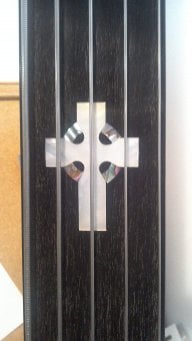
I'll chime in and say that the main, perhaps only, reason embedded dots are not standard on fretless string instruments, is that the fingerboards need to be dressed and so they become a problem for luthiers to deal with during that process. Also, for the luthiers putting them in, they'll know that in a few years all that work will be planed out, so why bother?

Meanwhile for fretted instruments, the dots appear, because they are safe from wear and maintenance. They became elaborate artwork, where builders show off their creative designs, and these designs are protected from wear by the frets. Even a regretting won't harm the beautiful artwork made of mother of pearl or similar material.

The presence or absence of this art, has almost nothing to do with players finding their notes.

However, look at electric guitar players playing, this easy to play small instrument with frets to give them their intonation, and many often stare at their fingers when soloing. Are they bad players for doing so? (jokes can go here... but really...)

It doesn't matter if the music sounds good.

So put dots in, or don't, no once cares but you.

The main goal is that the sound coming out is good to your ears.
 
The earliest videos of Edgar I can find where he has dots are from around 2000. I’m pretty sure he doesn’t have them on the Uncommon Ritual album cover (1997), but the lighting’s not focused on his fingerboard so I can’t say for certain. During the Work In Progress era (1990) though there are definitely no dots to be found on his bass, so it was something he did well into his career.

I again want to reiterate that I’m not anti-dots all (and I have had them on my bass at various times), but I do think they’re best employed after developing one’s ear and once some sense of tactile familiarity has been established. No dots are ever in tune because small changes in setup, strings, and even what part of the finger is stopping the string affect where notes lie on the fingerboard, and for me they’ve always been more of a way to impose a kind of “grid” onto the fingerboard where if I look at my fingerboard I can get roughly in the ballpark for pretty much any note. In actual performance in an orchestra or in a pit (with less than ideal lighting), my visual attention is much more focused on looking at the music, conductor, principal, concertmaster, principal cello, etc. and I end up barely looking at my hands anyway.
I am mainly curious about his VERY EARLY study of the DB, not his eventual mastery of the DB.
Just curious...
Thanks.
 
Last edited: