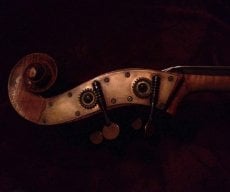
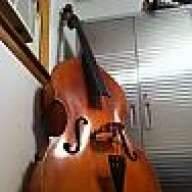
Hey! I also have a "beat to hell" 49! She's amber-colored, with the original black-painted hardwood fingerboard.
Regarding the pro's and con's-- there are a ton of threads that go over this in great detail, so I'll just sum up *my* experiences.
Pro's:
* Excellent tone and response, for a plywood instrument. My section's principal chair continually compliments the tone of my Kay in our orchestra
* Thin neck makes walking jazz and blues lines a breeze
* Not particularly picky about strings-- I'm using low-tension Spirocores (set-up by Mike Shank at Shank's Strings in Elizabethtown, PA) with surprisingly-versatile results.
* Pretty low-maintenance. I've never had to use a humidifier in my apartment, and my bass went nearly 20 years without any major maintenance. Only last year did I have Mike re-glue my fingerboard and the laminates.
Having owned a Kay for decades, this was sure not my experience. Assuming one is using "proper" left-hand technique, which I would argue is what really makes playing in any genre most efficient, the thin neck profile generally leads to left-hand fatigue. That's true whether you play classical or jazz. That is, unless you let your left hand collapse into the baseball-bat hold.

As for being picky about strings, I always found my Kay to have a pretty narrow "acceptance range." As for the sound, well, yes, it's purely a matter of opinion but compared to ply instruments that I consider to be of a higher level, I wouldn't characterize Kays as having "excellent tone." Sure, some are better than others. In terms of "higher level," I'm thinking about New Standards, Uptons, and some Shens.
I like ALL the basses I've met! The one thing a good Kay has is sound quality...I've side by side sound tested my 49 Kay against several Upton plys and it wasn't even close...the Uptons sound "new" and all any of us can figure is that it's simply the age and type of plys used...I love Uptons! Drub is on point with all he said but there's an aged element to the sound that only time can provide...
As I've posted here many times, I believe the "age effect" is largely a matter of bias and myth, even among carved basses. A brand new carved bass does seem to undergo a substantial period of change from birth to a matter of months and, perhaps, over the first year or two. After that, meaningful changes
might occur across decades. With a carved bass, the character and voice that are present at the beginning are essentially what one will have for its lifetime. Time does not transform a mediocre instrument into a fine one. This is why buyers are advised not to buy a new bass, the sound of which they are not particularly satisfied, while hoping that it will improve with time. Skilled builders can create brand new double basses that have a sound characteristic of what we typically associate with older instruments. That certainly applies to Upton's carved offerings. My own bass at one week old sounded "older" than many basses that were actually decades old. If you want a great first-hand example of this, go and play their Brescian. I'm not dismissing age as a factor. Rather, I'm suggesting that its effects are often overblown.
So much for carved basses. There has been considerable debate as to whether age is a substantial factor in the sound of ply basses. This is difficult to evaluate. Sure, vintage Kays do sound different than their younger counterparts and different than their Engelhardt facsimiles. The question is whether those vintage Kays sounded essentially the same when they were new.
Even conceding that time is a meaningful variable in the sound of old Kays, I've played more Upton, Shen, and other plys than I can count in the very same space as vintage and new Kays and Engels. Not once did I prefer the sound of a Kay. Not once. Okay, it's just a matter of opinion. If you especially like the thump and short sustain of a Kay, then I can understand why you'd prefer it to, for example, one of the pricier Upton plys. To my ears and hands, the Uptons played more like a carved bass than did the Kays. That, right there, explains why I preferred them. I suspect that the ply basses I preferred could be tweaked to sound like a Kay more successfully than the other way around.
There is certainly no right and wrong here. These are matters of preference. There are, however, certain shared and general "standards." That's demonstrated by the fact that experienced players will often broadly agree on what is a good DB sound. Among basses judges as such, there are certainly nuanced preferences but, overall, I think there is fair agreement such that it's not arbitrary.