• TalkBass has been independent since 1998. Add your voice.
    Create a free account to reply to discussions, view embedded media, and browse with fewer display ads.
    Join freeLog in
    Want zero display ads or expanded classifieds tools? Compare plans.

Tone cap question ?

cornfarmer

jam econo
Supporting Member
May 14, 2002
1,986
3,839
I basically rewired a bass today and to my memory I don't remember it being a dark sounding bass but maybe I'm brain fried from being hunched over it for a few hours. It just kind of sounds like the tone is rolled off a bit even with the tone pot at max if that makes sense. The pots are 250k, possibly the originals AFAIK (this is a '70s Japanese bass).

The rewire kit I bought included a new .022uF Orange Drop. The old cap is pictured below, and not really being a expert, how do they compare? (more below)

og.jpg


I'm pretty sure I can't reuse the old one because the legs are pretty much gone. I found this one below in my stash and it could work but don't know it's specs either:
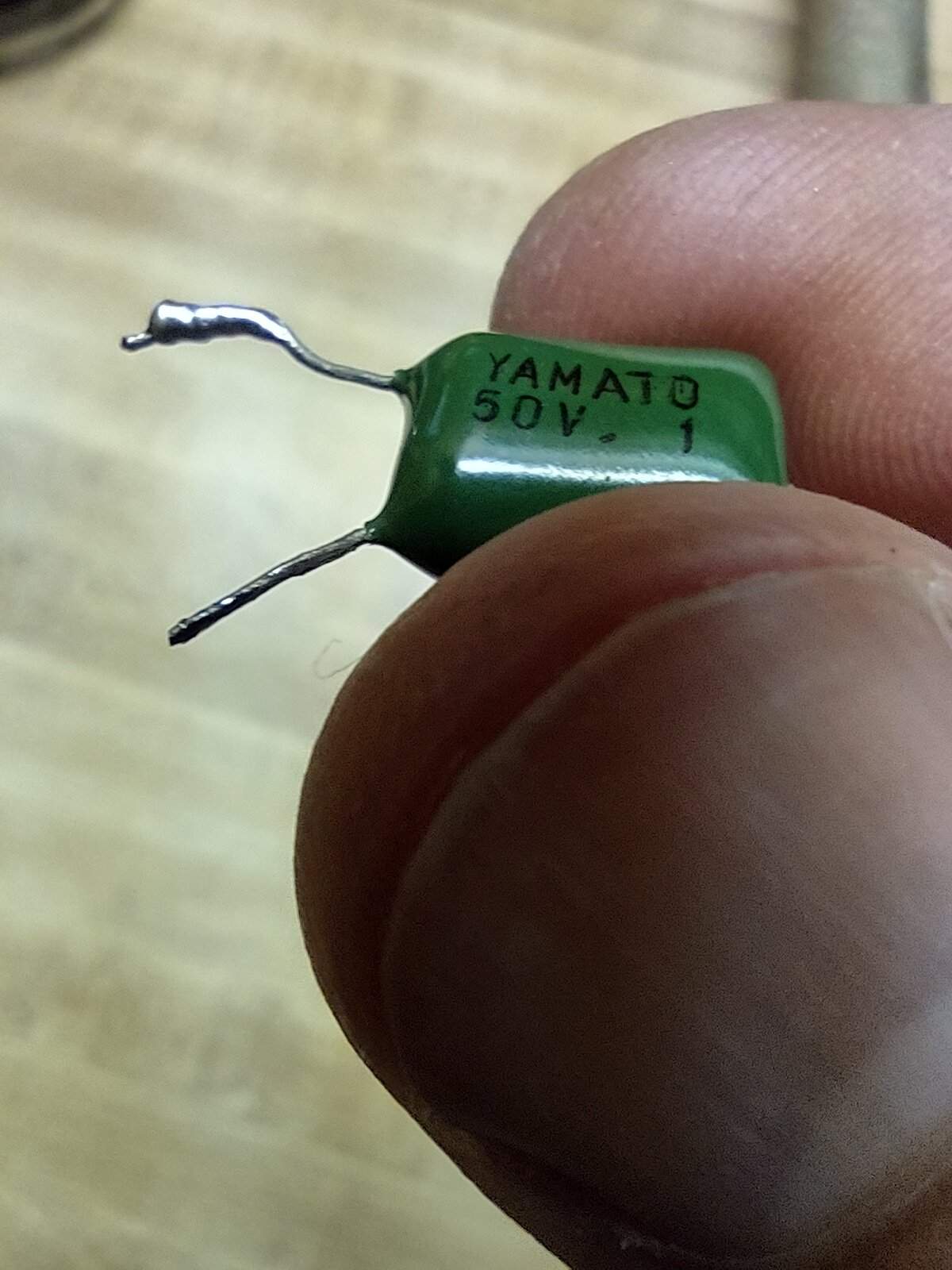
yama.jpg


Are either of the green ones better than the Orange Drop I just put in? - i.e. I'm wondering if either one won't roll off as much high frequencies.

 
Are either of the green ones better than the Orange Drop I just put in?
Material wise there's little difference except for colour, orange/green both basically poly capacitors.

Green cap you pictured , 503 = 0.05uF; very close to today's standard of 0.047uF used for P-basses. The 'K' stands for 10% tolerance.

By rights your new 0.022uF cap should make your bass brighter.
 
From what I understand, if the tope pot is on 10 (bright) the tone capacitor effect on the sound is minimal. While, if one really tries, he can hear the difference between if there is a capacitor or not (no load pot), However, with the pot at 10, imo, the difference between 0.022uF and 0.05uF, for practical purposes, is negligible. 0.022uF cap is usually for guitars. Bass typically has 0.047uF ( 0.05uF is basically within the 10% tolerance and can be considered the same as 0.047)
 
As stated, the .022uF cap won’t reduces the high end as much as what is considered common for bass, which is .047uF.

As for the other green cap you found in your stash, I can’t tell the value. If you have some jumpers, you could clip in in place and try it. If it seems to be another .022uF cap by the amount of high end it rolls off, you can put it in parallel with the known .022uF cap to get to .044uF, which would be plenty close enough to .047uF to function essentially the same.

Now to why it seems the bass is darker after you did the rewire; there’s not much that could cause that other than a cap. If the cap in the rewire kit is mis-valued and is actually a .22uF, that could affect the tone a little even with the tone pot on 10. Another possibility is if the tone pot got too hot during soldering and is conducting as if it’s set on something other than 10. There’s the possibility you have things reversed and the pot set on 10 is max treble roll off, but I think you would have discovered that. I’d de-solder one leg of the cap you have in place, get some jumpers with mini grabber clips and do some experimenting with what you have.
 
You can buy good quality poly film +/-10% caps for around 22 cents each at electronic shops or e.g. ebay. Just checked the last batch I bought (68nf & 100nf) were axial vishays rated up to 250v have nice long thick leads and are not large and cause things to get crowded in the control cavity. The brand is not important, +/-10% tolerance or better is what to watch for. If you have a multi-meter which can read capacitance, always good to check them so you know what you actually like/prefer in the end.

This - rather excessively long for this topic - youtube video can give you an idea what effects the different values can have:


Since uf was mostly used above: 68nf = 0.068uf

Caps rated for 100-250v are not required, but tend to be easier to solder... smaller voltage values would work just as well, with higher values above 250v the size of the cap can get a bit big for cramped control cavities.

If you want to get a couple of different values & test before you solder, small alligator clips are your friends (clip one capacitor leg to the pin on your tone pot and the other to any ground point).

-Henry
 
Last edited:
  • Like
Reactions: C0YS
Does the cap leg location come into the equation? I noticed one of the old cap legs was attached to the ground/sleeve of the jack instead of the flat/back part of the tone pot.

I put the new orange drop on the typical middle lug and flat spot, according to most of the wiring schematics I looked at.
 
Does the cap leg location come into the equation? I noticed one of the old cap legs was attached to the ground/sleeve of the jack instead of the flat/back part of the tone pot.

I put the new orange drop on the typical middle lug and flat spot, according to most of the wiring schematics I looked at.

Nope, does not make a difference, ground is ground. You are shunting the cap specified frequencies via the cap to the common ground, where that happens is irrelevant.

To which pin on the volume pot(s) you attach the tone pot wire to (or the cap if you are using the cap as the lead between the pots and the tone pot directly to ground), can cause the pots to interact differently with each other. Modern wiring is normally to the input of the volume pot.

-Henry
 
Last edited:
Material wise there's little difference except for colour, orange/green both basically poly capacitors.

Green cap you pictured , 503 = 0.05uF; very close to today's standard of 0.047uF used for P-basses. The 'K' stands for 10% tolerance.

By rights your new 0.022uF cap should make your bass brighter.
Yeah. Like, all the way down would be not much of a noticeable change in tone
 
Does the cap leg location come into the equation? I noticed one of the old cap legs was attached to the ground/sleeve of the jack instead of the flat/back part of the tone pot.

I put the new orange drop on the typical middle lug and flat spot, according to most of the wiring schematics I looked at.
I put my caps on the right. Where all my grounds go. I put the hot in the center pin of the tone pot
 
Does the cap leg location come into the equation? I noticed one of the old cap legs was attached to the ground/sleeve of the jack instead of the flat/back part of the tone pot.

I put the new orange drop on the typical middle lug and flat spot, according to most of the wiring schematics I looked at.
In some instruments the body of the pot is not connected to the ground. However if this was your case, the tone control would have simply not work and remained fully bright regardless. To put all doubts to side, simply remove the cap and see if the bass is still dark. Perhaps you need to change strings?
 
@cronfarmer

I just re-read your first post, am I understanding correctly, you installed a new .022uF cap (a value often used for E2 guitars with humbuckers to keep them brighter) and you are finding the bass much darker than before/too dark? (sorry, I was concentrating on your other questions).

0.022uf should be shunting less higher frequencies to ground than your old 0.050uf cap.

Do you have a multi-meter which can measure capacitance? or take a picture of that orange drop you installed on the side with the part number etc? ... I'm wondering if you received a 0.22uf (I have been sent the incorrect values in the past)... but even that should not be affecting your tone pot that drastically when fully open (non "no load" pots normally allow a tiny bit through when open).

It is possible to overheat & damage a pot with a low watt soldering iron when trying to heat up the pot casing sufficiently for a ground connection (or with a high watt if heated too long), you can check by playing with the pot *fully* open & then disconcerting the tone pot lead to the volume pot, play again and see if there is a difference, it should be minimal.

-Henry
 
  • Like
Reactions: cornfarmer
The new cap is pictured below. When I decoupled it from the tone pot, the bass sounded much brighter obviously. With it in the circuit I feel it is rolling off too much highs even with the pot wide open. The other 2 green caps sounded similar.

Suggestions on a different cap value that's somewhere in the middle?


IMG_20230612_132959213.jpg
 
  • Like
Reactions: HHudson
This is 0.022uF cap.... That is pretty minimal tone cap for a bass. If that with the pot fully open makes it sound too dark, I think your bass has other problem. I would look into that pot. Perhaps pot value is too low for the pickups you have. On a passive system the pot should be 500k... Maybe 250k at a minimum.
 
So I went and got a few caps from the local electronics place to experiment, ranging from .01 to .047uF..........tested the .015 and .01 which were pretty identical, so I just left the .01 in. Both of those values made the bass sound like it did before, i.e. brighter/clearer w/ the tone wide open, which I'm happy about. SUCCESS! The pots are what were in it when I bought it, both @ 250k, I'm not exactly sure if they're original to the bass.

If anyone is curious, here it is....it's an old Conrad Bumper, i.e. Dan Armstrong copy. Did some customization to the headstock, pickguard and bridge. It's a goofy and heavy little short scale but it sounds pretty boss.

IMG_20230612_161851963_HDR.jpg
 
@cornfarmer

"I went and got a few caps .... which I'm happy about. SUCCESS!"

Super & +1 , playing with cap values is worth it. I'm glad you got it sorted!

Either those PUs are very dark or you like it really bright (which is fine :D) with the value you chose.
Your bass looks cool, may I ask how much that bass weighs?

BTW: as kgbeast said above, that is a 0.022uf cap they sent you, so as advertised.
https://www.cde.com/resources/catalogs/716p.pdf

-Henry
 
@HHudson

It's 10lbs. Lucite/acrylic is heavy stuff. I don't know why this bass sounds so dark, with the cap out of the circuit it sounded totally not dark. I'm thinking it's the tone pot, which may have gotten a little cooked throughout the process. It's on par with any vanilla bass tone wise, it's not a sizzling nasty tone like a Stingray.
 
  • Like
Reactions: HHudson
@HHudson

It's 10lbs. Lucite/acrylic is heavy stuff. I don't know why this bass sounds so dark, with the cap out of the circuit it sounded totally not dark. I'm thinking it's the tone pot, which may have gotten a little cooked throughout the process. It's on par with any vanilla bass tone wise, it's not a sizzling nasty tone like a Stingray.

Thanks for the feedback @cornfarmer , that is actually fewer pounds than I feared it would be :D. I tried a Lucite guitar once (many years ago, long before my back became 60+) the thing that really stuck in my mind to this day was the weight.

Pots are actually a bit more robust than often feared... but I have cooked one in the past myself when I couldn't find my usual iron that I use for that purpose and was simply not patient enough to look hard enough.

If you should decide to swap out the old tone pot *and* you liked the tone without the tone pot in the circuit, you could use a "No Load" pot. When completely open, it is 100% out of the circuit. If you are Sateside/Canada you should be able to source the CTS version easily, but are available in e.g. the EU/UK too. The Fender branded ones are CTS, but cost a little bit more normally for the added "F" on the packaging. Though do check your old one beforehand and get the same shaft type for your knobs, makes life much easier.

Cheers
Henry
 
Last edited:
  • Like
Reactions: cornfarmer