• TalkBass has been independent since 1998. Add your voice.
    Create a free account to reply to discussions, view embedded media, and browse with fewer display ads.
    Join freeLog in
    Want zero display ads or expanded classifieds tools? Compare plans.

Tone to keep chords and arpeggios clear?

The vast majority of my playing time has always been unplugged, unamplified. I have an embarrassingly low level of skill in setting EQ and such, just because I so rarely get to do it.

Anyway, plugged in yesterday and tried playing some chord melody stuff. Unplugged, it sounds great. Amplified, it almost immediately becomes a muddy swamp.

My solution was to just kill bass and low mids, which worked, but I'm sure there are more elegant solutions. [Using my new Boss Katana 210, if that helps]
 
There’s no best settings but those mids generally may help with definition.
Lots of us grab a bass and play unconnected once in a while so I’m not going to say it’s wrong. But you’re going to miss a lot of the nuanced tones when you do it. Even if you have to play at low volume you’ll get a lot more out of practicing amplified because it is an electric instrument. What you’re describing sounds like the curve of not being used to amplification. You’re hearing all the other parts. Recommend plugging in more often.
 
The vast majority of my playing time has always been unplugged, unamplified. I have an embarrassingly low level of skill in setting EQ and such, just because I so rarely get to do it.

Anyway, plugged in yesterday and tried playing some chord melody stuff. Unplugged, it sounds great. Amplified, it almost immediately becomes a muddy swamp.

My solution was to just kill bass and low mids, which worked, but I'm sure there are more elegant solutions. [Using my new Boss Katana 210, if that helps]

You’re on the right track. This is where a couple PEQ bands come in handy. Do a boost (…or cut!) and sweep and attenuate the masking frequencies.

Riis
 
  • Like
Reactions: Bassaga
Man I think that's gonna be more about technique than EQ.
Specifically, probably (a) plucking much harder than necessary (so the bass can be heard unplugged) and (2) not having learned how to mute unplayed strings, the importance of which wouldn't be noticeable when playing unplugged.
 
I'm firm believer that practicing like you gig: standing and plugged in
learning how your amp responds to your technique is fundamental.

unplugged can be useful for figuring out stuff and getting a feel for what your body and fingers needs to do
but the physical things you have to do to be audible are useless or worse once you plug in

perhaps the best tone is turn up and pluck lightly
 
Man. I've seen threads about playing unplugged that had fewer replies about playing unplugged.

For what it's worth, I agree with all of you. It's definitely been detrimental to my technique. But it's how I've needed to do it most of the time. I guess owning a 2x10 is partly my way of expressing an aspiration to get louder at some point.

Anyway, was mostly wondering what people do to get a functional tone for chords (chord melody in particular, as long as we're recalibrating the conversation)
 
  • Like
Reactions: Alan Ace Cooper
. But it's how I've needed to do it most of the time. I guess owning a 2x10 is partly my way of expressing an aspiration to get louder at some point.

Anyway, was mostly wondering what people do to get a functional tone for chords (chord melody in particular, as long as we're recalibrating the conversation)

Can you not get loud at your place or something like that? Opt for headphones if so. Turn up and get to know your tone. A huge part of bass playing is muting properly.

As far as all of the chordal stuff, low action is gonna help more than any tonal changing stuff at first. Keeping the EQ flat is a good place to start, but more than anything, if you crave playing chords more than grooving single notes that often, then you may wanna give guitar a go.

I like flashy bass stuff as much as the next guy (Oteil Burbridge’s chords come to mind), but that stuff is a bit more rare for a good reason.
 
The vast majority of my playing time has always been unplugged, unamplified. I have an embarrassingly low level of skill in setting EQ and such, just because I so rarely get to do it.

Anyway, plugged in yesterday and tried playing some chord melody stuff. Unplugged, it sounds great. Amplified, it almost immediately becomes a muddy swamp.

My solution was to just kill bass and low mids, which worked, but I'm sure there are more elegant solutions. [Using my new Boss Katana 210, if that helps]
Actually you don't want to kill the low-mids. The low mids are what gives your bass presence and definition when playing with a group. It doesn't take much. I usually boost my low mids anywhere between 250Hz and 500Hz and only boost them to 1:30 using my passive Jazz Bass. If you boost it too much your sound will honk at you. If that happens just reduce the boost until the honk goes away. I typically keep the rest of my EQ settings flat.

Also, you cab is going to have a HUGE influence on how clear and articulate you sound. I have a couple of DNS cabs (210 and 410) by DNA and they are the clearest most articulate cabs I've ever heard. You can very distinctly hear each note of a 3-note bass chord. One cab I used to have was a GK115bpx and it was the boomiest, muddiest, cab I've ever heard. Had to drop the bass EQ down to 10 o'clock to clear up the mud and then good luck with chords. Bear in mind that is the bottom end of GK cabs and I have played through some of theirs that were night and day better sounding.
 
  • Like
Reactions: BOOG and Les Fret
The vast majority of my playing time has always been unplugged, unamplified. I have an embarrassingly low level of skill in setting EQ and such, just because I so rarely get to do it.

Anyway, plugged in yesterday and tried playing some chord melody stuff. Unplugged, it sounds great. Amplified, it almost immediately becomes a muddy swamp.

My solution was to just kill bass and low mids, which worked, but I'm sure there are more elegant solutions. [Using my new Boss Katana 210, if that helps]
Less strings on chords. 2 max, and either stay of the E string, or only hit the E and G

Arpeggios, play them slower, and cleaner. Arpeggios are just single notes. If you can't string single notes together cleanly, you need to play them slower so you can.
 
The vast majority of my playing time has always been unplugged, unamplified. I have an embarrassingly low level of skill in setting EQ and such, just because I so rarely get to do it.

Anyway, plugged in yesterday and tried playing some chord melody stuff. Unplugged, it sounds great. Amplified, it almost immediately becomes a muddy swamp.

My solution was to just kill bass and low mids, which worked, but I'm sure there are more elegant solutions. [Using my new Boss Katana 210, if that helps]
technique is the more reliable fix in this situation. for chords, play open chords-- not to be confused with open position chords on guitar. What this means is that the lowest and highest note are separated by more than an octave. Maintaining this large separation between your bass note and the higher notes will keep the tone clearer. If you play close position chords where the separation is less than an octave, especially in the lower registers and on lower strings, they are more likely to sound like mud. Fewer notes in your chords is also the way to go.

For arpeggios, assuming you are maintaining good separation between notes, it shouldn't be any different from normal playing.
 
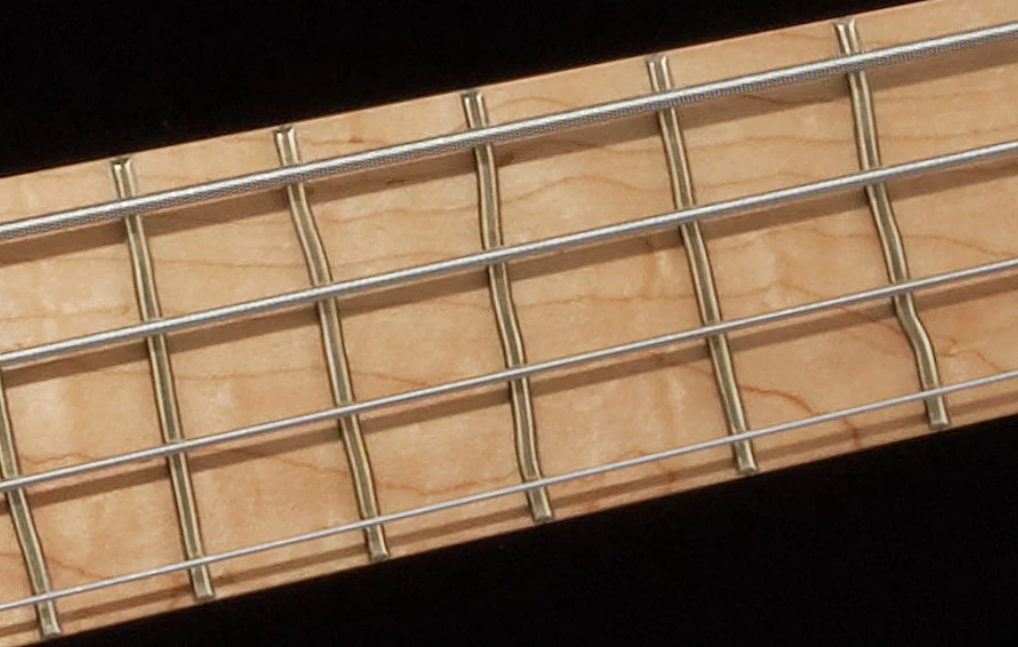
Perhaps you need true-temperament frets... Good luck.

ae1HxQs.png
 
The vast majority of my playing time has always been unplugged, unamplified. I have an embarrassingly low level of skill in setting EQ and such, just because I so rarely get to do it.

Anyway, plugged in yesterday and tried playing some chord melody stuff. Unplugged, it sounds great. Amplified, it almost immediately becomes a muddy swamp.

My solution was to just kill bass and low mids, which worked, but I'm sure there are more elegant solutions. [Using my new Boss Katana 210, if that helps]
Chords on bass will always be muddy in a bad way, if you play at the low end. Arpeggios are the same, if you have two notes at once. Play higher up the range or keep to your top-heavy EQ. I play two mud-free notes at once sometimes, but they are open E or A and the same eighth away from each other, or root and 3rd or 5th both above fret 12.
 
Last edited:
My suggestion would be to start out with your eq flat, then do your thing, adjusting your playing style until you get as close as you can without touching the eq. This may mean softening your touch and/or moving your plucking hand to a position that sounds right, also paying attention to what works and what doesn't. Once you get close, then start mucking around with eq.
Now the hard stuf..
You're more than likely gonna have to unlearn a your technique. Good players have a symbiotic relationship with their gear, and considering that you've mostly learned unplugged, you don't. Playing amplified is important because, well.. like others have stated, your bass is an amplified instrument. You need to know how to play amped. Incorporate headphones into your practice routine if playing amplified is not an option.
Wrt to eq voicing.. eq is always the last step to toan. Everything that comes before it (thought, fingers, strings, pickups, pedals, preamp, room dynamics) will have bearing on how the eq needs to be adjusted. So looking at eq as a solution to your problem won't yield the results your looking for.

Play closer to the bridge, avoid anything lower than fourth position for chords. Once there, adjust eq accordingly. Most likely a slight cut to lows and a slight bump in low mids.
 
  • Like
Reactions: lowplaces
Why do people talk all the time about bass players playing only one note? There is a very real reason. I'll explain.

There is a concept called "low interval limits" - when you try to play an interval (an octave, a fifth, etc) lower and lower, at some point, the result is mud. This is EXTREMELY relevant to playing bass. You can play unison notes anywhere and they'll sound good. You can play octaves anywhere, and they'll sound good. But a fifth, you will find that, in the lowest octave of your bass, they mostly don't sound good - towards the top of that octave, they start to sound OK.

A musical fourth (which is a closer interval), you need to go higher for it to sound OK. A third, even higher. Better gear will make a VERY small difference with this - the best rig on the planet might buy you another half step or two of acceptable sound for a given interval, as it has less intermodulation distortion - the issue with close intervals down low is that your ear is hearing intermod products, most of which it's making up itself; adding some from the gear makes the situation a tiny bit worse. As I said, the gear is a minor part of the equation - the best rig in the world won't get you past the fact that there is a floor under which you can't play a fifth, and have it sound good.

If you're trying to play chords on a bass, you are going to run into this - it is inevitable. Yes, you don't hear the problem unplugged, because an electric bass, when played acoustically, doesn't radiate much in the way of fundamentals - they are low enough that your ears aren't really hearing anything down there - you're just hearing harmonics. Plugged in, the fundamentals are there, and the problem is there. Turning off the bass in your signal will "fix"the issue, as you've figured out, but why would you play a bass and not want to hear bass? All the technique and the best gear in the world will not get you around this - it's something you need to learn how to work with.

We play an instrument that has limits, and this is one of them. In return for this limit, we get to play the thing that shakes the place (and gets people's butts moving). It's worth it.
 
Last edited:
As noted above, play near the bridge; use your bridge pickup and practice muting. You can definitely get there. And yes, it will be harder to make it sound good in the low range of your bass, but it is possible. Yes, amplification is a needed reference point (headphones or otherwise) to hone these types of parts, but there isn't anything wrong with practicing them unplugged as well IMO. But when you do, listen carefully, because the things that will make it sound bad amplified will be very difficult to hear unplugged.