Here's a direct comparison of a Tonedexter (V.2.01) wavemap made with an AMT 25b bass mic and the bass miked with the AMT 25b, recorded into Audacity recording software. Nothing added, nothing subtracted. Can you tell which is which?

Enjoy the benefits of a premium membership!
Upgrade Account
-
TalkBass has been independent since 1998. Add your voice.
Create a free account to reply to discussions, view embedded media, and browse with fewer display ads.
Join free Log in
Want zero display ads or expanded classifieds tools? Compare plans.
You are using an out of date browser. It may not display this or other websites correctly.
You should upgrade or use an alternative browser.
You should upgrade or use an alternative browser.
Double Bass Tonedexter vs. AMT 25b redux
- Thread starter statsc
- Start date
More options
Who Replied?
I'm listening on computer speakers, but I'm going to guess #1 Tonedexter, #2 mic.Here's a direct comparison of a Tonedexter (V.2.01) wavemap made with an AMT 25b bass mic and the bass miked with the AMT 25b, recorded into Audacity recording software. Nothing added, nothing subtracted. Can you tell which is which?
My guess is also 1 Tonedexter and 2 mic. In comparison #2 sounds like high resolution, while #1 let´s me think of a mp3 version, missing a bit of warmth and fullness. BUT the two samples are amazingly close.


Here's a direct comparison of a Tonedexter (V.2.01) wavemap made with an AMT 25b bass mic and the bass miked with the AMT 25b, recorded into Audacity recording software. Nothing added, nothing subtracted. Can you tell which is which?
IMHO they both sound pretty darn good. But I think 1 sounds a bit more open and natural. 2 sounds like it has an LPF on it. So I will guess 1 is the mic.
I know of no particular reason why the pickup should have less treble extension, but in my experience it is very challenging to get the high end of a pickup to sound natural. Perhaps with a bit of corrective EQ they could be even closer, but isn't this what the Tonedexter is supposed to do.
Or maybe I am guessing wrong.
In a real world playing environment, my experience with the AMT is it tends to pick up a lot of bleed from surrounding instruments. I found it unusable through an amp (very little gain before feedback) and also unusable next to a big band drummer. The bleed from the cymbals dominated in the mic. I felt the mic was rejecting the cymbal sound from the rear of the capsule, but the sound was reflecting off the face of the bass back into the front of the mic. This created sort of a flanging effect on the cymbals that was extra nasty.
1 Mic, 2 Dexter. There is a kind of frequency boosted sound piezo's have which I'm hearing, or imagining (!) in the 2nd example. The Mic has that acoustic warm wood sound where the attack of each note seems rounder.

I think most importantly this shows how close the Dex is getting! I believe the 2nd clip is the Tonedexter since I hear something in the low end that I hear with my wavemaps, maybe a hpf, or a slight compression, and I hear a little more naturalness (mic-likeness) in the first clip when you went up the g string a wee bit. But, overall it sounds pretty darn close! I'm liking the new firmware.
I'm thinking 1 is Tonedexter, 2 is mic.
Both sound very good. I think 2 sounds better. More clarity. So the real thing should be better right?
Another useful comparison is play the same bass line with the drums and piano backing tracks playing live over loudspeakers at good volume while you track. Then isolate the bass track and send it our way. That will be a difference.
Both sound very good. I think 2 sounds better. More clarity. So the real thing should be better right?
Another useful comparison is play the same bass line with the drums and piano backing tracks playing live over loudspeakers at good volume while you track. Then isolate the bass track and send it our way. That will be a difference.
Another useful comparison is play the same bass line with the drums and piano backing tracks playing live over loudspeakers at good volume while you track. Then isolate the bass track and send it our way. That will be a difference.
That what it is about! Will it sound right in the mix, with bleed from other instruments and amps in the mic sound vs the almost naked sound from the pickup/Tonedexter? While it is exciting to listen to this comparison, this is not the real life situation.
I did lend my Tonedexter to a fellow violinist, but I´ll get it back soon and am curious to check it with the updated firmware. I didn´t use it much in the past, because it was difficult to make percussion on the bass and slapping sound right.
My guess is 1 mic 2 dexter. 2 sounds better to me, but also a bit like an enhanced technicolor version of the real thing.
there’s a vast difference in how these clips sound on different speakers. Clip2 needs better speakers to be appreciated
there’s a vast difference in how these clips sound on different speakers. Clip2 needs better speakers to be appreciated
I'm guessing #1 mic, #2 tonedexter.
What pickup was used with the Tonedexter?
What pickup was used with the Tonedexter?
Fishman Full CircleI'm guessing #1 mic, #2 tonedexter.
What pickup was used with the Tonedexter?
I'm guessing #2 is tonedexter, and 1 is the mic. There seems to be just a bit more top end air in number one to my ears. It's amazing how close they both are though. The 2.0.1 really does sound better, and James has really made some great improvements from the first firmware versions.
I've had my Dexter for a couple years now, and I never gig without it. This thing is so great, to be able to have that mic tone from a pickup, without bleed and feedback headaches, and to be able to dial in more or less of either tone to cut through in certain rooms.
I've had my Dexter for a couple years now, and I never gig without it. This thing is so great, to be able to have that mic tone from a pickup, without bleed and feedback headaches, and to be able to dial in more or less of either tone to cut through in certain rooms.
True; nor was it meant to be. Besides the fact that there are no live situations to test this with now, creating recordings with other instruments in a live gigging situation involves all sorts of issues inherent when sound travels through air (room acoustics, bleed of other instruments, distance from the source, background noise, etc.). Although I've been using the Tonedexter in live situations for 2 years and thought it improved the sound of my bass, I had never actually tested how well it fulfilled its stated function, which is to "map" the sound of a microphone on to your pick-up so that your pick-up sounds like a microphone. So having some time on my hands, I thought that this would be a good way to directly compare the two in a controlled environment without the complications inherent in a live situation.While it is exciting to listen to this comparison, this is not the real life situation.
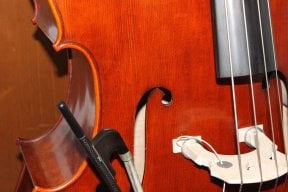
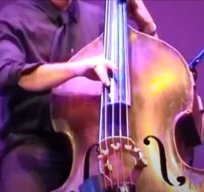
For this comparison, I used my mid-19th. century Tyrolean flatback strung with Spiro mittels and fitted with a Fishman Full Circle pick-up. The AMT 25b microphone was attached to the lower bout on the treble side positioned north/south slightly below the bottom of the f-hole and east/west about halfway between the f-hole and the string afterlenghs, about 5 inches from the top and pointing towards it. The mic was positioned the same for both the recording and for making the wavemap. The AMT 25b and the Tonedexter were plugged into separate channels of a Focusrite Scarlett Solo USB audio interface, connected via USB to a MacBook Pro and recorded with Audacity software on to one stereo track. The stereo track was then split into two mono tracks, one of the mic’s sound and one of the Tonedexter’s sound. Both tracks are exactly the same in terms of musical content and playing dynamics, and the room is not influencing the Tonedexter’s sound. The Tonedexter's character knob was set to CH2 (fully clockwise), which is the "raw" mic sound without any processing, and all EQ was set flat.
I think most of us would agree that the Tonedexter does a very good job at emulating the sound of a microphone, especially with this latest firmware upgrade (V.2.01). How that works in a live situation is of course another matter. Some folks pointed out the lack of "airiness" in the sample they thought was the Tonedexter, in comparison to what they thought was the mic. I'm not sure there's an algorithm for "airiness," but who knows! I think one would have to balance Tonedexter's lack of "airiness" with its superior feedback control and lack of bleed to evaluate its utility in live and studio situations. I've used Tonedexter in the studio before with good results; however, I think that a good engineer with access to good mics and the optimal acoustic environment and separation that a good studio provides can get better results. In a live situation however, for me the Tonedexter really shines!
Oh, BTW, Bass 1 is the mic; Bass 2 is the Tonedexter!
Thanks for doing this A/B, it was fascinating listening to each sample multiple times and figuring out the differences!
True; nor was it meant to be. Besides the fact that there are no live situations to test this with now, creating recordings with other instruments in a live gigging situation involves all sorts of issues inherent when sound travels through air (room acoustics, bleed of other instruments, distance from the source, background noise, etc.). Although I've been using the Tonedexter in live situations for 2 years and thought it improved the sound of my bass, I had never actually tested how well it fulfilled its stated function, which is to "map" the sound of a microphone on to your pick-up so that your pick-up sounds like a microphone. So having some time on my hands, I thought that this would be a good way to directly compare the two in a controlled environment without the complications inherent in a live situation.
For this comparison, I used my mid-19th. century Tyrolean flatback strung with Spiro mittels and fitted with a Fishman Full Circle pick-up. The AMT 25b microphone was attached to the lower bout on the treble side positioned north/south slightly below the bottom of the f-hole and east/west about halfway between the f-hole and the string afterlenghs, about 5 inches from the top and pointing towards it. The mic was positioned the same for both the recording and for making the wavemap. The AMT 25b and the Tonedexter were plugged into separate channels of a Focusrite Scarlett Solo USB audio interface, connected via USB to a MacBook Pro and recorded with Audacity software on to one stereo track. The stereo track was then split into two mono tracks, one of the mic’s sound and one of the Tonedexter’s sound. Both tracks are exactly the same in terms of musical content and playing dynamics, and the room is not influencing the Tonedexter’s sound. The Tonedexter's character knob was set to CH2 (fully clockwise), which is the "raw" mic sound without any processing, and all EQ was set flat.
I think most of us would agree that the Tonedexter does a very good job at emulating the sound of a microphone, especially with this latest firmware upgrade (V.2.01). How that works in a live situation is of course another matter. Some folks pointed out the lack of "airiness" in the sample they thought was the Tonedexter, in comparison to what they thought was the mic. I'm not sure there's an algorithm for "airiness," but who knows! I think one would have to balance Tonedexter's lack of "airiness" with its superior feedback control and lack of bleed to evaluate its utility in live and studio situations. I've used Tonedexter in the studio before with good results; however, I think that a good engineer with access to good mics and the optimal acoustic environment and separation that a good studio provides can get better results. In a live situation however, for me the Tonedexter really shines!
Oh, BTW, Bass 1 is the mic; Bass 2 is the Tonedexter!
This results are as I expected. The lack of air was the biggest difference, but there were also other hints in the way the sound develops. For example the attack of the notes is a bit different. The pickup seems to accent the envelope of the attack more and sound slightly artificial. Also, the balance of different frequencies in the tone is very good with the pickup, but not 100% authentic. I don't know exactly what the Tonedexter does, but I think some of it is corrective EQ...unfortunately to be perfect, each note would have to have corrective EQ applied in real time.
I have to wonder if the differences between the mic and pickup might actually provide advantages and disadvantages in a mix, depending upon if one is playing pizz or arco? For example, I think the mic would definitely sound better with arco because of the smooth extended high end. Conversely the altered attack envelope might help the sound punch through better with pizz.
No doubt, the pickup with the Tonedexter would be the best choice for live for the type of work I did...I found a mic pretty much useless.
Did you train the Tonedexter exclusively with pizz? I believe I have seen some suggestions to train with a mix of bow and pizz. I would expect arco to produce more harmonics, so maybe training the Tonedexter with a bow will give a smoother and more extended high end.
It might be necessary to use two wavemaps for optimal results...one for pizz, one for arco. Is there a way to quickly switch between two wavemaps?
Just ideas.
This was fun and informative. Thanks

I did create the wavemap using a combination of pizz and arco. It might be interesting to create a wavemap just arco. Also, you can switch between wavemaps using one of the foot switches that is part of the unit, but it switches only to the next higher number wavemap with each foot tap; for example, #12 to #13 to #14. If you had several switches between pizz and arco in one piece it might get complicated.This results are as I expected. The lack of air was the biggest difference, but there were also other hints in the way the sound develops. For example the attack of the notes is a bit different. The pickup seems to accent the envelope of the attack more and sound slightly artificial. Also, the balance of different frequencies in the tone is very good with the pickup, but not 100% authentic. I don't know exactly what the Tonedexter does, but I think some of it is corrective EQ...unfortunately to be perfect, each note would have to have corrective EQ applied in real time.
I have to wonder if the differences between the mic and pickup might actually provide advantages and disadvantages in a mix, depending upon if one is playing pizz or arco? For example, I think the mic would definitely sound better with arco because of the smooth extended high end. Conversely the altered attack envelope might help the sound punch through better with pizz.
No doubt, the pickup with the Tonedexter would be the best choice for live for the type of work I did...I found a mic pretty much useless.
Did you train the Tonedexter exclusively with pizz? I believe I have seen some suggestions to train with a mix of bow and pizz. I would expect arco to produce more harmonics, so maybe training the Tonedexter with a bow will give a smoother and more extended high end.
It might be necessary to use two wavemaps for optimal results...one for pizz, one for arco. Is there a way to quickly switch between two wavemaps?
Just ideas.
This was fun and informative. Thanks


