
Enjoy the benefits of a premium membership!
Upgrade Account
-
TalkBass has been independent since 1998. Add your voice.
Create a free account to reply to discussions, view embedded media, and browse with fewer display ads.
Join free Log in
Want zero display ads or expanded classifieds tools? Compare plans.
You are using an out of date browser. It may not display this or other websites correctly.
You should upgrade or use an alternative browser.
You should upgrade or use an alternative browser.
More options
Who Replied?
I was going to say this about the floor tom... you'd be missing a lot of attack and mids that distinguish it from the kick.With all my respect, I don't think having the kick coming out of the subs only is a good idea.. it'd sound muddy.


Umm I know what the faders do..... But thank you for the rest. Let me clarify.... I'm not getting the separation that I was hoping for with the internal crossover. I know how to set the gain and adjust the faders. When I adjust the level of the kick to have it sit well in the mix it is coming out of the subs and the mains in equal level. I would like it to come out of the subs more than the mains. not equally.
I agree Aux fed subs can be great but as a newbie try this way first.
Leave your kick, bass and toms centered in their panning section. Take everything else and hard pan them to the right. Send the right out of the board to the tops only and make sure your sub button is engages so they aren't seeing anything below say 100 hz.
Take the left out of the board and send it to the subs, bingo it's magic and sounds amazing. If you like this then you can experiment with aux fed subs.


Excellent discussion.
This is a very practical problem that many of us face.
While I sympathize with those posting that the mains and subs are supposed to be balanced in tandem, reality is that concept rarely if ever occurs. From the bass guitar perspective, here's how I have come to understand it. Our band somewhat recently went ampless; which means that my ONLY amp IS the FOH. Trying to configure my sound on the mains+subs in tandem results in what you would expect from a bi-amp bass rig; which quite clearly is NOT the way bass amplification ended up going. For very good reasons. If that were the best way to go, our bass rigs would all be configured that way. Which, they aren't.
Here is one way I understand the Aux to Subs as the best approach. While being fussier to deal with, that approach gives the sound person the ability to set the tone in the mains where it belongs, and then separately bring the subs in to provide reinforcement, as necessary.
A lot of the desire to use the subs as a straight bi-amp topology is driven by fear of damaging the mains with the low end. That is a fallacious approach. Your mains need to be robust enough to handle lows, with appropriate HPF use. If they aren't, then get better mains. Fear is not a good reason to use a flawed topology; but, IME, that is a common motivation.
Subs are most effective when used for reinforcement vs biamping. Aux to subs is the only way I know to get there. IMLE.
This is a very practical problem that many of us face.
While I sympathize with those posting that the mains and subs are supposed to be balanced in tandem, reality is that concept rarely if ever occurs. From the bass guitar perspective, here's how I have come to understand it. Our band somewhat recently went ampless; which means that my ONLY amp IS the FOH. Trying to configure my sound on the mains+subs in tandem results in what you would expect from a bi-amp bass rig; which quite clearly is NOT the way bass amplification ended up going. For very good reasons. If that were the best way to go, our bass rigs would all be configured that way. Which, they aren't.
Here is one way I understand the Aux to Subs as the best approach. While being fussier to deal with, that approach gives the sound person the ability to set the tone in the mains where it belongs, and then separately bring the subs in to provide reinforcement, as necessary.
A lot of the desire to use the subs as a straight bi-amp topology is driven by fear of damaging the mains with the low end. That is a fallacious approach. Your mains need to be robust enough to handle lows, with appropriate HPF use. If they aren't, then get better mains. Fear is not a good reason to use a flawed topology; but, IME, that is a common motivation.
Subs are most effective when used for reinforcement vs biamping. Aux to subs is the only way I know to get there. IMLE.
Great point bucephylus! Thank you for your perspective and input.Excellent discussion.
This is a very practical problem that many of us face.
While I sympathize with those posting that the mains and subs are supposed to be balanced in tandem, reality is that concept rarely if ever occurs. From the bass guitar perspective, here's how I have come to understand it. Our band somewhat recently went ampless; which means that my ONLY amp IS the FOH. Trying to configure my sound on the mains+subs in tandem results in what you would expect from a bi-amp bass rig; which quite clearly is NOT the way bass amplification ended up going. For very good reasons. If that were the best way to go, our bass rigs would all be configured that way. Which, they aren't.
Here is one way I understand the Aux to Subs as the best approach. While being fussier to deal with, that approach gives the sound person the ability to set the tone in the mains where it belongs, and then separately bring the subs in to provide reinforcement, as necessary.
A lot of the desire to use the subs as a straight bi-amp topology is driven by fear of damaging the mains with the low end. That is a fallacious approach. Your mains need to be robust enough to handle lows, with appropriate HPF use. If they aren't, then get better mains. Fear is not a good reason to use a flawed topology; but, IME, that is a common motivation.
Subs are most effective when used for reinforcement vs biamping. Aux to subs is the only way I know to get there. IMLE.

I'm gonna say I probably didn't say what I meant right - which means you misunderstood what I meant - my short fall. I think enough real estate has been covered that I don't really need to clear this up a whole lot.no, that's not how the aux-fed thing is supposed to work.
the tops and subs are supposed to be balanced and crossed over so that things that need the low end (kick, floor tom, bass) are sent 100% into both and sound right, while the rest is taken out of the subs entirely.
aux-fed is not about adding in stuff to the tops, it's about removing stuff from the subs!
so you're sure you set the tops to where the the lows were taken out? that's the point of the external sub, to carry the low end and let you take it out of the tops so they have more headroom too.
next time, once you're sure all the boxes are set with the right crossover settings, try running hi-fi music through the system with all EQ shut off everywhere, then adjust the levels of the tops and subs until it sounds right.
if you're gonna do an aux-fed sub thing, set the aux channel out for the subs to 0dB, set the aux send level to 0dB and leave it there before adjusting the gains on the boxes.
put your low instruments in the sub aux all the way to 0dB, then take the other instruments all the way out of that aux.
at that point you should be able to run every channel EQ however you want and the highs will go where they should and the lows will go where they should.
for the kick, try the classic "rock kick EQ" curve: remove any HPF or LPF, set the lowest EQ band to shelf and boost the low end from like 70 and below, cut it from like 100 to 300, then add a pinch of boost up high, like 2k and up with it set to shelf. you shouldn't need a lot of boost on the high end unless you're in a metal band, but don't be scared to scoop out that flappy, loose low mid. (make a cut, then slide it back and forth with your finger in that 100-300 zone til you find where the flappy, boxy stuff goes away.)
that'll give you a big fat kick that keeps from stressing the low end of the top boxes and still has snap and attack.
Trust me - I get how it works. Thanks KB
With all my respect, I don't think having the kick coming out of the subs only is a good idea.. it'd sound muddy.
The crossover only separates the frequencies at the crossover point and sends the frequencies below and above the point to the subs and the mains respectively. If your kick has high frequency content, they'll come out of the mains (which is good imo). If you don't want that, you need to lowpass filter the kick at the crossover frequency on the channel itself. In other words, if your crossover point is at 120Hz, then you need to cut everything above that frequency on the channel.
This!
Before going through the trouble of setting up a separately mixed sub-feed (which will only confuse and lead you into trouble), try to adjust the relative levels of the mains and subs or adjust the crossover freq. If it still doesn't sound good, ask a pro engineer for help with the initial configuration.

I've backed away from aux fed subs and learned to work the HPF better and to EQ slot better as well. Walt touched on that above. If the kick is stressing the mains, pull out some of the woof. Somewhere in the 100 to 250. Leave higher mids for the snap. Want more snap? Put an sm57 on the back side to get the beater attack and flip it's polarity in relation to the mic on the front side of the drum.
Unless you are really paying attention aux fed subs can create more issues than they fix. I will do aux fed subs now as a last resort. Usually that is on a really boomy stage. I won't do aux fed subs while mixing from stage. If I'm doing FOH I'll consider it ...
For me the issue is that if you need to get louder, you have to bring up the mains and the subs exactly to same amount or you change the apparent crossover point. That creates weirdity usually in the 80 to 120 hz range which is a place where there can be a lot of energy. Which can translate into a bucket of mud...
Getting it right while playing and singing, getting ready for the next song is a very tall order...
Unless you are really paying attention aux fed subs can create more issues than they fix. I will do aux fed subs now as a last resort. Usually that is on a really boomy stage. I won't do aux fed subs while mixing from stage. If I'm doing FOH I'll consider it ...
For me the issue is that if you need to get louder, you have to bring up the mains and the subs exactly to same amount or you change the apparent crossover point. That creates weirdity usually in the 80 to 120 hz range which is a place where there can be a lot of energy. Which can translate into a bucket of mud...
Getting it right while playing and singing, getting ready for the next song is a very tall order...
Last edited:

I was a drummer for over 30 years before I decided to play bass full time 5 years ago. I currently own the PA and run the sound for my band.
Back in the day I spent a lot of time trying to mic my bass drum to get a good pro sounding thump into the PA. The issue with a bass drum is there are are so many overtones. You get the classic low tones which we think are the only tones we hear when we hear the bass drum without being amplified, but there are many other pitched overtones being produced as well. These overtones become prominent when amplified. As a result you can end up with a scooped hollow tone or even a muddy tone that doesn't have that low end tight full sound you hear when you see a big time band at a concert with a pro sound engineer.
EQing can help but you might always be chasing that tone you are looking for. Different rooms will change the EQ as well.
Here's how I was able to get a great bass drum tone through the PA. First off, I dampen the bass drum with a pillow placed right against the batter head inside the drum. I dampen a third to half the bass drum. I look to get a dead thump, but not completely dry. Next I lay a bass drum mic on top of the pillow about an inch from the batter head any further back and you begin to pick up overtones from the bass drum. Acoustically this will give you fairly a dead bass drum sound and, yes on its own it won't sound full, but we are looking for a good amplified bass drum sound. Once it's amplified the acoustics of the room will add depth.
I own a digital mixer, the Behringer X32 Rack. First, I set up a channel for the acoustic bass drum mic. The X32 has a sign wave tone generator built into it. I set the tone generator signal to 60hz to produce a good low end tone. I route that into a separate channel.
Next I set up a noise gate on the channel with the 60hz signal. I set the gate to open up when it listens for certain frequency coming from the bass drum channel. I set the gate to let a quick pulse of 60hz signal and then shut the gate. I now get a 60hz tone pulse every time the drummer hits the bass drum. I send each of the 60hz pulse tone and the acoustic bass drum channels to the mains and sub.
I have a cross over set at 100hz so the 60hz pulse will always be sent to the sub. The bass drum will come through the sub and a bit through the mains due to a few over tones. I can then mix to taste how much acoustic bass drum vs 60hz pulse I want through the PA based on the particular venue's acoustics. I tend to like a bit more volume from the 60hz pulse than I do the actual bass drum. It gives me a well defined thump that doesn't interfere with my bass guitar or produce any overtones. And while the 60hz pulse is a bit dry once it comes through the subs the acoustics of the room will instantly add fullness to it.
With this set up I can get great bass drum thump that sounds like it came out of a recording studio or big time band playing an arena.
If you are using an analog board now, I can't recommend enough to upgrading to a digital mixer. The host of features packed into a good digital mixer gives you so many great options when mixing your band.
Back in the day I spent a lot of time trying to mic my bass drum to get a good pro sounding thump into the PA. The issue with a bass drum is there are are so many overtones. You get the classic low tones which we think are the only tones we hear when we hear the bass drum without being amplified, but there are many other pitched overtones being produced as well. These overtones become prominent when amplified. As a result you can end up with a scooped hollow tone or even a muddy tone that doesn't have that low end tight full sound you hear when you see a big time band at a concert with a pro sound engineer.
EQing can help but you might always be chasing that tone you are looking for. Different rooms will change the EQ as well.
Here's how I was able to get a great bass drum tone through the PA. First off, I dampen the bass drum with a pillow placed right against the batter head inside the drum. I dampen a third to half the bass drum. I look to get a dead thump, but not completely dry. Next I lay a bass drum mic on top of the pillow about an inch from the batter head any further back and you begin to pick up overtones from the bass drum. Acoustically this will give you fairly a dead bass drum sound and, yes on its own it won't sound full, but we are looking for a good amplified bass drum sound. Once it's amplified the acoustics of the room will add depth.
I own a digital mixer, the Behringer X32 Rack. First, I set up a channel for the acoustic bass drum mic. The X32 has a sign wave tone generator built into it. I set the tone generator signal to 60hz to produce a good low end tone. I route that into a separate channel.
Next I set up a noise gate on the channel with the 60hz signal. I set the gate to open up when it listens for certain frequency coming from the bass drum channel. I set the gate to let a quick pulse of 60hz signal and then shut the gate. I now get a 60hz tone pulse every time the drummer hits the bass drum. I send each of the 60hz pulse tone and the acoustic bass drum channels to the mains and sub.
I have a cross over set at 100hz so the 60hz pulse will always be sent to the sub. The bass drum will come through the sub and a bit through the mains due to a few over tones. I can then mix to taste how much acoustic bass drum vs 60hz pulse I want through the PA based on the particular venue's acoustics. I tend to like a bit more volume from the 60hz pulse than I do the actual bass drum. It gives me a well defined thump that doesn't interfere with my bass guitar or produce any overtones. And while the 60hz pulse is a bit dry once it comes through the subs the acoustics of the room will instantly add fullness to it.
With this set up I can get great bass drum thump that sounds like it came out of a recording studio or big time band playing an arena.
If you are using an analog board now, I can't recommend enough to upgrading to a digital mixer. The host of features packed into a good digital mixer gives you so many great options when mixing your band.
Last edited:
I'm using the Mackie DL1608 but it doesn't have the tone generator, at least I haven't found it yet! I'm going to try changing the mic and dampening on the kick as well as EQ before going to the Aux sub scenario. Even after quite a while of running sound for this band only I'm still a novice. Thanks for the info!I was a drummer for over 30 years before I decided to play bass full time 5 years ago. I currently own the PA and run the sound for my band.
Back in the day I spent a lot of time trying to mic my bass drum to get a good pro sounding thump into the PA. The issue with a bass drum is there are are so many overtones. You get the classic low tones which we think are the only tones we hear when we hear the bass drum without being amplified, but there are many other pitched overtones being produced as well. These overtones become prominent when amplified. As a result you can end up with a scooped hollow tone or even a muddy tone that doesn't have that low end tight full sound you hear when you see a big time band at a concert with a pro sound engineer.
EQing can help but you might always be chasing that tone you are looking for. Different rooms will change the EQ as well.
Here's how I was able to get a great bass drum tone through the PA. First off, I dampen the bass drum with a pillow placed right against the batter head inside the drum. I dampen a third to half the bass drum. I look to get a dead thump, but not completely dry. Next I lay a bass drum mic on top of the pillow about an inch from the batter head any further back and you begin to pick up overtones from the bass drum. Acoustically this will give you fairly a dead bass drum sound and, yes on its own it won't sound full, but we are looking for a good amplified bass drum sound. Once it's amplified the acoustics of the room will add depth.
I own a digital mixer, the Behringer X32 Rack. First, I set up a channel for the acoustic bass drum mic. The X32 has a sign wave tone generator built into it. I set the tone generator signal to 60hz to produce a good low end tone. I route that into a separate channel.
Next I set up a noise gate on the channel with the 60hz signal. I set the gate to open up when it listens for certain frequency coming from the bass drum channel. I set the gate to let a quick pulse of 60hz signal and then shut the gate. I now get a 60hz tone pulse every time the drummer hits the bass drum. I send each of the 60hz pulse tone and the acoustic bass drum channels to the mains and sub.
I have a cross over set at 100hz so the 60hz pulse will always be sent to the sub. The bass drum will come through the sub and a bit through the mains due to a few over tones. I can then mix to taste how much acoustic bass drum vs 60hz pulse I want through the PA based on the particular venue's acoustics. I tend to like a bit more volume from the 60hz pulse than I do the actual bass drum. It gives me a well defined thump that doesn't interfere with my bass guitar or produce any overtones. And while the 60hz pulse is a bit dry once it comes through the subs the acoustics of the room will instantly add fullness to it.
With this set up I can get great bass drum thump that sounds like it came out of a recording studio or big time band playing an arena.
If you are using an analog board now, I can't recommend enough to upgrading to a digital mixer. The host of features packed into a good digital mixer gives you so many great options when mixing your band.
Anytime! The Mackie is a very basic digital mixer. You might want to consider upgrading to something with more features in the future. There are many great options out there.I'm using the Mackie DL1608 but it doesn't have the tone generator, at least I haven't found it yet! I'm going to try changing the mic and dampening on the kick as well as EQ before going to the Aux sub scenario. Even after quite a while of running sound for this band only I'm still a novice. Thanks for the info!
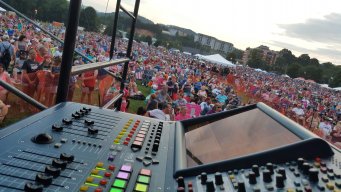
Had our second show last night and used the sub to aux method. Wow there is a big difference when you control what goes where. It is a bit more work, especially if you've never done it before. I talked to a couple friends that are really good sound guys and they both use the sub to aux for all their shows. If you haven't tried it give it a shot you might be pleasantly surprised.


