• TalkBass has been independent since 1998. Add your voice.
    Create a free account to reply to discussions, view embedded media, and browse with fewer display ads.
    Join freeLog in
    Want zero display ads or expanded classifieds tools? Compare plans.

tools needed?

So, i've basially started this luthier hobby and got some essential tools to expand my hobby. I
ve got a drill, a electric saw (the one you can easily make shapes with) rasps, files, sandpaper, screwdrivers, wrench, pliers, wire strippers, screws, thickness gage.

Am wondering, to all home builders, and long time luthiers, what are some essential tools that i am missing?

on my list i have a router and proper work bench.

 
Though you could make do with common tools, specialized tools and the like would make the job easier. I suggest perusing the Stew-Mac website to get a feel of what these specialized tools can do. For sure you don't have to have all of these specialized tools at hand, but if this is going to become a really serious hobby you might as well consider building up your "arsenal" of tools and the investment these things will cost.
 
Since you mention its a hobby, you can get by without a bandsaw and drum sander, Assuming you are outsourcing thicknessing and planing. A good workbench with a vice would be great, although it is possible to manage even without that. A good router with pattern bits is an absolute must. Its a luxury to have dedicated routers if you can afford it. But you can manage with just one. You might need a drill stand for your drill to drill straight perpendicular holes and a jig saw.

The tools which are hard to do without are the specialised fretting tools, especially a fret crowning file.
 
So far, i've been very lucky to not have to work with the frets. But it is on my list of future things to get. A router is on the top of my list as i want to start building my own custom project that has been in the closet for 3-4 years now. Nothing complicated, just need to rout the neck pocket, the cavity controls (which will only have a jack output) and my pickup cavity (faithful tv jones thundertron - direct screw in body)
 
Have you ever used scrapers for shaping wood? If not, I would definitely recommend buying a pack of scrapers (Clifton seem to be the best ones, and they are pretty inexpensive), or trying a friend's scrapers. It is amazing how easily a small metal rectangle slices through the wood, and they are a lot of fun to use too!

Another "can't think how I managed without it" tool (to me, anyway) is a good quality straight edge.

Enjoy your builds, and please post threads of them for us all to see! :)
 
Have you ever used scrapers for shaping wood? If not, I would definitely recommend buying a pack of scrapers (Clifton seem to be the best ones, and they are pretty inexpensive), or trying a friend's scrapers. It is amazing how easily a small metal rectangle slices through the wood, and they are a lot of fun to use too!

Another "can't think how I managed without it" tool (to me, anyway) is a good quality straight edge.

Enjoy your builds, and please post threads of them for us all to see! :)

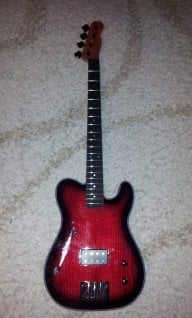
Straight edge acquired when massive shopping for tools. And build threads will be posted. I have one started for the closet project. http://www.talkbass.com/forum/f57/bass-build-slow-pace-977329/ Enjoy. (don't mind the bed sheets, outside was too hot so stayed cool inside :D
 
Have you ever used scrapers for shaping wood? If not, I would definitely recommend buying a pack of scrapers (Clifton seem to be the best ones, and they are pretty inexpensive), or trying a friend's scrapers. It is amazing how easily a small metal rectangle slices through the wood, and they are a lot of fun to use too!
:)
Scrapers are great tools, and very easy to use, but developing the knack for squaring and polishing the edge, and then using a burnishing rod to turn the "hook," definitely takes a bit of practice.
 
I'm learning painting right now. It is so complicated I'd say run for the hills.

Barring that, you want to first get your body ready for finishing, which means sanding down to at least 220 grit.

I personally get good results when I start with 80 grit sand paper. Use whatever method will work best for you. Wood blocks in a variety of shapes come in very handy. If you have a random orbital sander, use it , if not I'd say buy one. It takes me something like three hours to properly sand a body by hand per grit. I take it in steps, from 80 to 120 to 180 to 220. Each grit should replace the scratches of the prior grit. This is a difficult thing to properly explain. I sanded for hours before being able to properly identify when the body was ready for the next grit. I think you can only see this with experience.

When you get it down to at least 220 you can start to worry about the next step in your finish prep.

Not all woods need grain fill. Not all finishes accept a sealer coat. Determine what kind of paint you want to put on whatever kind of wood you have, and move on from there.