• TalkBass has been independent since 1998. Add your voice.
    Create a free account to reply to discussions, view embedded media, and browse with fewer display ads.
    Join freeLog in
    Want zero display ads or expanded classifieds tools? Compare plans.

Double Bass Total pull at tail piece?

Maybe I fell asleep in that class
Well one of us did at least. Note: If you could try to argue your point without large doses of confusing jargon (as I have attempted to do) then we might resolve this disagreement more quickly and clearly, and include a broader base of readers, including me!

Well... I'm not an engineer (and it sounds like you are). I don't know what confusing jargon you're talking about. I have studied grammar word definitions for decades in order to be able to clearly and concisely communicate. I don't think anyone is benefiting from our "back and forth". I'm honestly not seeing what you're trying to illustrate with your examples. If you can point me to the supporting information I will hang my next passenger elevator with rope designed to carry half the rated load, but only if you will take the test ride:)
 
Now... (it's always somethin") where do I buy one? Send away for one?
Also there must be a better way to secure it than a square knot or a mini-u-bolt clamp?

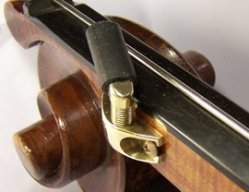
As far as I know I'm the only one selling 1/16" SS cable with an adjustable aluminium clamping sleeve. Lemur sells a 1/8" cable with a brass clamping sleeve and Bob sells the Wittner cable that's meant to go on a tailpiece like their Wittner Ultra with the hidden pocket on the underside.

Mine is meant to go through the holes in the tailpiece from top to bottom.
 
I understand what are saying with the bucket tied to a hook, but that models a completely different scenario than the two buckets. With the pulley model you described, There are two forces acting on the rope. Those two forces are being resisted by tension in either half of the rope. Because it is shared rope passing over a pulley, the total tension is the sum of the two halves. You are correct in that when you look at one half of the tailgut, it seems that force is cut in half. It is however, one tailgut that supports both sides and the tension must be added up.
 
robobass said:
Why does it matter if it's a single strand wrapped around a pulley (or endpin socket in this case), or two separately anchored strands? Are you saying that the tension will be different in these two cases? How would the cable tension in either case compare with a fixture with only a single rope connecting the TP to the socket? Inquiring minds want to know:hyper:

Amazing how physics is debated. :)
Think of the spun cables on a suspension bridge.
 
I understand what are saying with the bucket tied to a hook, but that models a completely different scenario than the two buckets. With the pulley model you described, There are two forces acting on the rope. Those two forces are being resisted by tension in either half of the rope. Because it is shared rope passing over a pulley, the total tension is the sum of the two halves. You are correct in that when you look at one half of the tailgut, it seems that force is cut in half. It is however, one tailgut that supports both sides and the tension must be added up.

Thank you. This is what I'm trying to say. Its back to grammar class for me !! :hyper:
 
I understand what are saying with the bucket tied to a hook, but that models a completely different scenario than the two buckets. With the pulley model you described, There are two forces acting on the rope. Those two forces are being resisted by tension in either half of the rope. Because it is shared rope passing over a pulley, the total tension is the sum of the two halves. You are correct in that when you look at one half of the tailgut, it seems that force is cut in half. It is however, one tailgut that supports both sides and the tension must be added up.

I swore I'd leave this, but I just can't. I have kind of a personal life mission to persuade industrial designers not to overbuild. When my first daughter was born there was a birthing hammock in the room which was held by a bearing mounted hook which must have weighed fourty pounds in itself. This hook was at least a hundred times stronger than it needed to be, and probably cost fifty times as much as necessary. Why?

I don't think I'm going to succeed in my mission, but I think my language skills are strong enough to communicate the basic physics I learned in the sixth grade, which is all we're dealing with here.

If you hang a hundred pound bucket from a hook on the ceiling, there are two pulling forces. The bucket pulls down with 100 lbs. of force, and the ceiling hook pulls up by the same amount. The tension in the rope is 100 lbs. If you loop over the hook and tie both ends of the rope to the bucket, then each side of the rope tenses to half the weight of the bucket. The tension on the ceiling hook stays the same. If you replace the hook with a pulley there is no change in the static system. If somehow each side of the rope had a hundred pounds of tension in it, then you would have two ropes pulling with a hundred pounds of force each on a hundred pound bucket. Wouldn't the bucket just fly up and smash against the ceiling?
 
The simplest way I can explain this is that you have one single rope holding the weight of the tailpiece. The fact that it wraps around the endpin changes nothing. It is one single single rope bearing the full tension of the strings. In your example with the bucket hanging from the ceiling, the tension of the rope is equivalent to the bucket's weight force. With two bucket hanging from each end of a rope hanging from a pulley, you have one rope supporting two buckets. The tension is equivalent to the weight of the two buckets. Again, the presence of a pulley in the system does nothing to reduce the tension in the rope.
 
I swore I'd leave this, but I just can't. I have kind of a personal life mission to persuade industrial designers not to overbuild. When my first daughter was born there was a birthing hammock in the room which was held by a bearing mounted hook which must have weighed fourty pounds in itself. This hook was at least a hundred times stronger than it needed to be, and probably cost fifty times as much as necessary. Why?

I don't think I'm going to succeed in my mission, but I think my language skills are strong enough to communicate the basic physics I learned in the sixth grade, which is all we're dealing with here.

If you hang a hundred pound bucket from a hook on the ceiling, there are two pulling forces. The bucket pulls down with 100 lbs. of force, and the ceiling hook pulls up by the same amount. The tension in the rope is 100 lbs. If you loop over the hook and tie both ends of the rope to the bucket, then each side of the rope tenses to half the weight of the bucket. The tension on the ceiling hook stays the same. If you replace the hook with a pulley there is no change in the static system. If somehow each side of the rope had a hundred pounds of tension in it, then you would have two ropes pulling with a hundred pounds of force each on a hundred pound bucket. Wouldn't the bucket just fly up and smash against the ceiling?

I swore I would stay out as well, but can't help myself. You are correct. Also, if you had a 100-lb. bucket hanging from a rope looped over a pulley and the other side tied to a 100-lb bucket, keeping everything balanced, then each side of the rope would have 100 lbs of force. The pulley would be holding up 200 lbs. Think of this as starting with your example of a rope looped over the pulley with both ends tied to a single 100-lb bucket. As you correctly state, each end of the rope experiences a force of 50 lb, with the pulley holding up 100 lbs. Adding a second bucket as in my example (one held up by each end of the rope) doubles the force on every component.
 
Again, the presence of a pulley in the system does nothing to reduce the tension in the rope.

...don't think so. Imagine cutting the rope and tying each end to a bucket, the other ends to the pulley or hook. Each rope experiences 100 lb of force, the hook or pulley experiences 200 lbs.
 
You guys could have joined me, but now you are clearly against me. Drurb, you are in the clear, but the safety of the others is out of my hands. You see, I have pending elevator contracts all over the world. If they go through, I will be able to selectively phase out all heads of state and business leaders who oppose Operation Picasso. If everyone here had agreed with my warped mechanics from the outset then it would have been much easier for us. But, don't think that logic-based resistance on this forum is going to foil our plans. Things will be harder, but we can deal with it. Don't worry. No rhythm section or string players should be affected, although I can't speak for any of those skinny tied, trumpet playing contractors who have been feeding secret info to the CIA for years. You can't stop us. Ha. Ha ha. Ha ha ha. Ha ha ha ha ha...Invalid Link Removed
 
I swore I'd leave this, but I just can't. I have kind of a personal life mission to persuade industrial designers not to overbuild. When my first daughter was born there was a birthing hammock in the room which was held by a bearing mounted hook which must have weighed fourty pounds in itself. This hook was at least a hundred times stronger than it needed to be, and probably cost fifty times as much as necessary. Why?

Come do some show biz rigging (especially in film) and you'll be thankful for every over built roof truss you see. You probably don't get a lot of "oh, by the way"s hanging elevators but you sure do hanging stage rigs. It's always nice to be able to say sure, no problem when the rig goes from 1500lbs with no people on it to a 4000lb dynamic live load gag.

Sorry for taking this so far of track but it's gotten so ridiculous I didn't think it really mattered any more. Bottom line if you want to know the pull on a tailpiece MEASURE the tension of the string AT the tailpiece. Nothing else matters.
 
Careful now... I've worked with hundreds of engineers over the last two decades. I'm not one, but one thing I know they hate is being accused of over-engineering anything. Professional pride, you know.

I myself think of Germany as the land of plenty of engineering. And I really admired that VW GTI I rented last year... great car to drive!
 
In my trade we believe in over-kill. Over-engineered is when healthy margin of safety is removed because "It should work just fine at 90% capacity". There are reasons that equipment "over-built" 100 years ago is still in operation today and equipment engineered 50 years ago has long since failed.

No offense to the engineer. My issue is with the purely profit driven corporation who pays that engineer to increase profits by engineering out all the costs they can.
 
You guys could have joined me, but now you are clearly against me. Drurb, you are in the clear, but the safety of the others is out of my hands. You see, I have pending elevator contracts all over the world. If they go through, I will be able to selectively phase out all heads of state and business leaders who oppose Operation Picasso. If everyone here had agreed with my warped mechanics from the outset then it would have been much easier for us. But, don't think that logic-based resistance on this forum is going to foil our plans. Things will be harder, but we can deal with it. Don't worry. No rhythm section or string players should be affected, although I can't speak for any of those skinny tied, trumpet playing contractors who have been feeding secret info to the CIA for years. You can't stop us. Ha. Ha ha. Ha ha ha. Ha ha ha ha ha...Invalid Link Removed

I wish we had that smiley that is laying on the ground pounding his fists and kicking his feet in laughter!