

Enjoy the benefits of a premium membership!
Upgrade Account
-
TalkBass has been independent since 1998. Add your voice.
Create a free account to reply to discussions, view embedded media, and browse with fewer display ads.
Join free Log in
Want zero display ads or expanded classifieds tools? Compare plans.
You are using an out of date browser. It may not display this or other websites correctly.
You should upgrade or use an alternative browser.
You should upgrade or use an alternative browser.
Totally transparent combo bass amp?
- Thread starter fretlessman71
- Start date
More options
Who Replied?
Jim Carr
Dr. Jim
- Jan 21, 2006
- 16,223
- 7,613
- 76
- Disclosures
- fEARful Kool-Aid dispensing liberal academic card-carrying union member Musicians Local 72-147
We know, even though we don't need to know.


Some modeling combo amps can be totally transparent as they start with the transparent amp/cab as the basic recipe.

...does such a thing exist? And how would we know?
No, but I suspect the Genzler Magellan 350 combo might be a step in the right direction.
Or you could try a QSC K12.2

...does such a thing exist? And how would we know?
I once put an audio signal through an instrumention amp used to drive a chart recorder for capturing data. This amp was designed to reproduce the input very accurately. It sounded awful. A musical instrument amp should be musical, not dry and uninspiring.

Al Kraft
Supporting Member
- May 2, 2016
- 10,770
- 40,447
- Disclosures
- Mesa Boogie beta product tester and player support
My guess is that our first hint would be poor sales - for all the outcry about "overly colored amps and cabs" just think about the all-time classics and ask yourself how ruler flat they were. As always YMMV!...does such a thing exist? And how would we know?
I may be wrong, but I believe PA systems add very little character or color to instrument tones. Hence the abundance of preamp/DI pedals for use with PAs....does such a thing exist? And how would we know?
Or, you could figure out some way to play through a set of studio reference speakers.
There are also ways to play through headphones without adding any coloration. E.g. I have a Zoom B1 Four, which has a headphone jack; put it on bypass and it should be a neutral tone.
Obviously, engineers have all sorts of ways to amplify a signal without significantly altering the frequency responses. Instruments generally don't tend to sound good that way, though.

Phil Jones stuff is very transparent but a little pricey.


OP: best of luck finding any "transparent" bass rig...you'll need all the luck you can get! 
i'd offer that there's no such thing as "transparent" in the audio realm. even in the studio (reference monitors) the term is really used to describe "great sounding" with nothing audibly biased towards a specific 'coloration'. and, of course, "flat" across the frequency range is a must (absolute flatness is also mythical!). Wasnex 's suggestion is about as close as you're going to get for a "transparent" bass rig...but you'd likely be dialing out some of the qualities that make those systems great for PA use.
i'd offer that there's no such thing as "transparent" in the audio realm. even in the studio (reference monitors) the term is really used to describe "great sounding" with nothing audibly biased towards a specific 'coloration'. and, of course, "flat" across the frequency range is a must (absolute flatness is also mythical!). Wasnex 's suggestion is about as close as you're going to get for a "transparent" bass rig...but you'd likely be dialing out some of the qualities that make those systems great for PA use.
Last edited:
IMHO Totally flat combo - don't know because none of them offer measurements.
Totally flat Headphone, earphones, Studio Monitors, FOH - yes you bet within "human hearing ranges".
There are several packages that measure headphones and off calibration files, signal processing, to correct for any variance. There are several packages that measure studio monitors from several different positions and FOH you bet they publish measurements and EASE data or other acoustic modeling data for Sound engineers to model the venues with. Passive room correction of course may be needed but the measurement mics help point this out.
So a totally flat combo could be found by measurement with an app. REW is a great place to start: REW - Room EQ Wizard Room Acoustics Software
It may take some tweaking of the combo's tone controls to approach a flat response, but I imagine it is totally achiavable but some top brand modern combos.
It's be nice if some magazine did some measurements.
Totally flat Headphone, earphones, Studio Monitors, FOH - yes you bet within "human hearing ranges".
There are several packages that measure headphones and off calibration files, signal processing, to correct for any variance. There are several packages that measure studio monitors from several different positions and FOH you bet they publish measurements and EASE data or other acoustic modeling data for Sound engineers to model the venues with. Passive room correction of course may be needed but the measurement mics help point this out.
So a totally flat combo could be found by measurement with an app. REW is a great place to start: REW - Room EQ Wizard Room Acoustics Software
It may take some tweaking of the combo's tone controls to approach a flat response, but I imagine it is totally achiavable but some top brand modern combos.
It's be nice if some magazine did some measurements.

- Feb 12, 2006
- 60,986
- 5
- 220,769
- Disclosures
- Development Engineer-Mesa Boogie, Development Engineer-Genzler (pedals), Product Support-Genz Benz
Any application expecting truly flat response needs to be evaluated in an anechoic environment. Otherwise room interactions will greatly skew the measurements and lead to false conclusions.

The one that came to mind for me was the EA iAmp 800 combo, but that's pretty old hat at this point.
Dispersion is more important than flat frequency response for live instrument monitoring IMO.
Genzler slanted array cabs are some of the best in this regard.
Genzler slanted array cabs are some of the best in this regard.
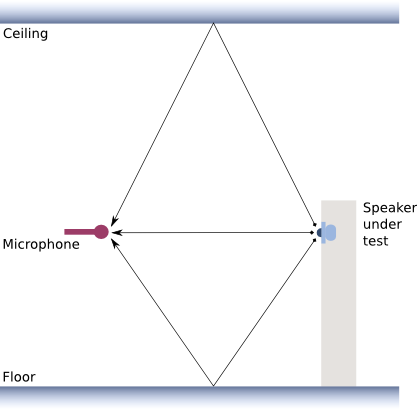
Impulse responses can be gated to measure the speaker before a reflection occurs in the room.
I have software that does this and REW does this also.
Or the old alternative of measuring outside still works.
I have software that does this and REW does this also.
Or the old alternative of measuring outside still works.
- Feb 12, 2006
- 60,986
- 5
- 220,769
- Disclosures
- Development Engineer-Mesa Boogie, Development Engineer-Genzler (pedals), Product Support-Genz Benz
Most software does not gate the signal.
My experience with gated acquisition is that the measurement window needs to be long enough to acquire the data yet the gate has to exclude the room contribution. In a room with large dimensions (specifically the earliest reflection) it's not too difficult, but that's not the size room most folks have available.
Outside is an option, but the ground plane boundary needs to be excluded unless you have the ability to lay the speaker on its back.
As is often the case, usually this stuff is easier said than done.
My experience with gated acquisition is that the measurement window needs to be long enough to acquire the data yet the gate has to exclude the room contribution. In a room with large dimensions (specifically the earliest reflection) it's not too difficult, but that's not the size room most folks have available.
Outside is an option, but the ground plane boundary needs to be excluded unless you have the ability to lay the speaker on its back.
As is often the case, usually this stuff is easier said than done.
REW does do gated impulses. It's Free and it's not brand new.
Typical floor or mic to ceiling or wall is 4ms - that's an eternity in CPU time.
It's not rocket science like landing a SpaceX booster on a floating barge.
I'm not sure why the excuses for not measuring the measurable - IMHO
Typical floor or mic to ceiling or wall is 4ms - that's an eternity in CPU time.
It's not rocket science like landing a SpaceX booster on a floating barge.
I'm not sure why the excuses for not measuring the measurable - IMHO
- Feb 12, 2006
- 60,986
- 5
- 220,769
- Disclosures
- Development Engineer-Mesa Boogie, Development Engineer-Genzler (pedals), Product Support-Genz Benz
It's not the CPU time, it's the window for the low frequencies.REW does do gated impulses. It's Free and it's not brand new.
Typical floor or mic to ceiling or wall is 4ms - that's an eternity in CPU time.
It's not rocket science like landing a SpaceX booster on a floating barge.
I'm not sure why the excuses for not measuring the measurable - IMHO
At 4mSec, that's 1 full cycle at 250Hz or 1/10th of a cycle at 25Hz, which becomes estimation or interpretation territory.
My experience is that it's necessary to get at least 1/2 of a complete cycle and preferably a full cycle worth of sampling at the lowest frequency which corresponds to a gate time of ~20-40mSec, which means that the earliest boundary would need to be roughly 40 feet away.
In an arena it theatre, flown, this would be no problem. The ground plane boundary ground stacked can be a problem though.
Otherwise, measurement folks would have given up the cost and hassle of using an anechoic chamber already. IME, outside on the speaker's back is the next best way.
IMHO Totally flat combo - don't know because none of them offer measurements.
Totally flat Headphone, earphones, Studio Monitors, FOH - yes you bet within "human hearing ranges".
There are several packages that measure headphones and off calibration files, signal processing, to correct for any variance. There are several packages that measure studio monitors from several different positions and FOH you bet they publish measurements and EASE data or other acoustic modeling data for Sound engineers to model the venues with. Passive room correction of course may be needed but the measurement mics help point this out.
So a totally flat combo could be found by measurement with an app. REW is a great place to start: REW - Room EQ Wizard Room Acoustics Software
It may take some tweaking of the combo's tone controls to approach a flat response, but I imagine it is totally achiavable but some top brand modern combos.
It's be nice if some magazine did some measurements.
I use Sonarworks Reference 4 (Reference 4 | Sonarworks). I find that it’s good for mixing but not necssarily something that you want for casual listening. When mixing, you don’t want your speakers or headphones to color your mixing decisions.
The technology is also good for reproducing an environment where good mixes are performed. Waves for example offers a package that duplicates an Abbey Road mixing room.
But real life is colored, not flat. Knowing how it’s colored and using that is important.
Last edited:


