• TalkBass has been independent since 1998. Add your voice.
    Create a free account to reply to discussions, view embedded media, and browse with fewer display ads.
    Join freeLog in
    Want zero display ads or expanded classifieds tools? Compare plans.

Trace Elliot dumb impedance question

I'm used to chaining two 8 ohm Trace cabs (a 4x10 and a 1x15) together in series to provide the amp (AH250) with a 4 ohm total, which provides maximum power from the amp's single output.

For a smaller setup, I have a BLX130SM combo with a GP7 SM amp section and a single 10" speaker and want to add a 2103H extension, also 8 ohms. The amp has two 8 ohm sockets, one of which is used by the internal speaker.

I'm not sure whether simply plugging the extension cab into the second 8 ohm socket provides the optimum 4 ohms total or the amp's output is just fed out in parallel to two 8 ohm speakers, which seems counterproductive.

Anyone using a TE combo and an additional cab and knows the best way to get max power out of the setup?
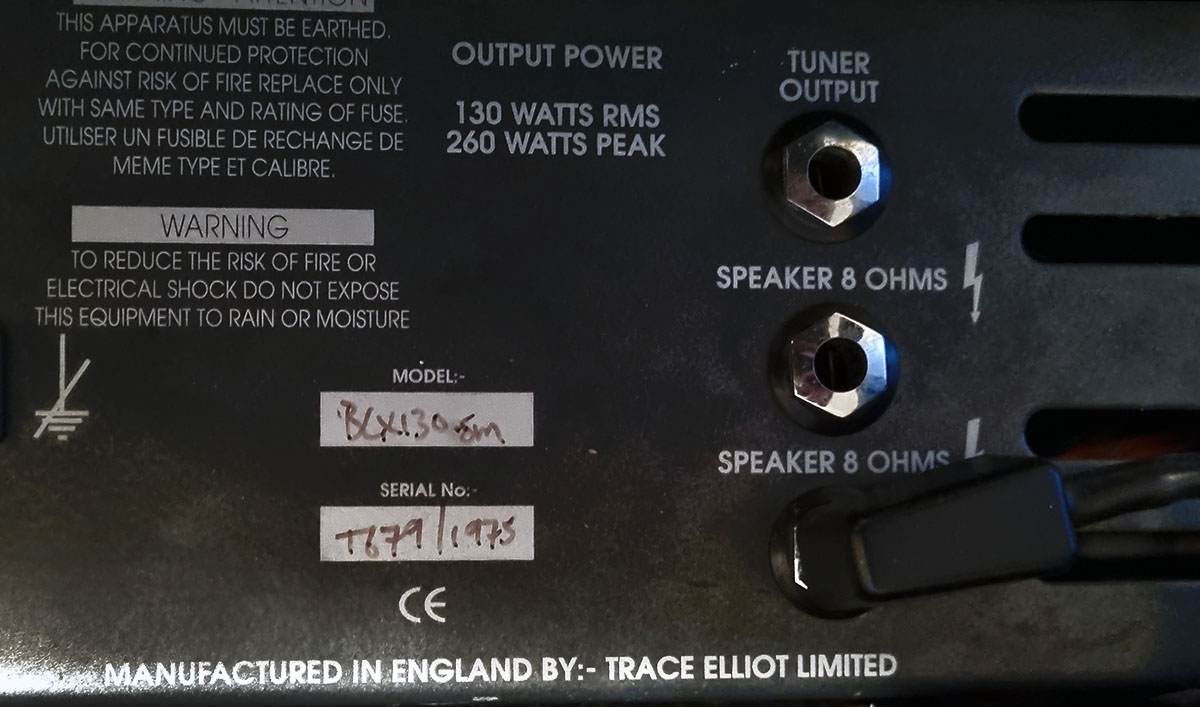
BLX130SM.jpg
 
After you reiterated the "parallel" aspect I realised my question was even dumber than I thought. Of course two 8 ohm parallel resistances equal 4 ohms. If they were in series, they'd be 16 ohms. o_O

I've always daisychained my two big 8 ohm cabs as Trace showed. From appearance I just associated their wiring with being series. If so, they'd be 16 ohms and would restrict the amp's power (but be gentle on the speakers). But it would make much more sense if they were actually parallel.

links.jpg


Now, another question. I have a Trace Elliot 4502H "Bright Box" which I've had for decades. It's a 4x5 tweeter cab for high frequency reproduction, so must have a built-in crossover. Although its nominal impedance is also 8 ohms, Trace said it could be added in the chain yet would effectively be "invisible" impedence-wise. I can confirm that when plugging a speaker lead into it to measure resistance, it shows nothing as if open circuit, yet produces sound when plugged into the speaker socket of the amp. On the big rig, I've always wired it in after the 2nd cab with no ill effects. Does it seem feasible to you that adding the bright box as well as the extension speaker to the combo would be safe, and not bring impedance down below 4 ohms? Being wedge-shaped, it's handy to use as a trebly monitor at foot level. Thanks!

brite.jpg


Above, 4502 Bright Box. Below, the connection panel on the back of the 2x10 extension cab.

t4.jpg
 
Last edited:
After you reiterated the "parallel" aspect I realised my question was even dumber than I thought. Of course two 8 ohm parallel resistances equal 4 ohms. If they were in series, they'd be 16 ohms. o_O

I've always daisychained my two big 8 ohm cabs as Trace showed. From appearance I just associated their wiring with being series. If so, they'd be 16 ohms and would restrict the amp's power (but be gentle on the speakers). But it would make much more sense if they were actually parallel.

View attachment 6971852

Now, another question. I have a Trace Elliot 4502H "Bright Box" which I've had for decades. It's a 4x5 tweeter cab for high frequency reproduction, so must have a built-in crossover. Although its nominal impedance is also 8 ohms, Trace said it could be added in the chain yet would effectively be "invisible" impedence-wise. I can confirm that when plugging a speaker lead into it to measure resistance, it shows nothing as if open circuit, yet produces sound when plugged into the speaker socket of the amp. On the big rig, I've always wired it in after the 2nd cab with no ill effects. Does it seem feasible to you that adding the bright box as well as the extension speaker to the combo would be safe, and not bring impedance down below 4 ohms? Being wedge-shaped, it's handy to use as a trebly monitor at foot level. Thanks!

View attachment 6971893

Above, 4502 Bright Box. Below, the connection panel on the back of the 2x10 extension cab.

View attachment 6971933
There shouldn't be an issue with the Bright Box, the internal HPF combined with the inductance of the cabinets themselves should be fine.
 
  • Like
Reactions: Bassic_desires
I've never had it explained to me: I was crazy for TE in its day, but why did they use XLR connectors on speaker cables?
Back in the day it was recognized how poor the 1/4" jack was for speaker level. There weren't many options, therefore XLR was used by some manufacturers. It did however create issues of confusion with mic cables, and longer pieces of mic cable, when used, could create instability issues with some amps. Back then, most pro mic cable was 20 gauge on pin 2 & 3, effectively 14 gauge on pin 1, far heavier than today's off shore cables.
 
  • Like
Reactions: Bassic_desires
Back in the day it was recognized how poor the 1/4" jack was for speaker level. There weren't many options, therefore XLR was used by some manufacturers. It did however create issues of confusion with mic cables, and longer pieces of mic cable, when used, could create instability issues with some amps. Back then, most pro mic cable was 20 gauge on pin 2 & 3, effectively 14 gauge on pin 1, far heavier than today's off shore cables.

As always, Thank You, Andy. Would it be safe to assume that in a way these were precursors of SpeakOns ?
 
As always, Thank You, Andy. Would it be safe to assume that in a way these were precursors of SpeakOns ?
Kind of, though they are not nearly as capable of SpeakOns. The precursor was really the Cannon AP/EP which were rated for the necessary voltage/current. They looked like XLR but about 2x the size and the female contact architecture is completely different.

1720133971736.png
 

Latest posts