I just looked at what looks like the same lead sheet in Ultimate Guitar and it appears to have been 'corrected':
Excellent.
Now, just the regular TB questions: what about that modulation between Intro and Verse?; what about that C#min7 chord?

TalkBass has been independent since 1998. Add your voice.
Create a free account to reply to discussions, view embedded media, and browse with fewer display ads.
Join free Log in
Want zero display ads or expanded classifieds tools? Compare plans.
I just looked at what looks like the same lead sheet in Ultimate Guitar and it appears to have been 'corrected':

I've just listened to a very nice Lisa Stansfield's song, "All Over the World."
It's from my "active" years. The song has a simple but interesting bass rhythmic pattern - it gives some "cool" buoyancy feeling.
(They don't write that kind of songs anymore.)
I've found on the Internet chords for the song - it's pretty accurate.
The song includes a "half-step" modulation from Intro to Verse 1, and some "other" chords.
Intro starts with Dbmaj7.
(Check the key.)
View attachment 4577344
Here are the chords for the song:
View attachment 4577348 View attachment 4577349 View attachment 4577350
Any ideas what's happening with the chords in Intro and, then, in Verse/Chorus?
What about that C#min7 chord in the song?
The verse starts with a Dm9 (minor, not major), but the tonality looks like C maj to me (see the G dominant function). So that's not really a 1/2 step modulation in the real sense.
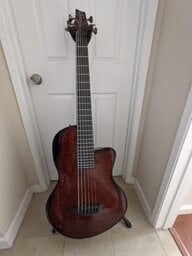
Let's look at a different pop song (with an extremely simple bass line) - Rock Dj - Robbie Williams.
(From my "happy times".)
I've found the chords for that song from here:
Robbie Williams - Rock Dj - Free Downloadable Sheet Music
All Internet resources say, the song is in the key of G major (one sharp).
I'm trying to understand why(!) the song is written in the key of G major.
There are only very few measures where one could hear that G chord.
And that G chord does not sound like any TONIC chord.
(It's on the last page.)
View attachment 4578872 View attachment 4578873 View attachment 4578874 View attachment 4578875
As Richard Lindsey points out, the tune has a key signature of 1 sharp but it is not in G major.I would just suggest, don't get too hung up on the key signature. The key signature doesn't determine the key, it's just a notational convenience meant to reflect it to a greater or lesser extent. By "convenience" I simply mean that it saves having to write a lot of accidentals. Technically, you could write a passage in any key you like using any key signature you like (eg, an E major passage with 5 flats in the key signature) ... IF you wanted to put in the work it would take to get all the accidentals right. But why do that if you don't have to? Most folks wouldn't, quite sensibly.
IOW, the fact that the sheet music uses the key sig conventionally associated with G major doesn't mean that the song is in G major. What determines the key is what the harmony is actually doing. And you're right, what it's doing is not G major in any meaningful way. You might get more benefit out of thinking of this song as essentially working in D mixolydian.
this song as essentially working in D mixolydian.
Sure, that's probably the most convenient way to do it. I'm just adding the point that the song could have been written with no key sig at all and still have been in D mixo if the accidentals were correctly notated.Yes, therefore, it has one sharp in the signature.
the absence of dominant to tonic cadences is striking
Sure, that's probably the most convenient way to do it. I'm just adding the point that the song could have been written with no key sig at all and still have been in D mixo if the accidentals were correctly notated.
But unless it actually performs a dominant function, which is more likely to be a function of tonality than of modality as a rule, it isn't really a dominant in the sense I believe Papageno meant.That slash chord of C/D belongs to the Dominant chord "family".
It could be interpreted as D7(or D9)sus4 chord that produces a "less" extreme Dominant sound.
Actually, this tune is not a tonal tune at all.
Sure: when writing it is not tonal, I do not mean it is atonal. In particular it has a clear tonal center which is D.By the most common definition of tonality in Western musical contexts, I'd say you're 100% correct about that. There are, however, some more expansive definitions of tonality that would probably accept this example as tonal, if only in the negative sense of its not being atonal, bitonal, or polytonal. And this example, even if it lacks dominant-tonic cadences as you rightly note, does have one component of tonal music, which is the the sense of a tonal center or "tonic" (in this case, D).
The Intro has the following chords:
Dbmaj7 / Eb x 3 (4 flats in the Key)
and (preparation for Modulation) E/D.
Verse: Dmin9 ...
The rest of the song, is related to C major.
Sure: when writing it is not tonal, I do not mean it is atonal. In particular it has a clear tonal center which is D.
It is unfortunate that the established language is so misleading: as pointed out by Richard Lindsey, the "strict" sense of "tonal" here, refers to what is called "common practice tonal music", i.e. music based upon functional harmony and in particular dominant-to-tonic cadences; "tonal" music in this sense encompassing music ranging from the barock period all the way to bebop.
One could also use the word "tonal" in a looser sense to include all music based upon a tonal center, and thus include all of modal music.
 )
)
In a lifetime of playing, I haven't seen G# major, ever.