• TalkBass has been independent since 1998. Add your voice.
    Create a free account to reply to discussions, view embedded media, and browse with fewer display ads.
    Join freeLog in
    Want zero display ads or expanded classifieds tools? Compare plans.

Troubleshooting: Hearing overtones?

Thanks templar, will try. Top signature too haha.

Mark4, not yet. Have only had it a few days.

Jim C I used Ernie Ball slinky rounds before, have never used flats. It could be that I'm just not used to these strings, but the symptoms are telling me it's something more structural or mechanical. In which case, I hope I'm wrong :)
 
use a Christmas ornament hook/paperclip and hang something about the weight of a battery off of it from the A string BEHIND THE NUT (between the nut and your string tree/tuner). play it for a sec and see if anything changes..

edit- I guess a gator clip/ small rubber clamp would work better.. its late , sorry
 
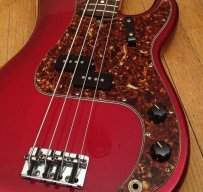
Pics for reference. Does the break angle of the A string look concerning to anyone?
 

Attachments

  • 1.JPG
    1.JPG
    29.4 KB · Views: 81
  • 2.JPG
    2.JPG
    27.4 KB · Views: 82
use a Christmas ornament hook/paperclip and hang something about the weight of a battery off of it from the A string BEHIND THE NUT (between the nut and your string tree/tuner). play it for a sec and see if anything changes..

edit- I guess a gator clip/ small rubber clamp would work better.. its late , sorry


Haha no problem, I'm in the office so can't really try now. Will give it a shot if I don't get to take it to my tech in time. Thank you sir.
 
Mark4, not yet. Have only had it a few days.

I mention strings because I've seen bad strings result in odd overtones. When this happened to me, either they were defective or perhaps the way the ends were cut damaged the core. Some were worse than others. The strings were relatively new, but replacing them resolved the issue. You might even try swapping on a set of old, but known to be good, strings. The point being to try a different set to see if the overtones go away.
 
Pics for reference. Does the break angle of the A string look concerning to anyone?
It doesn't look terrible, but maybe a little bit. Try holding it down BEHIND the nut (Or use a capo) or something to add pressure at that string. If it's still bad then the problem is not the break angle. Also, make sure your saddle height screws are BOTH touching the bridge plate. Sometimes saddles bind against each other and only one screw hits the plate and the other one "floats" above the plate. Otherwise... everything I'm reading here seems to lead to a bad string. Keep me posted!

Ian
 
Nothing in particular? I'm self taught so I might have missed out on these things. If it answers your question, I played a borrowed Fender J bass for the past 3-4 months with, and my other bass (Yamaha RBX) through the same amp with no issues.

You need to mute unplayed strings, or else you will get sympathetic vibrations. 7th fret of the A string is E, which will cause vibrations on the E string. This effect is more pronounced on some basses than others.

A good teacher can help you clean up your muting. The "cliff notes" version is that you need to touch the unplayed string in at least 1, and preferable 2, spots that are not harmonic "nodes."

So for example when you are playing 7th fret A string, you could rest your right-hand thumb on the E string and/or touch the E string with one or more left-hand fingers (or some people like to wrap the left hand thumb over the neck) BUT you don't want to touch it at the 5th or 7th fret, because those are harmonic nodes. 6th fret would be good.

Hope that helps! Muting is an essential but overlooked intermediate skill, in my opinion. :)
 
Pics for reference. Does the break angle of the A string look concerning to anyone?

Well, it's hard to tell for sure from that pic. But even the E string angle looks a bit weak, its wraps are not all the way down on the post. If the A string is wrapped like the E, the angle is likely weak and could be part (or all) of the problem.

It cannot be overstated that the A string on Fender basses needs maximum wraps on the post to ensure a decent break angle. The stupid "tapered" tuner posts just make it more difficult IMO.
 
+1 more to suspecting the strings themselves; are they the ones that came with the bass?

a bad or overly twisted string will indeed have funny, chorus-y overtones.

twisting happens when you wind the string on the post without allowing the ball end to spin freely at some point to un-twist the string. it's a pain with string-through-body basses like you have, but it still needs to be taken into account.
 
Twisting also happens when you play too many Chubby Checker records! (Sorry... couldn't resist). I agree that a twisted string or one that has slipped windings is the most likely culprit. But first check you saddle height screws, be sure they are ALL touching the bridge plate.