

Enjoy the benefits of a premium membership!
Upgrade Account
-
TalkBass has been independent since 1998. Add your voice.
Create a free account to reply to discussions, view embedded media, and browse with fewer display ads.
Join free Log in
Want zero display ads or expanded classifieds tools? Compare plans.
You are using an out of date browser. It may not display this or other websites correctly.
You should upgrade or use an alternative browser.
You should upgrade or use an alternative browser.
Trying to develop a punchier tone
- Thread starter tothemax
- Start date
More options
Who Replied?

EQ. Turn down the bass. Turn up the mids.
Depending on what you're looking for, it may be low mids or high mids. I generally turn the bass knob down to maybe 9:00, low mids down to 11:00, high mids up to maybe 2:00, leave highs at noon. Depends on the room, the rest of the gear I'm using, and the band / sound I need.
Depending on what you're looking for, it may be low mids or high mids. I generally turn the bass knob down to maybe 9:00, low mids down to 11:00, high mids up to maybe 2:00, leave highs at noon. Depends on the room, the rest of the gear I'm using, and the band / sound I need.

Great info - really appreciate everyone taking the time to give helpful responses.
This afternoon, I followed the advice and reset the EQ with the bass about 9:30, Mid at 2:00, and the highs at noon - muting to get rid of the overtones and playing closer to the bridge really hit the sweet spot. Getting the right pluck action really gives a lot of control on the tone.
I immediately remembered why I play so close to the neck. It goes with my love-hate relationship with this P-Bass. It's a 50's re-issue with a slab body, it has a pretty hard edge (Tele style) right where my wrist lays on the body to play closer to the bridge. With a few strap adjustments I was able to play closer to the chamfer area and it worked out pretty well.
I love the look of the bass, it plays great and sounds good. Beside the hard edges on the body it weighs in at about 10 lbs. It's got a butterscotch blonde finish or I'd route the edge a bit, ain't nothing easy.
Thanks so much, I think I'm back on track here...
This afternoon, I followed the advice and reset the EQ with the bass about 9:30, Mid at 2:00, and the highs at noon - muting to get rid of the overtones and playing closer to the bridge really hit the sweet spot. Getting the right pluck action really gives a lot of control on the tone.
I immediately remembered why I play so close to the neck. It goes with my love-hate relationship with this P-Bass. It's a 50's re-issue with a slab body, it has a pretty hard edge (Tele style) right where my wrist lays on the body to play closer to the bridge. With a few strap adjustments I was able to play closer to the chamfer area and it worked out pretty well.
I love the look of the bass, it plays great and sounds good. Beside the hard edges on the body it weighs in at about 10 lbs. It's got a butterscotch blonde finish or I'd route the edge a bit, ain't nothing easy.
Thanks so much, I think I'm back on track here...

May we ask about strings?
This, and the tone knob on his bass, are the two keys to getting him where he needs to be.
Great info - really appreciate everyone taking the time to give helpful responses.
This afternoon, I followed the advice and reset the EQ with the bass about 9:30, Mid at 2:00, and the highs at noon - muting to get rid of the overtones and playing closer to the bridge really hit the sweet spot. Getting the right pluck action really gives a lot of control on the tone.
I immediately remembered why I play so close to the neck. It goes with my love-hate relationship with this P-Bass. It's a 50's re-issue with a slab body, it has a pretty hard edge (Tele style) right where my wrist lays on the body to play closer to the bridge. With a few strap adjustments I was able to play closer to the chamfer area and it worked out pretty well.
I love the look of the bass, it plays great and sounds good. Beside the hard edges on the body it weighs in at about 10 lbs. It's got a butterscotch blonde finish or I'd route the edge a bit, ain't nothing easy.
Thanks so much, I think I'm back on track here...
Before we go any further, what kind of strings are you playing?
Also, where do you set the tone knob on your bass?
As to the second question, leave you tone knob dimed (all the way up). That sends pretty much everything coming out of your bass to your amp. This allows you to sculpt your tone at the amp.
If you back down on the tone knob, it's nutn but mud.

You want punch try GK, I play Pbasses and one Jazz with a variety of strings from Flats to rounds and they all punch thru the GK and yes I play fingerstyle!!


- Get a pick and learn how to use it;
- Turn your low mids way up, everything else flat;
- Report back.
I get plenty of fingerstyle punch playing any of my basses (A Pedulla Buzz with Bartolini 3-band, a passive Fender MIM Jazz with Dimarzios, and a SBMM Ray4 with SD Alnico pup/Mojo 2-band) through an old Hartke VXL Di into the board and to IEMs. Three basses that are different as night and day from one another, different voices but the same punch and kick is there whenever I want it.
I know amps can be more or less punchy for sure, and some significantly so.
If you have a way to take your amp out of the equation at least for practice time, you might find the solution.
If you have a decent headphone amp, or even better a way to go direct at home for example Bass>usb interface>computer>DAW of your choice (keep amp sims and eq settings simple and not scooped)>decent headphones.
Taking your amp and big 15" or 12" speaker out of the chain might allow you to really focus on the settings that are directly underneath your fingertips.
Oh, and don't forget to check your pickup height and setup.
Good Luck, and Rock on.
I know amps can be more or less punchy for sure, and some significantly so.
If you have a way to take your amp out of the equation at least for practice time, you might find the solution.
If you have a decent headphone amp, or even better a way to go direct at home for example Bass>usb interface>computer>DAW of your choice (keep amp sims and eq settings simple and not scooped)>decent headphones.
Taking your amp and big 15" or 12" speaker out of the chain might allow you to really focus on the settings that are directly underneath your fingertips.
Oh, and don't forget to check your pickup height and setup.
Good Luck, and Rock on.
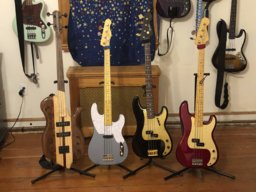

Like others have said keep lows at or about flat, and boost your low mids. I've also had good success getting more punch out of higher tension hex core strings like Diadarrio xl's or DR nickel or regular lo-riders. I play through either a Gk800rb w/ an Ampeg fridge or an 80's 400rb with a stack of matching 80's 410b cabs. Jazz bass with picks. Neither rig is short in the punch department!
I think the EQ settings and playing zone were the "Aha" moment. Always love it when you can move past a plateau, and tone has been a sticking point for while now. I was working on the Neville Bros version of Steve Miller's "Fly like an eagle" this afternoon and getting some nice sounds, a real improvement.
Btw: I use D'Addario Nickel wound light top, medium bottoms .45 - .105 strings
Just watched this video... he covers a number of the same tips posted here...
If you're not familiar with Rick Beato - you should check out his "What if" YouTube on "Stairway to heaven" where they substitute three different players style leads in place of Jimmy Page. Pretty cool: Frampton, Van Halen, and Eric Johnson. It was coincidence and aired a week before Eddie passed, but in it's own way is a very cool tribute.
Btw: I use D'Addario Nickel wound light top, medium bottoms .45 - .105 strings
Just watched this video... he covers a number of the same tips posted here...
If you're not familiar with Rick Beato - you should check out his "What if" YouTube on "Stairway to heaven" where they substitute three different players style leads in place of Jimmy Page. Pretty cool: Frampton, Van Halen, and Eric Johnson. It was coincidence and aired a week before Eddie passed, but in it's own way is a very cool tribute.
Get a mid boost pedal that allows you to boost the volume of one frequency while adding some gain and boost to your overall signal.
Get a 410 cab.
Get a 410 cab.
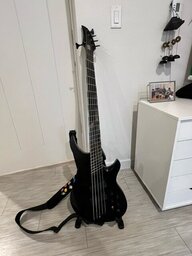
Lots of good suggestions and ways to go about this. I’ll just recommend a couple pedals for quick fix fun. Darkglass b3k,b7k, b7k ultra, or DSM noisemaker Omni-cab sim. Any of those can give you a flexible variety in different kinds of punch especially the latter two.
Ah. Playing close to the neck yields a fatter/rounder sound. Good for when you need fat/round sounds, but definitely the opposite of punchy. You're playing a P-bass, which I'm not a fan of but has no shortage of punch in it in the form of low mids--all you have to do is experiment with your hands, especially your right hand technique. How you attack the string, and especially where you attack the string between the neck and bridge, makes a huge difference.

. . . my normal playing position is right near the base of the neck, I often use it as a thumb rest.
Yeah, you'll get a lot closer to the attack you're after by playing as near the bridge as practical.
Also, as mentioned by others, try cutting your low frequencies (below 70 Hz) and boost your lower mids (try around 150 Hz) instead. I don't know if you can pinpoint specific frequencies like this with your existing preamp controls. If not, try just cutting the bass knob a little and give a slight boost to the mid knob.
A compressor will definitely help, but there are so many to choose from and they vary widely in how well they work and in the usability of their controls. A good compressor that is set wrong will make tour sound worse, not better.
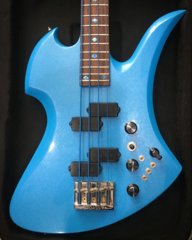
personally, i don’t recommend a lot of the advice given so far, aside from keeping your tone knob at max and cranking your mids. your finger technique is most likely fine, and playing closer to the bridge is gonna give you a more nasally tone, which maybe doesn’t sound like you’re looking for.
Cheapest and easiest is to try a set of stainless steel strings, like DR Hi-beams.
Try out a GK or an ampeg SVT 3 head.
ABSOLUTELY try out a Tech 21 sansamp. You can basically set one at noon and it’ll drastically liven up your tone.
switch to a sealed 4x10” cab instead of the ported 15”. this is instantly going to remove a lot of the wooly, woofy thump from your bass tone, and will translate that faster attack better. know that a ported 4x10”, like the ported ampeg svt410-hln, will have a similar issue.
A bass with a single coil jazz pickup configuration will give you loads of growl and presence. Fender jazz basses for sure, warwick corvettes, and a few sleeper Peavey basses you can find for super cheap will have that punch i think you’re looking for.
Cheapest and easiest is to try a set of stainless steel strings, like DR Hi-beams.
Try out a GK or an ampeg SVT 3 head.
ABSOLUTELY try out a Tech 21 sansamp. You can basically set one at noon and it’ll drastically liven up your tone.
switch to a sealed 4x10” cab instead of the ported 15”. this is instantly going to remove a lot of the wooly, woofy thump from your bass tone, and will translate that faster attack better. know that a ported 4x10”, like the ported ampeg svt410-hln, will have a similar issue.
A bass with a single coil jazz pickup configuration will give you loads of growl and presence. Fender jazz basses for sure, warwick corvettes, and a few sleeper Peavey basses you can find for super cheap will have that punch i think you’re looking for.

That's all player variables...don't forget instrument set-up variablesThere is a whole universe of tones available to you, each depending on a few key variables...
1: Where you play on the string. Head towards the bridge for punch, fast transients, brightness, cleaner attack and clearer articulation. Play towards the fingerboard for more pillowy, thicker tone, slower attack, extra volume and less definition.
2: Vary the speed of your fingertips. Faster for note definition, slower for a softer attack
3: Vary the depth of the pluck. Anything from full-on hook and release to a gentle smooth glance across the surface.
4: Try different parts of the finger. The very tip for definition and punch. Move to the side of the pad for softer tones.
5: Change the angle of attack: Pluck into the face of the body for a more percussive attack and snappy tone. Play across the face for a more open, airy tone with more projection and a vocal-like quality.
6: Change the stiffness of the fingers....
7: Vary between straight and curved/hooked
8: Vary between rest strokes (apoyando) and free strokes (tirando).
9: ...
YMMV


