
• TalkBass has been independent since 1998. Add your voice.
    Create a free account to reply to discussions, view embedded media, and browse with fewer display ads.
    Join freeLog in
    Want zero display ads or expanded classifieds tools? Compare plans.

Tube Op Amps Experience/Interests?

I only have a single tube project to finish before I need a new one but being it's been a half built bass preamp for three years now I probably won't be looking into utilizing the tube op amp too soon... Always good to learn something new though!
 
Look at this!
An Op-Amp made with Transistors! ;)
The XL741 Discrete Operational Amplifier | Evil Mad Scientist Laboratories
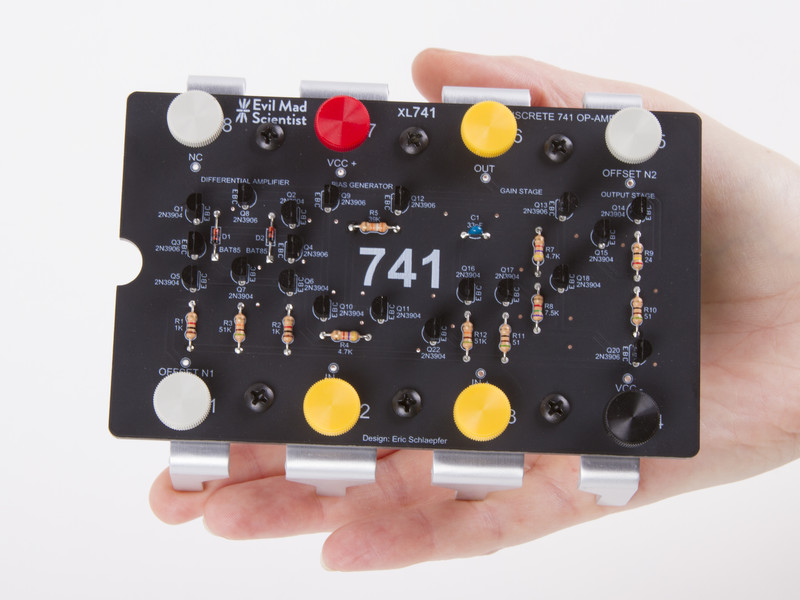
1@2x.jpg

I heard they'll get smaller when we go to the moon.
An even eviller madder scientist could probably redesign that to use 741 ICs instead of transistors (like an op-amp Big Muff), thus building an XXL op-amp out of op-amps.
 
What's the advantage of using a tube as an op-amp?
Today?, none that I can see! The original opamps were made from tubes because transistors did not exist but the need for opamps did. Discrete transistor opamps were used before ICs replaced them. Technology marches on but it is entertaining to recreate ancient artifacts so there, I guess I do see one "advantage" of using a tube opamp! When I was in college it was long enough ago that analog computers were still expected to play an important role in the professional life of a working engineer so I was given instruction on using them. I don't know if the computers in the lab that we practiced on were tube, discrete transistor, or integrated circuit based but we did use them enough to become familiar with how to solve a problem using one. As it turns out I never again needed to do that but the techniques you use to "program" an analog computer were useful in general analog circuit design as well so the time was not wasted. Tube based opamps were used in every kind of circuit application that you might use an IC opamp today, not just in analog computers. I suppose the novelty of a tube opamp circuit design could be marketable in a niche sort of way but I doubt they will make significant inroads into modern musical circuit design. They are a fascinating chapter in the history of technology however.
 
  • Like
Reactions: cfsporn
Here is some interesting history on the op-amp. As Walt Jung describes, the term operation amplifier was coined in 1947 but the origin of using tubes in this configuration dates back to the dawn of tubes.
Very good paper. It should be noted that many of these pioneers, including Bob Pease, are no longer with us. These guys were brilliant engineers in every sense of the word, and maintained their quirkiness throughout their lives.
 
it's a interesting history too. and a few well known names came to develop them. and of course a few that deserve more credit. the main financial interest and research seems to stem from the 40s when early single input op amps increased artillery accuracy by 90%. inverting inputs came next and then chopper stabilization
 
it's a interesting history too. and a few well known names came to develop them. and of course a few that deserve more credit. the main financial interest and research seems to stem from the 40s when early single input op amps increased artillery accuracy by 90%. inverting inputs came next and then chopper stabilization

They touch on the GAP/R that you started this discussion with. Understanding where concepts come from and how the evolved is important.
 
sonkey said:
Look at this!
An Op-Amp made with Transistors! ;)
The XL741 Discrete Operational Amplifier | Evil Mad Scientist Laboratories
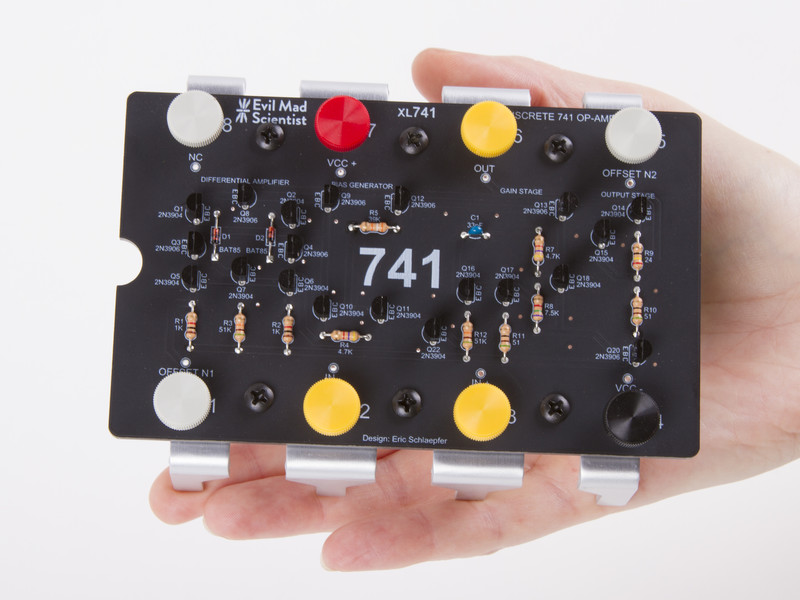
1@2x.jpg

I heard they'll get smaller when we go to the moon.

building discrete op amps can be very educational helps understand input topologies, stabilization, noise reduction and current mirrors etc etc
I use to build experimental touch synthesizers called kracle boxes or crackle box. which uses the very unstable old 709 op amp. it was hard to find and I've paid 8 to 13 dollars for single ic. so eventually I just built my own discrete 709s.
likewise older and slower op amps do actually distort better. and I've built rather simple op amps to be overdriven.
 
Very good paper. It should be noted that many of these pioneers, including Bob Pease, are no longer with us. These guys were brilliant engineers in every sense of the word, and maintained their quirkiness throughout their lives.

In an ironic tragedy Bob Pease died in a car crash on the way home from a memorial service for another early analog circuitry giant, Jim Williams. The industry and anyone who loves analog electronics lost two irreplaceable beacons of knowledge in a very short time. It was quite a shock to all of us.
 
I have one of those Philbrick op amps. ;) Never fired it up, though. The data sheet says that the gain bandwidth product is 100 kHz, which means you'd struggle with intermodulation distortion at audio frequencies unless you manage the overall circuit gain carefully.
 
Back in the day I worked on Subscriber Trunk Dialling racks. There was a massive rotating drum at the centre of the rack. the rest was taken up with little plug in modules we called toggles. Each had a pair of wire in tubes, pentodes as I recall. The object was to write onto the drum the area code of where you needed to call. The drum was then read to give all the numbers to direct the call though all the switching centres you needed to go through to get to that destination. 01 was London and 051 was Liverpool. Still is actually.

A huge power supply was in the bottom position. these supplied high voltage power for the toggles, IIRC 250 - 350V DC plus heater power. Firing up one of the power supplies for the first time was always somewhat of an adventure. Sometimes the filter caps were installed backwards and would explode and fill the air with unravelling foil. Quite pretty really but a bit stinky. :D

I always thought one of those drums would have made a great echo unit ala Binson. Would have been huge though, not to mention heavy. We were always terrified of damaging that damn drum. The replacement cost of 1800 quid was a small fortune to someone earning around 12 GBP a week!
 
Last edited:
  • Like
Reactions: webmonster
@fdeck
good point. i was planning on using
a gain of 1 to 5 to keep the noise down. didn't even think of bandwidth product. 100,000 make a calculations easy. with gain of 10 bandwidth is only 10,000hz. wow lol. good news is it's within bass range. bad news guys looking to get up to 20k gotta keep things low gain. I'm not looking to get gain just a 2 pole filter with a little Q at 5000Hz.

@BassmaPaul interesting story I've had interest in telephone equipment and operating methods too. likewise enjoyed fluid drum echo units as well. was the drum you speak about fluid filled
 
Last edited: