
Enjoy the benefits of a premium membership!
Upgrade Account
-
TalkBass has been independent since 1998. Add your voice.
Create a free account to reply to discussions, view embedded media, and browse with fewer display ads.
Join free Log in
Want zero display ads or expanded classifieds tools? Compare plans.
You are using an out of date browser. It may not display this or other websites correctly.
You should upgrade or use an alternative browser.
You should upgrade or use an alternative browser.
Tube Rectified bass head.
- Thread starter jeff ward
- Start date
More options
Who Replied?
They had a pretty trim for the "home" market. Best sound back in the days I ever heard was from "Blind Faith". There was 4 of them pushing EACH side of the house system. Gloriously sweet, clear, clean and the kind of loud you didn't know is there until you try to talk to someone (even yourself).
[But, they didn't use tube rectifiers]
[But, they didn't use tube rectifiers]
Last edited:

If you guys have not seen or read this, it is a most fascinating book on McIntosh, a must read for anyone who loves great audio gear, hi-fi, and superb manufacturing.
McIntosh .... For the Love of Music ....
McIntosh .... For the Love of Music ....: Ken Kessler: 9780978723606: Amazon.com: Books

Worth every penny for this really lavishly produce tome om the company.
McIntosh .... For the Love of Music ....
McIntosh .... For the Love of Music ....: Ken Kessler: 9780978723606: Amazon.com: Books
Worth every penny for this really lavishly produce tome om the company.
As an Amazon Associate, TalkBass may receive commissions from qualifying purchases made via links on this site.
I got mine for $75 as the store was closing down and the book was sitting on a coffee table. I asked the sales dude if the book was part of the 1/2 off sale going on and he said soitenly! so I could not not bring the book home, I am so glad I did, it really is worth the money. It covers the complete company history including outdoor concert events (Woodstock) and the Wall Of Sound.

I have inquired about the divided by 13 if it's multiple rectifiers or just a single/hybrid approach. I sent the email months ago and never heard back, not thrilled with their customer service, but I'll keep digging.
In the past, Fred has actually said that it's best to call Divided by 13 than send him an email. I know that doesn't really excuse it, but he seems a bit behind the times on the IT end of things.
How about an end run around the problem with a tube rectified preamp? The Jule Amps Monique gets part of its feel from the tube rectifier...
This has probably been covered before, but does the rectifier in the Monique really do anything for the feel? I've seen it asserted by a number of amp designers that the desirable "sag" from a valve rectifier is only significant with class AB power amps, as with class-A circuitry (like most preamps) the current demand does not vary with output to the same extent. The current draw of a preamp is much lower than that of a power amp too, so I'm somewhat sceptical that rectifier sag is a significant factor in a standalone preamp.
Though I'm sure that with the 6SL7 preamp and transformer output it'll still sound very good indeed!
I got mine for $75 as the store was closing down and the book was sitting on a coffee table. I asked the sales dude if the book was part of the 1/2 off sale going on and he said soitenly! so I could not not bring the book home, I am so glad I did, it really is worth the money. It covers the complete company history including outdoor concert events (Woodstock) and the Wall Of Sound.
Without reading further that you were talking about a book, I thought you were saying you picked up a MacIntosh tube amp for $75.00
BurningSkies
CRAZY BALDHEAD
- Feb 20, 2005
- 27,956
- 20,350
- Disclosures
- Endorsing artist: Dingwall Guitars
This has probably been covered before, but does the rectifier in the Monique really do anything for the feel? I've seen it asserted by a number of amp designers that the desirable "sag" from a valve rectifier is only significant with class AB power amps, as with class-A circuitry (like most preamps) the current demand does not vary with output to the same extent. The current draw of a preamp is much lower than that of a power amp too, so I'm somewhat sceptical that rectifier sag is a significant factor in a standalone preamp.
Though I'm sure that with the 6SL7 preamp and transformer output it'll still sound very good indeed!
It really does. I've switched mine out before only to switch back because the replacement tube didn't have the same feel and messed with the note envelope. I would guess that having a tube rectifier in the Monique is one of the 'big secrets' in it sounding and feeling like a fully tube amp.
Well, silly old me could have had a MC240 for free, but I did not take advantage of the situation at the time (early '80s).Without reading further that you were talking about a book, I thought you were saying you picked up a MacIntosh tube amp for $75.00


Back to the OP's question.
Unless you are content with a lower powered bass/guitar amp, like a B-15 or early Bassman,
there really is no advantage to a tube rectifier unless
you want sag and a looser low end response.
Back in the day, trying to borrow friend's B-15s and Bassmans at jams, it was all mud & distortion if you pushed them at all.
Some of that may have been the speaker of choice, but it was mostly that those amp just didn't hold together very well, especially for live use in a rock band up against a drummer.
I never understood how Ronnie Lane could keep up with Kenny running his B-15, but they
also had amazing intra-band volume discipline.
While this is totally classic, Ronnie would have had very little definition unless
he used a pick.
Unless you are content with a lower powered bass/guitar amp, like a B-15 or early Bassman,
there really is no advantage to a tube rectifier unless
you want sag and a looser low end response.
Back in the day, trying to borrow friend's B-15s and Bassmans at jams, it was all mud & distortion if you pushed them at all.
Some of that may have been the speaker of choice, but it was mostly that those amp just didn't hold together very well, especially for live use in a rock band up against a drummer.
I never understood how Ronnie Lane could keep up with Kenny running his B-15, but they
also had amazing intra-band volume discipline.
While this is totally classic, Ronnie would have had very little definition unless
he used a pick.
Last edited:

McIntosh amps are beasts - they have been in commercial use
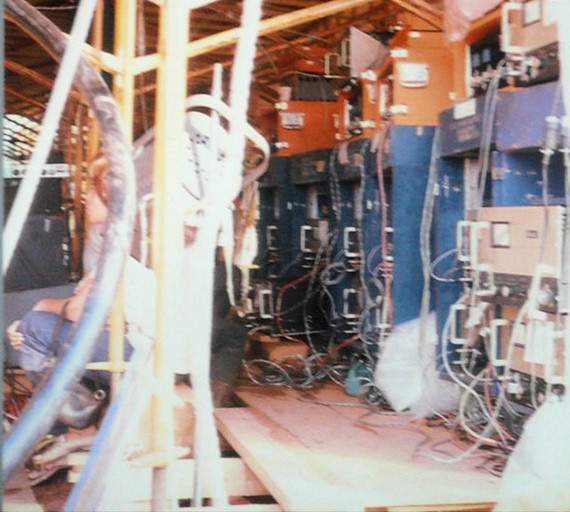 sporadically due to their high price/watt, weight and fragile front glass. The older metal face commercial amps were more often used by bands - Grateful Dead wall of sound, and Woodstock PA to name a couple. The MI-350's in the photo were used under the main stage at woodstock - 350 watt monoblocks - very rare and valuable today!

Back to the OP's question.
Unless you are content with a lower powered bass/guitar amp, like a B-15 or early Bassman,
there really is no advantage to a tube rectifier unless
you want sag and a looser low end response.
Back in the day, trying to borrow friend's B-15s and Bassmans at jams, it was all mud & distortion if you pushed them at all.
Some of that may have been the speaker of choice, but it was mostly that those amp just didn't hold together very well, especially for live use in a rock band up against a drummer.
I never understood how Ronnie Lane could keep up with Kenny running his B-15, but they
also had amazing intra-band volume discipline.
While this is totally classic, Ronnie would have had very little definition unless
he used a pick.
Not sure what these gigs are that people play that a 50 watt tube amp isn't performing. I've played to 20000 all the way to 5 people in a bar. All have a PA system, the amp is for stage volume and to be mic'd for the PA. Do you play death metal at ear bleed volumes? Why not use in eaR monitors if so?
The need for these massive wattage amps blows my mind, unless you play no PA support shows. Even then, unless you're doing large theaters I still don't see how you need that much power.

Back to the OP's question.
Unless you are content with a lower powered bass/guitar amp, like a B-15 or early Bassman,
there really is no advantage to a tube rectifier unless
you want sag and a looser low end response.
Back in the day, trying to borrow friend's B-15s and Bassmans at jams, it was all mud & distortion if you pushed them at all.
Some of that may have been the speaker of choice, but it was mostly that those amp just didn't hold together very well, especially for live use in a rock band up against a drummer.
I never understood how Ronnie Lane could keep up with Kenny running his B-15, but they
also had amazing intra-band volume discipline.
While this is totally classic, Ronnie would have had very little definition unless
he used a pick.
I am going to pretend I didn't just read this post.

Yeah, it's not a loud amp, but if you run it cleanly, there's plenty of definition. Of course, like you said, some of the speakers used in them are darker than others. Like the 60's CTS's have plenty of definition but the 70's CTS were considerably darker. And the Altecs in the 70's were also brighter and had more mids. And when you crank one to the level that Ronnie Lane did, it ain't quiet by any means. I've done as big as an 800 seat theater with one running clean using nothing but stage volume and my band isn't especially quiet.
Apologies for not reading through the entire thread before posting, it's late.
Two of my low powered bass amps have tube rectifiers, Fender Bassman 5E6 (45 watts), arguably not a bass amp, actually has two recto tubes.
And Ampeg B25 (55 watts) has a 5ar4 which when replaced by a plug in SS rectifier has shown an increase of about 3% to the plate voltage. From 520 to 535. The amp becomes noticeably punchy and seems more powerful compared to running the 5ar4. You can actually perform with it in SS mode.
Two of my low powered bass amps have tube rectifiers, Fender Bassman 5E6 (45 watts), arguably not a bass amp, actually has two recto tubes.
And Ampeg B25 (55 watts) has a 5ar4 which when replaced by a plug in SS rectifier has shown an increase of about 3% to the plate voltage. From 520 to 535. The amp becomes noticeably punchy and seems more powerful compared to running the 5ar4. You can actually perform with it in SS mode.
Back to the OP's question.
I never understood how Ronnie Lane could keep up with Kenny running his B-15, but they
also had amazing intra-band volume discipline.
While this is totally classic, Ronnie would have had very little definition unless
he used a pick.
Notice Ron Wood is using a little Fender Champ, which must help with the stage volume. I think that's a great idea for these sort of TV studio appearances, where every other band would have showed up with the same stacks they'd use for a festival gig. It's weird that no other band at the time (that I'm aware of) thought of taking that approach!
A lot of people assume Ron Wood is using a small Fender for that show, but closer inspection shows it's either front panel Jet, Reverbocket II or a Gemini I. Their back line was Ampeg.Notice Ron Wood is using a little Fender Champ, which must help with the stage volume. I think that's a great idea for these sort of TV studio appearances, where every other band would have showed up with the same stacks they'd use for a festival gig. It's weird that no other band at the time (that I'm aware of) thought of taking that approach!
That era Fender would not have the Tolex Bar under the Faceplate.
Best I could do with stop motion.
Last edited:
Latest posts
-

-
-
 Misled by Talkbass Seller on Recent Trade
- Latest: MultiScaleMale
-

-
