• TalkBass has been independent since 1998. Add your voice.
    Create a free account to reply to discussions, view embedded media, and browse with fewer display ads.
    Join freeLog in
    Want zero display ads or expanded classifieds tools? Compare plans.

Double Bass Tuning a C extension

For several years I used a Thomastik fine-tuning tailpiece. I'm sure other players have seen or used them-all metal, heavy, with fine tuners for each string, which I never used. Why I started using it I have no clue. I know a player who has adapted a Thomastik five-string fine tuning tailpiece to tune a low B that is wrapped around a common peg with the E string and is tuned with the fine tuner. It seems to work well for him.
 
  • Like
Reactions: BassFalcon
I remembered that I still have this Thomastik tailpiece and dug it out of a box of old gear. It must weigh a couple of pounds and is extremely ruggedly built. It has a solid, very stiff wire and must have been a real vibration killer. I don't know what I was thinking, but actually used it for quite a while. I replaced it with a composite, extremely light one that really opened up the instrument. Who knew? :)
 
  • Like
Reactions: BassFalcon
that’s kind of funny, I had the exact same thought, maybe I should change my order from a 4+extension to just a 5-string. It would be cheaper. There’s no playability issues or extra costs for gates or tuning conundrums. I get a low B instead of a C… Upton apparently knows how to make a great 5er from what I can gather. I’ve played 6-string electric bass for about 25 years now so I’m very comfortable with a B-string. I’m really thinking now, To quote The Mandelorian, “This is the way”

If that's where your heart is, go for it. There are no wrong answers here.

It's worth noting a few things, though. Adding a 5th string adds a lot of tension onto the top, and the top ends up being thicker to account for it. The string spacing is altered, and the A ends up sort of in the middle of the bridge, which can we be weird to play. Obviously, fivers are common in Europe, so there are basses and bassists for whom it works great, but it's a bigger compromise, in my opinion, than simply adding a 5th or 6th string to an electric bass.

As a further counterpoint, since I'm playing devil's advocate, I have a bass with an extension. I love when I get to use the low notes in the orchestra, and I can sometimes use the open C to "cheat" notes in upper positions (there's a trick in the prelude of the 1st Bach suite where using your thumb to play a C harmonic at the octave). However, I often find myself longing to not have an extension at all. They're heavy, adding weight at the top of the instrument, and playing on the extension can be awkward and difficult. If I wasn't playing regularly with orchestras where the other players mostly don't have extensions, I would take mine off. I dream of having a "solo" bass where I can't unabashedly have no extension with no regrets.

One of my teachers (who was admittedly more of a soloist than an orchestral player) doesn't have an extension on his Laborie bass, and instead tunes to DADG when he needs a lower note. Tuning a normal lengthE to a C doesn't work so well, but I have done it. I know other people who have learned to just live in DADG for orchestra work.

Anyway, food for thought.
 
If that's where your heart is, go for it. There are no wrong answers here.

It's worth noting a few things, though. Adding a 5th string adds a lot of tension onto the top, and the top ends up being thicker to account for it. The string spacing is altered, and the A ends up sort of in the middle of the bridge, which can we be weird to play. Obviously, fivers are common in Europe, so there are basses and bassists for whom it works great, but it's a bigger compromise, in my opinion, than simply adding a 5th or 6th string to an electric bass.

As a further counterpoint, since I'm playing devil's advocate, I have a bass with an extension. I love when I get to use the low notes in the orchestra, and I can sometimes use the open C to "cheat" notes in upper positions (there's a trick in the prelude of the 1st Bach suite where using your thumb to play a C harmonic at the octave). However, I often find myself longing to not have an extension at all. They're heavy, adding weight at the top of the instrument, and playing on the extension can be awkward and difficult. If I wasn't playing regularly with orchestras where the other players mostly don't have extensions, I would take mine off. I dream of having a "solo" bass where I can't unabashedly have no extension with no regrets.

One of my teachers (who was admittedly more of a soloist than an orchestral player) doesn't have an extension on his Laborie bass, and instead tunes to DADG when he needs a lower note. Tuning a normal lengthE to a C doesn't work so well, but I have done it. I know other people who have learned to just live in DADG for orchestra work.

Anyway, food for thought.

I neglected to add, with an ordinary 4 string and no extension you have more options and less to worry about when choosing strings.
 
If that's where your heart is, go for it. There are no wrong answers here.

It's worth noting a few things, though. Adding a 5th string adds a lot of tension onto the top, and the top ends up being thicker to account for it. The string spacing is altered, and the A ends up sort of in the middle of the bridge, which can we be weird to play. Obviously, fivers are common in Europe, so there are basses and bassists for whom it works great, but it's a bigger compromise, in my opinion, than simply adding a 5th or 6th string to an electric bass.

As a further counterpoint, since I'm playing devil's advocate, I have a bass with an extension. I love when I get to use the low notes in the orchestra, and I can sometimes use the open C to "cheat" notes in upper positions (there's a trick in the prelude of the 1st Bach suite where using your thumb to play a C harmonic at the octave). However, I often find myself longing to not have an extension at all. They're heavy, adding weight at the top of the instrument, and playing on the extension can be awkward and difficult. If I wasn't playing regularly with orchestras where the other players mostly don't have extensions, I would take mine off. I dream of having a "solo" bass where I can't unabashedly have no extension with no regrets.

One of my teachers (who was admittedly more of a soloist than an orchestral player) doesn't have an extension on his Laborie bass, and instead tunes to DADG when he needs a lower note. Tuning a normal lengthE to a C doesn't work so well, but I have done it. I know other people who have learned to just live in DADG for orchestra work.

Anyway, food for thought.
All very good points, thank you! I appreciate it, as I try and figure out what it is I want. My thinking is as follows; I already have the Deluxe top option on my order which is basically just a lot of extra attention to detail when they carve the top, so I believe if I went with a 5er that they would really take the time to carve it right and not leave it too thick and unresponsive…because that’s exactly what I’m paying for. I’m thinking the closer string spacing could actually facilitate easier upper register acrobatics for both the bow and left hand. I’m also considering moving to 7/8, which considering a really well carved top should help make this bass an absolute cannon, blasting the back row with low B’s lol. But that should also lead to a great tone and projection for the upper register as well. At least that’s my theory.
 
Last edited:
so I believe if I went with a 5er that they would really take the time to carve it right and not leave it too thick and unresponsive…because that’s exactly what I’m paying for. I’m thinking the closer string spacing could actually facilitate easier upper register acrobatics for both the bow and left hand. I’m also considering moving to 7/8, which considering a really well carved top should help make this bass an absolute cannon, blasting the back row with low B’s lol. But that should also lead to a great tone and projection for the upper register as well. At least that’s my theory.
I have two similar German fully carved basses: 3/4-4str 1968 and 7/8-5str 1967 in different price classes. A five-string bass costs more and sounds better. I'm not a virtuoso, but this is the best sound in the entire range. It is more responsive and has a rich timbre. My 5-str.bass has more string-space than many 4-str.bass, but it has a thick neck and big body, it takes some getting used to. I think the sound is more about the quality and price than the number of strings.
 
  • Like
Reactions: BassFalcon
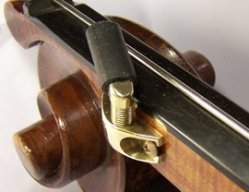
Veering off topic here, but does anyone use a fine tuner on their C/E string?

I've seen a few on basses for sale, but I've never found a source to buy such a thing. I'm starting to think that they only exist as specialty items handmade by request.

Rene Zaal in Arnhem, NL makes them. They are heavy though. The only time I can see a need would be maybe with a 5-string conversion where the added 5th string tuner doesn't work very well, or withsome older extensions which either have no pulley or the string binds on the volutes.
 
  • Like
Reactions: Carl Hillman
Veering off topic here, but does anyone use a fine tuner on their C/E string?

I've seen a few on basses for sale, but I've never found a source to buy such a thing. I'm starting to think that they only exist as specialty items handmade by request.

Here's one on a 5 string:

View attachment 4750051
Haven’t found a need for my 5 string. The B is pretty darn stable. Albeit it’s a Spiro and I live in SoCal, so weather (asides from fires) is a mystery to me and my basses.
 
  • Like
Reactions: Carl Hillman

Latest posts