• TalkBass has been independent since 1998. Add your voice.
    Create a free account to reply to discussions, view embedded media, and browse with fewer display ads.
    Join freeLog in
    Want zero display ads or expanded classifieds tools? Compare plans.

Double Bass tuning a cello like a bass- where to find strings?

:hyper:thanks for this post- I have always wanted to play the cello- never occurred to me that I could just change the strings- makes me wonder what else I don't know. You can tell by the response that you have asked a good question and I hope that WE get to a good answer(not that there hasn't been some already)that works the best. If so, I will now be able to play three instruments not very well.

With lots of bass and cello love
 
Well, I found this thread looking for playing a cello as a bass. I knew someone a while back who put a strap on a cello and tuned and played it like a bass guitar (over the shoulder with a strap, not stand up style) and said it was a blast. Not sure what strings he had, but he played in EADG tuning. I am not interested in the straight up and down playing but more electric style on a big hunk of hollow wood for a unique sound. Traditionalists say playing it like a bass will kill your cello, but I don't see why? Just thought I would chime in with my take on it.
 
Super-Sensitive makes viola da gamba strings in flat-wound perlon. Get a low D and tune it up to E. Same or similar string length to a 4/4 cello, and they make 3 gauges. Here's one source:
[Invalid or Expired Link Removed]

Probably a bunch cheaper than the custom Kolstein strings.
 
When I get the time, I will write on how to calculate for a cello from any given bass string tension. If one can do this, the choice of strings and tensions is only limited by the amount of manufacturers who do not publish a tension (and exact scale) spec.
 
Years ago, Karl Fruh the great cello teacher and studio musician in Chicago had an old 3 strings church bass which was a 32" body cello converted into a EADG cello/bass for studio work. It was a Ballzy instrument that played wonderful and made him a lot of money. Later on, he had a Voller Brother cello converted to E A D G. He used it on several recordings including some tracks with the '60s band HP Lovecraft.
 
I would say D'Adarrio Flats. They already have the winding, so they won't hurt the pegs at all, and they feel rather like a cello string/bass string hybrid, IMHO. I use them on my electric, and absolutely love them. :D
 
its a different story with a different octave. I prefer the cello to work closer to its designed resonance. There are decent sets specifically designed for "1/10" or "1/16" basses which are also 70 - 72 cm string length.
For the bass guitar strings, if you want to check the tension--I would do this first because there are some steel or flatwownd sets with extremely high tension--, whatever the percentage difference there is in the vibrating scale length, you must square the difference to arrive at the difference in tension. for example: a half step in length or tuning (1.059) translates to app. 1.12. 12% plus or minus tension.

Remember, you will need to be recutting the nut and possibly the bridge. and forget those fine tuners. Go and buy some knilling peg gears. I did not want to modify a valuable old cello, so I made a replacement bridge and a nut with wider spacing for my 8ve above the bass 4th tuning.
 
I forgot to mention. for the higher octave it gets a little more complicated. You can make a standard formula for the bass strings from each scale length (Combining pitch and scale difference), but only for scale lengths that match. for example, daddario uses different lengths than thomastik for most size basses. So a different formula for each company.
I also suggest using same construction ex. Spiral core bass D and G and Cello D and A (eadg), or braided core etc....when possible, for consistent result out of the gate, but of course you can mix to your own taste.
 
Maybe because fifths sound better??? And yes, I do admit to being biased....

Years ago I had a conversation with Red Mitchel about this, he would agree with you about the instrument sounding better. Balance, overtones were cited. Fingeringwise he felt that for playing bebop it was also better for him, though for blues a bit less natural the way things laid. His initial reason though, was to not have a 5th string or an extension which was a requirement for the studio work he was doing. He went into the shortcomings and impracticalities of these methods.

He also raved about Jim Hughart who he said could switch between 5ths and 4ths, which he could not.
Btw, remember the Barney Miller theme? And of course the beatuful playing on records with Tom Waits.
 
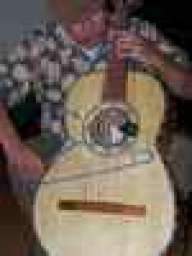
I don't know if this is of any use to you, but on my 26" (660mm) scale upright guitarrón—which I play sitting behind it like a cellist, pizz only—I'm very happy with a set of six Rotosound Tru Bass 88s (RS886LD), which are black-nylon-wrapped flat-wounds 0.075" (G2) to 0.135" (E1). (I'm ignoring the two highest strings for this discussion.) These are ball-end strings, and I had to enlarge the bridge holes to take the increased gauges. They have a far more dark, thumpy sound that is closer to a DB sound than the original round-wounds had.
 

Latest posts