If the neck was unstable in a way that affected the tuning, you should be feeling a clear difference in action/string height also.
Actually I didnt feel a notable difference in action/string height.

TalkBass has been independent since 1998. Add your voice.
Create a free account to reply to discussions, view embedded media, and browse with fewer display ads.
Join free Log in
Want zero display ads or expanded classifieds tools? Compare plans.
If the neck was unstable in a way that affected the tuning, you should be feeling a clear difference in action/string height also.
My (limited) understanding is that the whole instrument swells with humidity, which slightly increases the distance between top and back plates. If the post was cut in a much different environment, there might be more top movement in the humid environment than ideal. Again I'm absolutely not a luthier but it's one hypothesis.
Might also check the fingerboard glue joint as Ben Green suggested, and you'd probably be having other big issues if the bass bar was loose, but might as well look in there with a flashlight and mirror and rule it out?

 Looking at the first pictures, it seems the neck may have shifted (triangular shadows at the joint, both sides). My bass recently fell off the chair it was resting on, at a gig, and, though it still played, was no longer stable in tuning. I soon realized the neck, though still attached, and unable to be felt moving, was in need of resetting. I reset it (hidden dowels from a previous hack job made it difficult), and now it sounds better than before its accident. Here are some pictures of mine.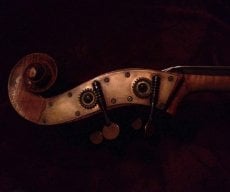
View attachment 3420582 Looking at the first pictures, it seems the neck may have shifted (triangular shadows at the joint, both sides). My bass recently fell off the chair it was resting on, at a gig, and, though it still played, was no longer stable in tuning. I soon realized the neck, though still attached, and unable to be felt moving, was in need of resetting. I reset it (hidden dowels from a previous hack job made it difficult), and now it sounds better than before its accident. Here are some pictures of mine.View attachment 3420582 View attachment 3420582
I cursed the idiot who did this when I discovered it.Folks, PLEASE, no dowels. You’re actually removing material and making a weaker joint.

Luis,
Your first two pictures: 1st picture, triangle shape from bass top side (left)-thin apex crescendo shape to back (right) where the neck joins the body. Perhaps a quarter inch wider at back. Identical on picture two. If this is not an illusion in the photo, it may indicate that the neck has at some time, moved, within the block, raising the action. If it happened a long time ago, it could still indicate possible subtle motion is possible.
Steven
Yes, I noticed this, too, and have had exactly the same issue in high-humidity environment. Since then, I always store the bass in its bag when not in use.
It looks like the neck may have moved and that the heel button was filed down. You can check current movement by holding the bass body and pulling on the neck. If there is movement, then the neck needs a re-set. Also, check if there is a slight gap between the button and the neck heel. If you can slide a razor blade in there, then it needs a re-glue.

Hi, thanks for the insight.
You are correct @CreativeBass , as @notabene mentioned, the neck had shifted a little. Considering that the fingerboard had been ruined by a luthier some years ago and other problems and the fact that I didnt have the cash, time and certainty I could fix everything at this moment I opted to trade it in for a new instrument which is more ergonomically sound for me (that bass was always awkward, not large but heavy and difficult to feel at ease with even if it had a very nice sound)
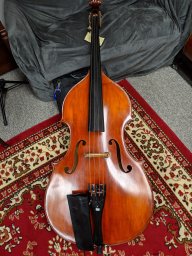
The bass had an origin attributed to "Prague" circa early 20th century and had very pretty and nice wood.
Not sure if the neck was still moving but by far it is the most sensitive bass to humidity I ever owned here so if there was loosenes, which I was able to confirm later, that seems to have been the major cause of the problem. Unfortunately here in Puerto Rico there is no one that can do proper neck resetting or major fingerboard work at the moment and I didnt want to do the "experiment" since I dont have the time and money to invest.
But thanks to everyone for the comments and discussion, I learned many things.


