• TalkBass has been independent since 1998. Add your voice.
    Create a free account to reply to discussions, view embedded media, and browse with fewer display ads.
    Join freeLog in
    Want zero display ads or expanded classifieds tools? Compare plans.

Tutmarc audiovox model 736: where are they?

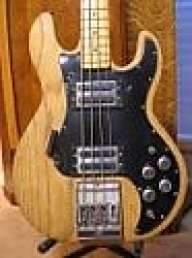
The tutmarc 736 in nashville and the one Peter has both have a scratch plate that goes all the way to the bridge, there is a wire under it that connects the bridge to ground and the pickup cavity . the one in the museum does not, so it could have been modified I.E. the pickup moved and painted white at a later time probably by Bud since he talks about moving the pickup to the middle in his interviews alot, the jack could be original or not since some of the lap steels made by paul have screw on connectors.
I believe the bass was not successful as in productionwise because Paul really lost interest, with his love life a mess and the bridge problem and the fact he made them one at a time he probably didn't care.
 
The tutmarc 736 in nashville and the one Peter has both have a scratch plate that goes all the way to the bridge, there is a wire under it that connects the bridge to ground and the pickup cavity . the one in the museum does not, so it could have been modified I.E. the pickup moved and painted white at a later time probably by Bud since he talks about moving the pickup to the middle in his interviews alot, the jack could be original or not since some of the lap steels made by paul have screw on connectors.
I believe the bass was not successful as in productionwise because Paul really lost interest, with his love life a mess and the bridge problem and the fact he made them one at a time he probably didn't care.

I'd really like to see under the scratchplate of the white EMP bass! Did Paul Tutmarc's steels have a ground wire to the bridge? My other big wish is that the owners of any of the surviving Audiovox or Serenader basses would come forward with some more specs! I have emailed EMP again, they replied promptly the first time with the few measurements they had on file, but no further response. Where ARE those Serenaders hiding?
 
Fuzzy pics from Vintage Guitar mag march 1999. The transcribed text is in post #160.
 

Attachments

  • image.jpg
    image.jpg
    66.2 KB · Views: 247
All these recent developments and new articles and photos are very exciting to read. I am transfixed following all of this, and am still hoping that after everyone's research and Bflat's hard work making prototype reconstructions, that one day those of us interested in the history of Tutmarc's invention might be able to buy an affordable copy!

I know....who would be crazy enough to spend the money doing all the steps necessary to go into production offshore or otherwise, making a very limited interest historical "conversation-piece" electric bass?

I sure hope someone here at TB would! Many of us here own AVRI basses, or even "Classic Vibe" recreations of Leo Fender's original Precision. I would absolutely be interested in owning a "recreation" of the first Tutmarc bass! For that matter, considering how many guys out there are rebuilding early tube amps now, why not a copy of the 236 amp to go with it?

I think that this combo would be JUST the thing for the "Bass Player Who Has Everything", and if priced accordingly, would be affordable to those of us who DON'T! Please sign me up as one who wants to be put on a waiting list for such an opportunity!


.
 
eldoryder,
I have considered doing just that. alimited run of Tutmarc 736's and a 236 amp to go with it. But What would you build for the 736.....A bass that is updated with a bridge that makes it play in tune???? or an exact copy with its flaws???? What about a pickup? I'm building horseshoe pickups right now trying to get it like the original.....After my Walnut copy is finished and is as close to original as possible. I will build one more out of one piece of alder with new bridge, pickup and volume and tone control to play on stage....to copy the 236 is easy, as I just picked up an original in good shape....But I really don't see myself making many more, maybe someone else could takeup where i left off.... I would be glad to share my information
 
Bflat-

You pose an interesting dilemma....I think that whoever was going to have the means to start a limited production of the Tutmarc bass would need to get a list of those who wanted one, and were willing to put a deposit down, and ask THEM:

"Would you rather have........a
(1) Faithful to the last item exact copy of the Tutmarc <or> a
(2) "Classic Vibe" Tutmarc utilizing the body, neck, scratchplate but updated electronics and bridge for easy tuning and playability?"

Or even perhaps the "Kickstarter.com" approach, where you determine which type to build, and see how many subscribers you can get to support that decision, and get the investment money up front by a certain date? All subscribers at a certain dollar amount to get a copy?

Just scatterbraining here. Obviously, if Squier made them as a "Classic Vibe" model, they would have a street price of around $379.95, and would be made in Indonesia or China.

I am not a museum purist. Personally I would be very happy with a "Spiritually Stock" reproduction of this original bass. I want to play it, and amaze my friends! I'm sure there will be other people who would prefer to have it totally authentic.

Tough choice indeed!

As to the amp, I'm sure there's many competent woodshop cabinet makers who could recreate the 236 box and finish. Again, I would be perfectly happy to have it look authentic on the outside, and have a new 25-watt tube section amp inside without having to make it an exact electronic copy.

What does anyone else think?


.
 
What does anyone else think?

My ideal version would be the 12 fret shortscale model with the original style bridge but a bit high, unslotted and floating so I could set the action and intonation for my choice of strings and then screw it down. String-through body anchoring.

The horseshoe pickup would be fine but placement would be closer to the neck (maybe middle) position and I'd rather have a side-mounted Electro-Socket in the usual location on the lower bout.

Tuners would be the open-back Hofner style for the small headstock and light weight.

I'd stick with my modern amp choices since they're so much more adjustable, lighter, and more robust.
 
Both good choices...... It would be cool if someone could make these basses in the 500.00 dollar range....... You wouldn't believe the cost for me to experiment around just making these copies.....the copper bridges are 80.00 the scratch plate out of copper 135.00 the ebony fret board 56.00 just to get someone to make a 3 piece body was 300.00, 1930's grovers 200.00 etc..... the time I'm done with everything probably somewhat under a 1000.00......I'm sure it could be done for a lot less in quantity and still look original that would be great.....I was talking to a friend that said he could CNC a one piece body pretty cheap.....anyway I am not up to the task so it would have to be someone else with more know how.
 
What does anyone else think?.

I'm currently in the middle of my first build: an early '60s P Bass (sawed the fret slots today!) and planning on building two Audiovox basses, the first will be as close as I can make it to an original 736 dark walnut model, the second will be modified with an intonatable bridge, possibly a wider neck, possibly move the tuning pegs to get a better string line, and put the output socket in the lower bout. I was thinking of calling it an Audiovox 2, or maybe a 737?

I've sent Vintage Vibe Pickups a custom order for a blade pickup, but I'm not doing the horseshoe magnet. I sent them what specs I have, plus a copy of the Stimson patent file for the pickup as used by Dopyera, as a reference. I'm opting to put the pickup about 6" from the bridge, like the white EMP model.

I love the slab look, and the '30s vibe, and the idea that I can make one in a workshop like Paul Tutmarc and all those other cool inventors.
 
attachment.jpg


  • 1-3/4" solid walnut ( laminated from two 7/8" boards )
  • body scaled up about 5%, with 3/8" round-overs
  • Fender standard neck pocket
  • first coat of clear danish oil

This is not meant to be an accurate reproduction. It is going to be thoroughly modern and playable, with a 32" 20-fret Fender-type neck with trussrod, sealed bass tuners, intonating bridge, and modern pickup and electronics.
 

Attachments

  • audiovox_01.jpg
    audiovox_01.jpg
    48.7 KB · Views: 570
attachment.jpg


The body is now all drilled & routed ( actually, Forstner bit on drill press, just the way Tutmarc did it. Walnut shavings everywhere. ) Took a lot of coats of Dan oil to fill all the walnut pores, now just needs final finishing. Output jack will be on the side. Neck attachment is bolt-on ferrules.

The pickguard is 90% finished, still covered with masking tape, aged pearl. That is a concentric knob, this bass will have a tone control, and maybe a tiny pickup switch, if it turns out to be useful. The pickup is in the historic place, but the knob is moved out of the way a bit. I have my regrets about the bridge, but I made a shim for it, and it should work out. Kind of rounded, like the original.

The pickup I have for this is a blade-style strat humbucker. Say what? A pickup is a pickup. The only problem I can foresee is that it is a bit narrow for the string spread. If the E and G are weak, I have already routed for a lipstick pickup. I'll bet the guitar pickup works though, and will sound just fine. Or at least as good as Tutmarc's horseshoe magnet contraption ( which was brilliant in its day. )

The neck is patterned on a Precision that I had handy, but 32" scale. Stewmac fretboard, cut down; masking tape has the layout for the dot markers. The 20th fret hangs over, a design I worked out that allows you to build a 32" neck that is a drop-in replacement for a 34", with no modifications to the body. Or in this case, if I wanted, I could bolt on a 34" off-the-shelf neck. The tuners will be compact sealed Gotohs, and each will have a nearly straight string pull. I leave it to you to figure out how that is going to work.

I think that's about it. Next report will be when finished.
 

Attachments

  • P4010591.JPG
    P4010591.JPG
    152.2 KB · Views: 711
.

Wow. A "Modern-Player-Classic-Vibe" Tutmarc! That's EXACTLY what I would like to own!

.

Yep, I guess that's what it is. I had the whole thing together for a couple of days, then took it apart again for final finishing and tweaking. Other than that, the setup is coming along as expected. Always starts out awful and gets better over time as the new parts settle and you get everything dialed in. Plays pretty good already. With a new build, I usually get to a plateau pretty quickly, and then let it sit for a few months. Once everything has stabilized, I go for the final setup. My benchmark for basses is a '90s Japanese P that I have, and likewise for six strings it is 1985 Japanese Squier Strat.

The guitar pickup works great, no issues with the width, the E and G strings catch enough magnet to sound fine. The mode switch went in after all. Series mode gives a strong Precision sound. Parallel mode is a lighter Jazz sound. Single-coil is in-between, closer to the Jazz sound, but punchier. You could omit the non-humbucking single coil mode and not really miss anything, but I had the special switch lying around and I wanted to use it for something. It is quiet in all modes. That's pretty good for a cheap pickup that is not even supposed to be in a bass. It is also a very hot pickup - 5.5k per coil, so series mode roughly equals the impedance of a P-pickup. In nearly the same position with similar width, it is no wonder it sounds like it does. A 683 cap lets you really dig deep with the tone control.

The ergonomics are not great. Plays a lot like a Steinberger, all the same flaws - the body is just too small. Thankfully, walnut is pretty heavy, and weighs it down a bit. Takes some getting used to though. I ended up needing a shim for the neck, not the bridge as I had expected. I'll never buy another bridge like this - it is a real bother to set up, with 16 tiny set screws just waiting to get lost. You can't get at the intonation lock screws without removing the strings. Leo's bent steel bass bridge is still the best design ever.

Tuning up is interesting. Even with Tutmarc's reversed-taper headstock, I managed to give each tuner a fairly straight string pull to the nut, and at the same time maintain nice even spacing of the posts and knobs, and keep all of them clear of each-other. It's a clever arrangement, but upside-down inside-out backwards from anything you're used to. The plastic nut cracked, so I am going to make a brass one, and the flat headstock badly needs string hold-downs.

The first pickguard delaminated along one edge and I scrapped it. Cheap Chinese material. Luckily I had enough to make a second, which worked out fine. I also got a Hofner pickguard and some smaller pieces from the same blank, and I am working on a matching headstock logo from the remaining scrap. So I guess I got my money's worth out of it.

So all in all, I'd say it working out pretty well. I'll post some pictures when it is ready for prime time.
 
  • Like
Reactions: Sartori
Can't wait for the pics......I had trouble with the tuning issues also, in order to keep the strings straight to the tuners you have some turning one way and others turning the other....Done with my walnut recreation except pickup and finish....pic soon
 

Latest posts