And Here It Is ... "Classic Vibe - Modern Player" Tutmarc Audiovox Bass

Specs:
Neck
I never intended to build an accurate reproduction of an original Tutmarc. The 16-fret banjo neck on those looks unplayable, and the electronics are primitive. This is more of an "inspired by" ... I kept to the original aesthetics as much as possible while building a modern instrument on a budget. The rounded contours of the bridge, the blade pickup, big black knob, squared-off neck heel, and compact tuners all suggest the original, without giving up anything in playability, tone, range, or function. You could take this thing out on a gig, and you can play it any style you want, from pick to slap.
The stacked knobs keep the one-big-knob aesthetic while adding a tone control. The extra switch is tiny and easily overlooked, while the strap buttons and string hold-downs are black to blend in, because they really shouldn't be there. There is no way I was going to hard-wire a cord into the upper bout, the side output jack is conventional. The whole thing is scaled up about 5% from what I think the original dimensions are, assuming the original scale is 30.5". No extra holes for the thumb rest, which can be mounted in either of 2 positions or left off.
On the back view, you can see how I solved the string pull problem of the reverse-tapered headstock without having the tuners wind all crazy. This also gives sufficient spacing for the bigger tuners, which would otherwise not fit, since Tutmarc originally used small guitar tuners. Likewise, the strings all just barely clear the fat bass string posts. The brass nut was made from bar stock after the original black plastic one broke. This is the first time I've made a nut from brass, it is very soft and easy to work, and doesn't break like plastic. I also like aluminum for nuts.
The finish is basically varnish, which is what you end up with if you use enough Danish oil. Takes forever, I would not recommend it, and will probably never attempt it again. I must have used a gallon of Danish oil building dog-proof furniture in the past year, but it takes too long to get a guitar-quality finish. The color you see is just the wood, no stain at all. I also tried the Danish oil on the fretboard. I would never do that again, it just didn't come out like you'd want, and it took a while to clean it back up.
Walnut is very nice to work with, pity it is not more available in guitar-sized pieces. Very strong and hard, but not as brittle and chip-prone as maple, with a slightly open grain that I filled by wet-sanding in the oil. Now I have lots of scrap-sized pieces left over that I'm sure will find uses. I've already built a walnut floating bridge and tailpiece for another project. Walnut takes glue much better than rosewood, and is as strong as maple but not as hard. My guess is that it is not hard enough to securely hold frets though, that would be an interesting experiment.
It plays really very nice, and will only get better as everything settles in and I continue to tweak it. The neck feels like any modern instrument, which should be no surprise, it is patterned after a standard Fender neck. The small body leads to inevitable ergonomic issues, but no worse than a $10,000 Steinberger. Balance is not as bad as you would think, with the fairly lightweight tuners and heavy bridge for a counterweight. The bridge is a pot metal pain in the ass to set up, I will never use another one like it.
Sounds great. I really had no idea what to expect in terms of tone for this setup, and had a lipstick pickup waiting as a backup in case it didn't work out. But I must say I am very pleased with the sound. The guitar pickup works perfectly, with strong even output across all strings, and no noise. The pickup switching modes are very useful, you can get anything from a Precision to a Jazz sound. The fact that you can get such a range of great bass tones from one cheap guitar pickup ( that I selected more for its looks and price than anything else ) just goes to show how much BS there is in the guitar industry ! The tone control has an extended range thanks to the bigger cap, you can wipe away any trace of highs, and get all Gibson-muddy if you want to. All the electronics are mounted to the pickguard, nice and neat.
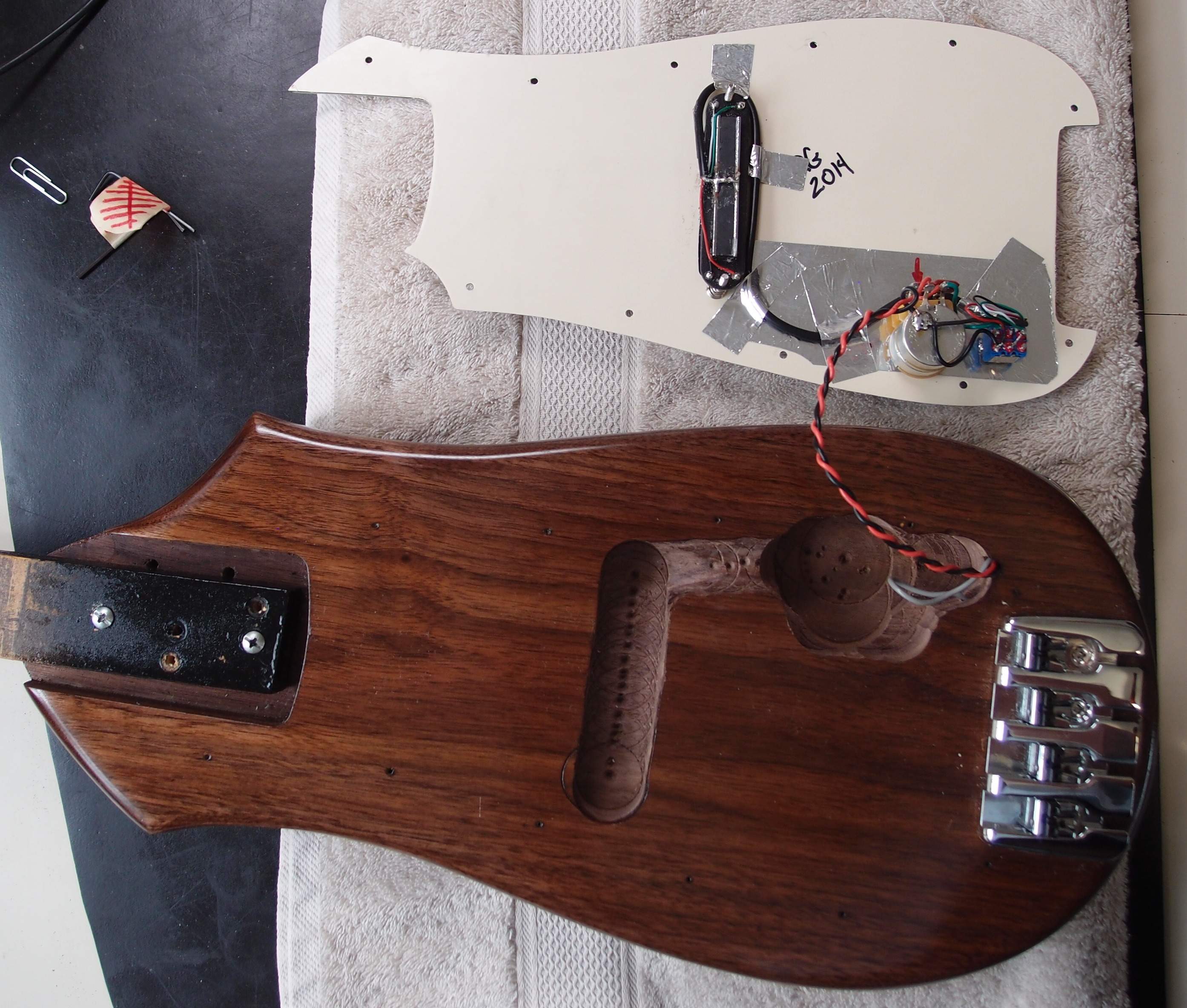
inside view - couldn't be simpler
too bad the pickguard covers the best part of the wood
These pictures are still not quite the final build. The tuners are a little crooked, the pickup is a little crooked, the nut is not fully cut, fingerboard is kind of ugly, and the finish is still not 'finished' - you can always buff it out and rub on another coat with oil. But nothing really noticeable is going to change from here. Most of these issues have already been fixed.
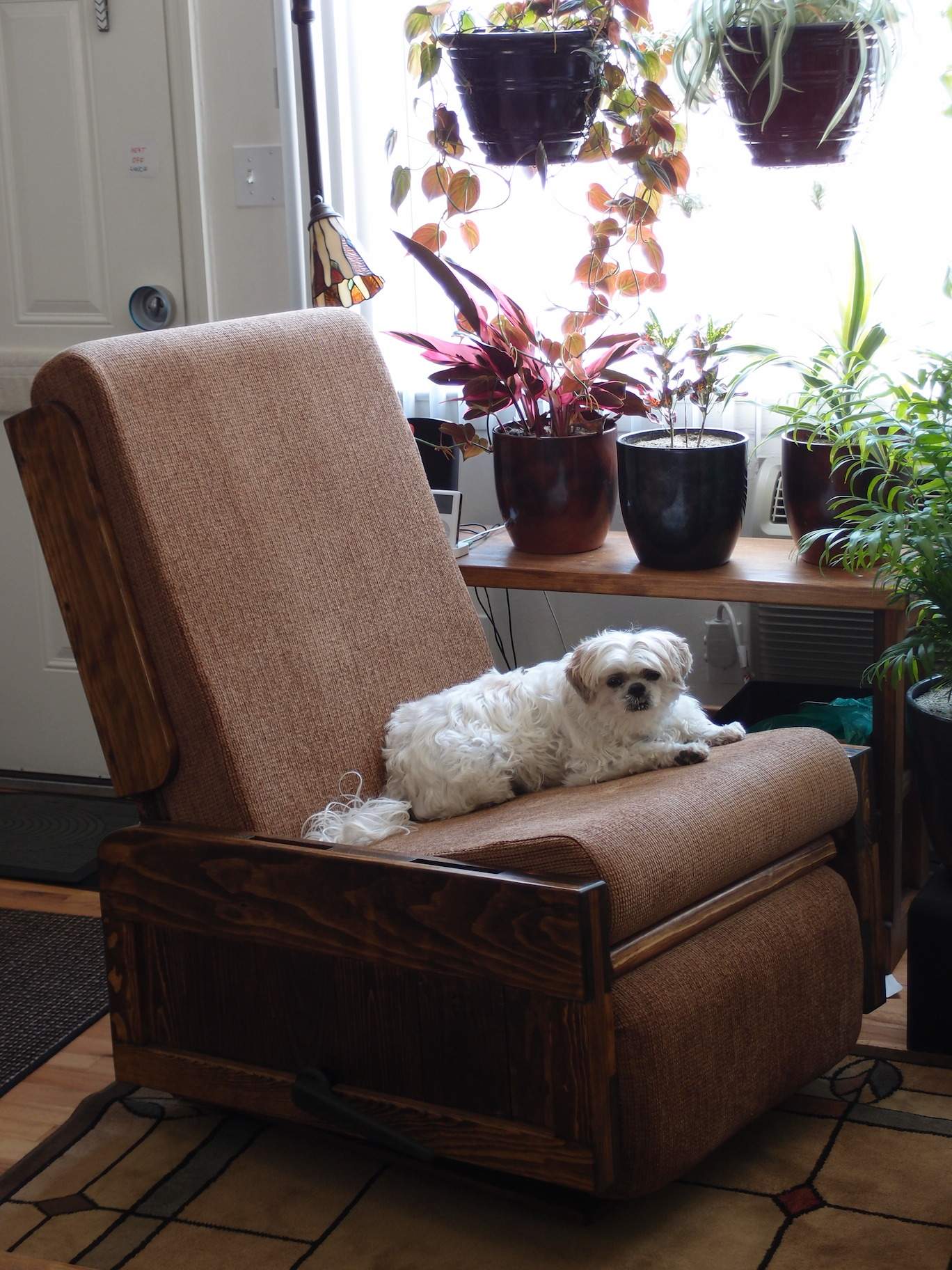
dog-proof furniture
Specs:
Neck
- wood: 7/8" walnut, Fender-style flat headstock & heel
- fingerboard: rosewood StewMac, cut down to 32" scale, re-radiused to 12"
- frets: 20 Fender Jumbo nickel, 20th fret overhanging
- tuners: Gotoh compact sealed chrome 2+2, inners reversed
- nut: Gibson-style brass, hand-made, Precision-spacing
- truss rod: salvaged Epiphone double-acting, shortened 2"
- attachment: bolt-on, chrome ferrules, SS screws
- logo: inkjet decal on pearl plastic, lacquered
- misc: 1/4" pearl markers, Fender black string guides
- wood: walnut, 1-3/4" thick, laminated from 2x 7/8" pieces, 3/8" edge radius
- bridge: adjustable high-mass chrome, 18mm string spacing
- pickguard: aged pearl plastic, SS #4 screws, walnut thumbrest
- strings: d'Addario roundwound 50-105 medium scale
- pickup: cheap Belcat dual-blade humbucker for Strat, 4-wire, 11k in series
- pickup switch: on-on-on mini for series / single coil / parallel modes
- controls: stacked 500k volume & tone, .68uf tone capacitor
- output: oval chrome side jack plate
- finish: deep polished Danish oil, clear
- overall weight: 7.4 lbs
- overall length: 42"
- cost: $300
I never intended to build an accurate reproduction of an original Tutmarc. The 16-fret banjo neck on those looks unplayable, and the electronics are primitive. This is more of an "inspired by" ... I kept to the original aesthetics as much as possible while building a modern instrument on a budget. The rounded contours of the bridge, the blade pickup, big black knob, squared-off neck heel, and compact tuners all suggest the original, without giving up anything in playability, tone, range, or function. You could take this thing out on a gig, and you can play it any style you want, from pick to slap.
The stacked knobs keep the one-big-knob aesthetic while adding a tone control. The extra switch is tiny and easily overlooked, while the strap buttons and string hold-downs are black to blend in, because they really shouldn't be there. There is no way I was going to hard-wire a cord into the upper bout, the side output jack is conventional. The whole thing is scaled up about 5% from what I think the original dimensions are, assuming the original scale is 30.5". No extra holes for the thumb rest, which can be mounted in either of 2 positions or left off.
On the back view, you can see how I solved the string pull problem of the reverse-tapered headstock without having the tuners wind all crazy. This also gives sufficient spacing for the bigger tuners, which would otherwise not fit, since Tutmarc originally used small guitar tuners. Likewise, the strings all just barely clear the fat bass string posts. The brass nut was made from bar stock after the original black plastic one broke. This is the first time I've made a nut from brass, it is very soft and easy to work, and doesn't break like plastic. I also like aluminum for nuts.
The finish is basically varnish, which is what you end up with if you use enough Danish oil. Takes forever, I would not recommend it, and will probably never attempt it again. I must have used a gallon of Danish oil building dog-proof furniture in the past year, but it takes too long to get a guitar-quality finish. The color you see is just the wood, no stain at all. I also tried the Danish oil on the fretboard. I would never do that again, it just didn't come out like you'd want, and it took a while to clean it back up.
Walnut is very nice to work with, pity it is not more available in guitar-sized pieces. Very strong and hard, but not as brittle and chip-prone as maple, with a slightly open grain that I filled by wet-sanding in the oil. Now I have lots of scrap-sized pieces left over that I'm sure will find uses. I've already built a walnut floating bridge and tailpiece for another project. Walnut takes glue much better than rosewood, and is as strong as maple but not as hard. My guess is that it is not hard enough to securely hold frets though, that would be an interesting experiment.
It plays really very nice, and will only get better as everything settles in and I continue to tweak it. The neck feels like any modern instrument, which should be no surprise, it is patterned after a standard Fender neck. The small body leads to inevitable ergonomic issues, but no worse than a $10,000 Steinberger. Balance is not as bad as you would think, with the fairly lightweight tuners and heavy bridge for a counterweight. The bridge is a pot metal pain in the ass to set up, I will never use another one like it.
Sounds great. I really had no idea what to expect in terms of tone for this setup, and had a lipstick pickup waiting as a backup in case it didn't work out. But I must say I am very pleased with the sound. The guitar pickup works perfectly, with strong even output across all strings, and no noise. The pickup switching modes are very useful, you can get anything from a Precision to a Jazz sound. The fact that you can get such a range of great bass tones from one cheap guitar pickup ( that I selected more for its looks and price than anything else ) just goes to show how much BS there is in the guitar industry ! The tone control has an extended range thanks to the bigger cap, you can wipe away any trace of highs, and get all Gibson-muddy if you want to. All the electronics are mounted to the pickguard, nice and neat.
inside view - couldn't be simpler
too bad the pickguard covers the best part of the wood
dog-proof furniture
Last edited: