A burning question I don't think has been posed- Before I remove the tweet in my 210 - Is turning the tweeter off going to accomplish the same thing? There is still a crossover in there is it going to affect things like not getting the full range out of the speaks?

Enjoy the benefits of a premium membership!
Upgrade Account
-
TalkBass has been independent since 1998. Add your voice.
Create a free account to reply to discussions, view embedded media, and browse with fewer display ads.
Join free Log in
Want zero display ads or expanded classifieds tools? Compare plans.
You are using an out of date browser. It may not display this or other websites correctly.
You should upgrade or use an alternative browser.
You should upgrade or use an alternative browser.
Tweeters?..... We Don't Need No Stinking Tweeters!
- Thread starter ebozzz
- Start date
More options
Who Replied?
Lowendtech
Happily trending in my own peculiar direction.

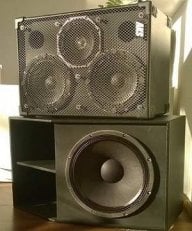
The distortion characteristics are designed into the driver to be a musically pleasing characteristic of the cabinet's personality under these conditions. This is something a tweeter typically does not do well (or in a pleasing manner).
A lot of woofers have higher 3rd order harmonics in the upper mids(created by the cone breakup, peak in the response) then 2nd order, and most quality horns have higher 2nd order in the upper mids then 3rd order harmonics. In this case the horn would sound more pleasing to the ear then the woofer.
On axis, yes. Off axis? No. It's too bad Eminence doesn't show off-axis response, but it's not going to be all that different from what you'll see on off-axis charts from manufacturers like 18sound or Faital.First, there is the woofer response to consider. The particular woofer in the NeoX cabinet is voiced with a midrange extension that yields a flat or rising response through ~4kHz along with a carefully cultivated and managed distortion profile when driven hard.
That's my point. No twelve is going to have dispersion at 4khz that comes anywhere near what the dispersion of a tweeter is at 4khz. The tweeter might be 90 degrees, there's no way the woofer will be even half that. They'll be a lot closer crossed over as low as possible.Second, why the concern with beaming in conjunction with a tweeter. The tweeter doesn't have a 180 degree or wider pattern, in fact it too has a narrowing pattern as frequency increases. The goal is for relative uniformity in the summed polar pattern around the crossover point, and that may end up being roughly 120 degrees give or take, narrowing naturally as frequency rises (at somewhat different rates as the mechanisms are different)
I guess the answer is none, since no cab manufacturers publish even axial charts, let alone off-axis.The third aspect that's not being considered is the way the signal rolls off on both components. Different responses, alignments and rolloff slopes can yield an acoustic crossover point that is significantly different from the electrical crossover point. Which one should be published and why?
Because the voice coil inductance causes enough rise in the woofer impedance at 4khz so theres no need to low pass it to prevent a too low impedance load at the crossover frequency. Thats OK if the summed response still looks good, but leaving out the low pass also saves money.Why no electrical LPF on the woofer you might ask?
There's also a lot less thought and engineering with some products than their manufacturers claim.A lot more thought and engineering goes into this (at least with some products) than some folks seem to give credit to.


- Feb 12, 2006
- 61,047
- 5
- 221,000
- Disclosures
- Development Engineer-Mesa Boogie, Development Engineer-Genzler (pedals), Product Support-Genz Benz
Rick, your comments are simplistic and not all that accurate relative to the comments I made.
To clarify and update your comments for accuracy:
Off axis response adds a low pass filter section in the acoustic response but the response still rises (rate of rise or degree of relative fall varies with axial angle) and all of this can be modeled with summed filter equations. Off axis acoustic response is most certainly factored into the selection criteria of a particular driver.
I disagree that the polar response of a 12" driver will be near 45 degrees at 4kHz. Why would you not think we have off axis data on Eminince drivers? Just because it's not published at the retail level doesn't mean it doesn't exist. Not publishing the data means it won't be mis-interpreted by those who don't understand how it's used by those who have experience in the field of transducer engineering.
I used to believe that frequency response plots and polars were valuable, useful tools. Answering countless and pointless questions, and listening to idiotic arguments about the most bizarre interpretations of the presented data has unequivocally cured me of this. 99% of the market has no interest in expending the effort of learning what the data really means and why. Most can't even define accurately what their preferences might even suggest. The vast majority are do much better off listening to cabinets to find something that suits their own personal preferences and playing style.
The lack of a LPF filter section on many designs is not just for impedance reasons. There are several different mechanisms at play that contribute toward the a LPF acoustic response other than pure inductance, including electro-mechanical effects. In general, the combination of all of these mechanisms result is a pretty nice response (assuming the driver is appropriately designed for the application) without the addition of additional series resistance present with any practical passive speaker level LPF. Additionally, eliminating the LPF usually results in a more pleasing distortion character (again, for drivers designed with this in mind)
I do agree that some manufacturers do a better job than others when it comes to engineering. It generally takes an engineer to do good engineering work, and engineers are often a missing element at speaker cabinet companies.
Arjank- every woofer design has it's own distortion profile. In the end, it's up to the designer to make good choices when it comes to making design decisions based on what the MARKET finds pleasing.
To clarify and update your comments for accuracy:
Off axis response adds a low pass filter section in the acoustic response but the response still rises (rate of rise or degree of relative fall varies with axial angle) and all of this can be modeled with summed filter equations. Off axis acoustic response is most certainly factored into the selection criteria of a particular driver.
I disagree that the polar response of a 12" driver will be near 45 degrees at 4kHz. Why would you not think we have off axis data on Eminince drivers? Just because it's not published at the retail level doesn't mean it doesn't exist. Not publishing the data means it won't be mis-interpreted by those who don't understand how it's used by those who have experience in the field of transducer engineering.
I used to believe that frequency response plots and polars were valuable, useful tools. Answering countless and pointless questions, and listening to idiotic arguments about the most bizarre interpretations of the presented data has unequivocally cured me of this. 99% of the market has no interest in expending the effort of learning what the data really means and why. Most can't even define accurately what their preferences might even suggest. The vast majority are do much better off listening to cabinets to find something that suits their own personal preferences and playing style.
The lack of a LPF filter section on many designs is not just for impedance reasons. There are several different mechanisms at play that contribute toward the a LPF acoustic response other than pure inductance, including electro-mechanical effects. In general, the combination of all of these mechanisms result is a pretty nice response (assuming the driver is appropriately designed for the application) without the addition of additional series resistance present with any practical passive speaker level LPF. Additionally, eliminating the LPF usually results in a more pleasing distortion character (again, for drivers designed with this in mind)
I do agree that some manufacturers do a better job than others when it comes to engineering. It generally takes an engineer to do good engineering work, and engineers are often a missing element at speaker cabinet companies.
Arjank- every woofer design has it's own distortion profile. In the end, it's up to the designer to make good choices when it comes to making design decisions based on what the MARKET finds pleasing.
Because I've seen the OEM data sheets that Eminence provides to manufacturers. Axial response only. And I know that your not going to get better than 45 degrees when the diaphragm diameter is three wavelengths. This is the age of the internet, there are no secrets, and you can find anything you want to with a few mouse clicks, including this:I disagree that the polar response of a 12" driver will be near 45 degrees at 4kHz. Why would you not think we have off axis data on Eminince drivers?
Invalid Link Removed
Check out page 29.
- Feb 12, 2006
- 61,047
- 5
- 221,000
- Disclosures
- Development Engineer-Mesa Boogie, Development Engineer-Genzler (pedals), Product Support-Genz Benz
Rick - Here's a 90 degree polar (45 degrees off axis) with -10dB down all the way to 8kHz, and extrapolating, the -6dB polar should end up around 70-75 degrees (32-35 degrees off axis). A horn's terminal polar is typically between 60 and 90 degrees depending on the geometry (and to some degree size) of the horn flair (30-45 degrees off axis).
Invalid Link Removed
Do you really think I don't understand data sheets and have never seen a data sheet? In fact, sometimes (maybe even often with some manufacturers) I don't trust data sheets and generate my own data to either verify or get additional data that may help me make specific decisions regarding a possible application. I don't rely on folks who think the internet carries no secrets... I know for a fact that the internet is full of folks who know enough to be dangerous (scary on some of the DIY medical websites) and don't take anything as fact until it is proven otherwise.
Perhaps in your comments you MEANT off axis rather than dispersion? Dispersion, or pattern, or coverage inclusion angle is twice the off axis number, and a 45 degree polar (pattern) would be 22-1/2 degrees off axis which is pretty darn narrow by any account. The ultimate goal (for some applications) is to get reasonably close with the horn's defined coverage pattern with the woofer's defined coverage pattern at the acoustic crossover frequency. Since the horns are always specified as pattern (horiz x vert, or as a spherical pattern in a spherical horn), then we need to be discussing this in the same units.
Invalid Link Removed
Do you really think I don't understand data sheets and have never seen a data sheet? In fact, sometimes (maybe even often with some manufacturers) I don't trust data sheets and generate my own data to either verify or get additional data that may help me make specific decisions regarding a possible application. I don't rely on folks who think the internet carries no secrets... I know for a fact that the internet is full of folks who know enough to be dangerous (scary on some of the DIY medical websites) and don't take anything as fact until it is proven otherwise.
Perhaps in your comments you MEANT off axis rather than dispersion? Dispersion, or pattern, or coverage inclusion angle is twice the off axis number, and a 45 degree polar (pattern) would be 22-1/2 degrees off axis which is pretty darn narrow by any account. The ultimate goal (for some applications) is to get reasonably close with the horn's defined coverage pattern with the woofer's defined coverage pattern at the acoustic crossover frequency. Since the horns are always specified as pattern (horiz x vert, or as a spherical pattern in a spherical horn), then we need to be discussing this in the same units.
Last edited:
Your speakers will get frozen due to underpowering. If this happens then defrost speakers slowly to avoid risk of cracking.A burning question I don't think has been posed- Before I remove the tweet in my 210 - Is turning the tweeter off going to accomplish the same thing? There is still a crossover in there is it going to affect things like not getting the full range out of the speaks?
Answer to your question, no concern.
Refering to page #29 do you like discuss Fig. 2.7. the characteristics for Circular Ring Source or the math for Plane Circular Surface Source formula 2.28 ?Because I've seen the OEM data sheets that Eminence provides to manufacturers. Axial response only. And I know that your not going to get better than 45 degrees when the diaphragm diameter is three wavelengths. This is the age of the internet, there are no secrets, and you can find anything you want to with a few mouse clicks, including this:
Invalid Link Removed
Check out page 29.
Note: characteristics for circular piston source are illustrated on page 30, see Fig. 2.8.
By the way a very nice book. Very nice to see state of the art in the year of 1940.
The circular piston surface source is the model to do lots of math in acoustic. But I would not claim a real loudspeaker shows exactly same characteristics like a plane piston surface source.
Sometimes I'm wondering that TB does not discuss further stuff all around acoustic science.
For the record, acoustic science starts where the speaker ends.
Sourced to the off axis considerations, as an engineer just this moment I'm considering if the sheet on top of a steinway grand piano fits the needs when opened to adjust the sound to the audience. Does the piano player really bother about off/on axis just the moment when playing? Probably not. Does this misshappen formed plank mounted on top of a grand piano really fit the needs to provide a well ballanced off axis characteristic of all the keys on a piano keyboard? I'd doubt that it's really perfect but, It's good since around 150 years, seems like there is no need to make any improvement to this old lady.
Does this all have anything to do with the subject?
IMO yes because it is related to acoustic science.
Sourced to the HT crossover,
I find it best to have a crossover for the HT set to around 4kHz. It's 4kHz because of the response of the woofers.
You may ask why? I'm playing an ampeg svt and sometimes like this midrange/treble growl when the power amp is overloaded. Crossover setting around 3kHz (or below) gives an unpleasant sound coming out from the HT. The woofers do this job in a far more pleasant way. That's why I prefere full range for the woofer (electro-mechanical LPF) and let the HT come into play where the woofer ends. Of course I know I have dispersion and comp filter effects.
I could do it the different way and make the cab perfectly working under acoustic science considerations but very likely then would not have much fun with the svt when the power amp is running into overload range. To me it's a trade off. A trade off of beeing perfectly applied to acoustic science consideration or having fun with the svt.
Last edited:
Your speakers will get frozen due to underpowering. If this happens then defrost speakers slowly to avoid risk of cracking.
Answer to your question, no concern.
Woah, I had no idea the danger I faced. I'll just turn it down. Slowly.

Usually the crossover circuit in bass cabs is a high pass filter, so the highs on the woofer don't get cut off.A burning question I don't think has been posed- Before I remove the tweet in my 210 - Is turning the tweeter off going to accomplish the same thing? There is still a crossover in there is it going to affect things like not getting the full range out of the speaks?
Arjank- every woofer design has it's own distortion profile. In the end, it's up to the designer to make good choices when it comes to making design decisions based on what the MARKET finds pleasing.
I know that each driver/woofer has it's own distortion profile (I have hundreds of measurements at home). I just pointed to the fact that the majority of the woofers have more 3rd order distortion then 2nd order(the latter is more pleasing to the ear) and with quality compression drivers it's the other way around. A lot of the modern Neo woofers and the ferrite ones with demodulation rings/copper caps on the polepieces have less 3rd order harmonic distortion.
That's my point. No twelve is going to have dispersion at 4khz that comes anywhere near what the dispersion of a tweeter is at 4khz. The tweeter might be 90 degrees, there's no way the woofer will be even half that.
Also one of the reasons I used this 8" coaxial mid/high driver.
A typical 410 with the tweeter between the four 10" drivers and a xover point around 3.5khz will have a very rugged off-axis response with a lot of dips and peaks, especially around the xover point where the off-axis response of the tweeter and the four 10" drivers don't match. A way better approach would be a high sensitivity 6.5" fullrange driver instead of the tweeter and a xover point somewhere between 500-800hz.
There's also a lot less thought and engineering with some products than their manufacturers claim.
Definitely, especially with basscabs.....
- Feb 12, 2006
- 61,047
- 5
- 221,000
- Disclosures
- Development Engineer-Mesa Boogie, Development Engineer-Genzler (pedals), Product Support-Genz Benz
There is also a lot less acceptance that other players might prefer something different and that's ok too...
- Feb 12, 2006
- 61,047
- 5
- 221,000
- Disclosures
- Development Engineer-Mesa Boogie, Development Engineer-Genzler (pedals), Product Support-Genz Benz
It may be a way better way for your tastes (and maybe my tastes also) but you must remain open minded to the fact that other people may have different tastes and this approach may not be better for them, especially if they use an overdriven tone.A way better approach would be a high sensitivity 6.5" fullrange driver instead of the tweeter and a xover point somewhere between 500-800hz.
There are no absolutes in any of this.
Hi Arjan, hi Andy,
as usual great posts and great information, many thanks to both of you. IMO two different engineers dont't have to share always exactly same considerations. I think it's very great to read how a destinct concept may be realized, and why it is realized as is.
I myself don't hold this great knowledge about acoustic science that you have. So clearly I can learn by reading your posts.
There is one question I like to ask to you. As I told above I'm playing a svt that sometimes is noticable at the overload range. To me it seems like a skunk work to balance the response of a cab to provide a smooth response in combination of a somewhat overloaded tube power amp. At one hand side I like to have a cab that provides an extended response with HT but, at the other hand side it's difficult to find the perfect balancing in combnation with an overdriven tube power amp.
My question is, do you consider in your concepts the use of slightly overdriven tube power amps? If yes, how do you implement this in your concepts?
as usual great posts and great information, many thanks to both of you. IMO two different engineers dont't have to share always exactly same considerations. I think it's very great to read how a destinct concept may be realized, and why it is realized as is.
I myself don't hold this great knowledge about acoustic science that you have. So clearly I can learn by reading your posts.
There is one question I like to ask to you. As I told above I'm playing a svt that sometimes is noticable at the overload range. To me it seems like a skunk work to balance the response of a cab to provide a smooth response in combination of a somewhat overloaded tube power amp. At one hand side I like to have a cab that provides an extended response with HT but, at the other hand side it's difficult to find the perfect balancing in combnation with an overdriven tube power amp.
My question is, do you consider in your concepts the use of slightly overdriven tube power amps? If yes, how do you implement this in your concepts?
It may be a way better way for your tastes (and maybe my tastes also) but you must remain open minded to the fact that other people may have different tastes and this approach may not be better for them, especially if they use an overdriven tone.
There are no absolutes in any of this.
Absolutely


- Feb 12, 2006
- 61,047
- 5
- 221,000
- Disclosures
- Development Engineer-Mesa Boogie, Development Engineer-Genzler (pedals), Product Support-Genz Benz
I do pay a lot of attention to the overdriven sound, in both the speakers as well as in amplifier designs. It's a lot harder to accommodate a wider range of tones than a one trick pony tone. Sometimes, if the one trick pony sound is really what you must have, then the one truck pony product might just be the best way to go.
Guitar amps very often generate overdriven lead sounds thus generating lots of Harmonic content beyond 4kHz due to overdrive. On guitar preamps the signal may pass three our four overdriven tube stages. Keep in mind that a guitar plays one octave above the bass guitar. So the generated Harmonic content due to overdrive spreads to a higher frequency band then doing the same with a bass guitarGuitar amps, no tweeter. Bass amp , tweeter? Hmmmmm.
It would not sound very pleasant if a guitar preamp signal would be feed into a cab containg a Tweeter. On guitar cabs the loudspeaker works as LPF thus cut off the Harmonic content at the highs that sounds too spicy.
Very often (mostly) the guitar cab is an very essential part of the sound.
That's the reason why guitars are often miced for FOH rather then taken with DI.


