
Enjoy the benefits of a premium membership!
Upgrade Account
-
TalkBass has been independent since 1998. Add your voice.
Create a free account to reply to discussions, view embedded media, and browse with fewer display ads.
Join free Log in
Want zero display ads or expanded classifieds tools? Compare plans.
You are using an out of date browser. It may not display this or other websites correctly.
You should upgrade or use an alternative browser.
You should upgrade or use an alternative browser.
Two Cabs - positioning
- Thread starter Mr_Martin
- Start date
More options
Who Replied?
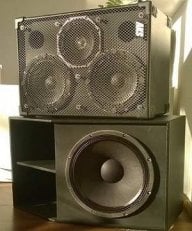
nr 2 will be the most efficient down low, this setup will sound more "beefy" then the others.
nr.1 will approx have the same lowend as nr. 3 but horizontal dispersion will be better.
In most cases I would choose nr.1 not as "beefy" as nr.2 but better dispersion which will increase audibility (intelligibility).
nr.1 will approx have the same lowend as nr. 3 but horizontal dispersion will be better.
In most cases I would choose nr.1 not as "beefy" as nr.2 but better dispersion which will increase audibility (intelligibility).
Last edited:

nr.1 will approx have the same lowend as nr. 3 but horizontal dispersion will be better.
Why the horizontal dispersion?
Not vertical because the cabs in nr. 1 are vertical stacked?
Why the horizontal dispersion?
Not vertical because the cabs in nr. 1 are vertical stacked?
When you would place the cabs side-by-side (nr. 3) the "beaming" effect will start at a lower frequency(twice as low), in return dispersion in the horizontal plane will be reduced (significantly)
To increase dispersion of nr.3 one should cross-fire them.
Why the horizontal dispersion?
Not vertical because the cabs in nr. 1 are vertical stacked?
When you would place the cabs side-by-side (nr. 3) the "beaming" effect will start at a lower frequency(twice as low), in return dispersion in the horizontal plane will be reduced (significantly)

- Oct 7, 2000
- 18,619
- 38,939
- Disclosures
- Endorsing artist: Musicman basses
I don't know anything about the science behind this, but I know that you will hear yourself best in the first position.
Also, is that your setup, or anticipate setup? I was running 2 GK 2x12 Neo cabs for a short while. I was very underwhelmed.
Also, is that your setup, or anticipate setup? I was running 2 GK 2x12 Neo cabs for a short while. I was very underwhelmed.
I don't know anything about the science behind this, but I know that you will hear yourself best in the first position.
Also, is that your setup, or anticipate setup? I was running 2 GK 2x12 Neo cabs for a short while. I was very underwhelmed.
Yet i have only one 212 but i need another cab because i play in a loud Band (loud Drummer) and i feel that i haven't enough lowend and Volume (even at 500W@8ohm).

I don't know anything about the science behind this, but I know that you will hear yourself best in the first position.
Yeah, there's nothing like getting one of those cabs up closer to your ears -- especially when you have to stand right in front of the rig.
I was running 2 GK 2x12 Neo cabs for a short while. I was very underwhelmed.
Why underwhelmed, and what cabs are you running now?
- Oct 7, 2000
- 18,619
- 38,939
- Disclosures
- Endorsing artist: Musicman basses
FWIW, I felt the same way, and the added 2X12 didn't make a whole lot of difference. I held onto one of the cabs because I like the way it sounds at low volumes, but for reasons unknown to me even 2 of those GK 12s didn't do the trick. They farted and rattled before I could get the volume and sound that I wanted out of them.
I've been through a lot of heads, bottoms and combos trying to get the most most volume possible out of the smallest package. For a while I had a Bergantino NV610 that delivered in spades... big, but actually easier to lug around for me than the 2GK cabs. I've since had to downsize due to a new car, and actually found myself really happy running 2 Carvin MB15s with a 500 watt head. Puts out much more without breaking up than the the 4X12s did, as impossible as that might seem. And in the US they're only $229 each. Not sure what it would cost you in Germany but you might want to investigate.
I've been through a lot of heads, bottoms and combos trying to get the most most volume possible out of the smallest package. For a while I had a Bergantino NV610 that delivered in spades... big, but actually easier to lug around for me than the 2GK cabs. I've since had to downsize due to a new car, and actually found myself really happy running 2 Carvin MB15s with a 500 watt head. Puts out much more without breaking up than the the 4X12s did, as impossible as that might seem. And in the US they're only $229 each. Not sure what it would cost you in Germany but you might want to investigate.
What cab? Not all 212's are created equal. What is your placement with respect to walls and corners? A cab placed in that danger zone of 2'~8' of a wall or corner is at risk of boundary cancellation.Yet i have only one 212 but i need another cab because i play in a loud Band (loud Drummer) and i feel that i haven't enough lowend and Volume (even at 500W@8ohm).
- Oct 7, 2000
- 18,619
- 38,939
- Disclosures
- Endorsing artist: Musicman basses
What does comb filter mean?But No.2 will also begin to comb filter as the frequency rises.
Excellent question, I wish more people asked it.What does comb filter mean?
When two drivers playing the same frequency ranges are placed next to each other, the sound waves they produce will overlap in certain places. Where they overlap, or collide, the waves created a null or drop out in certain frequencies as you walk along the stage from left to right. The higher the frequency, the worse it gets. Combing really messes up the goal of even dispersion. 410 guitar cabs suffer from it dearly. And a stack two cabs wide with 410's or 412's is the worst thing ever to happen to the guitar backline. It happens to bass cabs as well, any 410, 610, 810, etc, comb filters. And the guy who sets up two stacks of 410s, 610s, or 810s has no idea how badly he is messing up his output. Some people think it adds to a cabs unique sound, some hate it. In either case, it is a defect. Why do people use 410, 610, 810, or set cabs together side x side? Because they saw the other guy do it, and it is stuck in the zeitgeist now.
The general principle of driver placement to mask destructive interference with the other driver (combing), and maximize dispersion, is to stack vertically for horizontal dispersion. That is the purpose of backline gear. You want even horizontal dispersion for you when you walk about the stage, for your bandmates, and for the audience on the floor right in front. The combing will still be there in the vertical plane, but only noticeable if you run up and down a ladder. Now you know why there is so much science involved in PA rigs. The audience is both horizontal and vertically arranged in a theater.
Try this: drop a pebble in a pond and look at the waves radiate evenly. Now drop two pebbles about 6" apart at the same time. You will notice weird wave front interference where the wave from one pebble collides with the wave from another. There's lots of diagrams to Google for that illustrate it better than me.
Last edited:
What cab? Not all 212's are created equal. What is your placement with respect to walls and corners? A cab placed in that danger zone of 2'~8' of a wall or corner is at risk of boundary cancellation.
I have a GK 212_II now, so i want to add another GK 212_II.
But when i read what "Joe Nerve" said i'm not sure if it will be loud enough.
But No.2 will also begin to comb filter as the frequency rises.
Yes, but the cabs are so close to the ground that you won't hear much mid-highs anyway.... If you like to play reggae this is a great setup

For practice, okay. But in real life, the people out front will be subject to combing.Yes, but the cabs are so close to the ground that you won't hear much mid-highs anyway.... If you like to play reggae this is a great setup
You will effectively be creating a 412. IMO, a nightmare. You will be wasting power and getting more combing. Try orientating your 212 vertically and look at boundary cancellation before simply buying another cab.I have a GK 212_II now, so i want to add another GK 212_II.
But when i read what "Joe Nerve" said i'm not sure if it will be loud enough.
I believe it was Bill FitzMaurice that wrote the only way to fix a 410 or 412 is to saw it in half and stack it on top of the other half.
For practice, okay. But in real life, the people out front will be subject to combing.
If you're playing on a stage without PA support and the audience is up-close, then yes.
For reggae this would be a non-issue
Meaning they are too stoned to notice or care?If you're playing on a stage without PA support and the audience is up-close, then yes.
For reggae this would be a non-issue


