The blend pot to use is a Alpha 100 ohm M/N tapper pot. DO NOT USE a 50 ohm or a 250 ohm or 500 ohm M/N tapper pot!!!!! I recommend using a 250 ohm Linear tapper pot for volume and a 250 ohm Audio tapper for a tone pot. I am very pleased with this set-up. After using this I don't understand why the passive Jazz and PJ guitars don't come with this from the factory.

Enjoy the benefits of a premium membership!
Upgrade Account
-
TalkBass has been independent since 1998. Add your voice.
Create a free account to reply to discussions, view embedded media, and browse with fewer display ads.
Join free Log in
Want zero display ads or expanded classifieds tools? Compare plans.
You are using an out of date browser. It may not display this or other websites correctly.
You should upgrade or use an alternative browser.
You should upgrade or use an alternative browser.
More options
Who Replied?

But to 'kind of' return to the original topic of this thread, if we are going to wire the blend/balance pot without grounding any of its terminals, the consequence of miswiring the direction of the gangs/wafers would not be quite the same as what you described.
You're right, not quite the same, but very close.
The following 3 scenarios assume the input signals are to the wiper arms (normal), but only the ground (if used) and output wiring to the end lugs is reversed.
1. With grounds - Center position, volume is full off ('cause the full signal is drained away thru the continuity segments to ground).
2. No grounds - Center position, volume is mostly off (signal didn't drain at all thru the continuity segments, so leakage happens thru the resistive elements).
3. No grounds, and 'no load' cut - Center position, same as 2.
So you can expect no (grounded), or very low (ungrounded), volume when the knob is centered. Immediate boo-boo notification LOL.
In all three cases above, when knob is full to one end, you get full volume for only one pickup.
Overall, I'm not that familiar with actually using blend pots. Given the schematics, interpreting how they work and the "what if's" is easy peasy. In fact, the "what if's" are what you gotta run thru your head when reading or drawing schematics.
I'm just not familiar with the different type blend pots out there, 'cause in the 4+ decades I've been playing and pulling apart the innards, I've only owned one bass with a blend. It was fine, but I just prefer separate volumes.
Hopefully someone comes along and answers the questions I couldn't.
Last edited:
The M/N pot value to use on the blend pot is 100ohms for sure. You do not need to cut the trace just leave it ungrounded. I tried a 250ohm M/N pot to start with and that was very much like a switch. I have used this on my PJ bass and it works great. When all the way to the P pickup all you get is P pickup and the same for the J. I am using this on a 5 string jazz with Barts and again the same great outcome.
Just to be clear, did you mean 100K ohm and 250K ohm? Or did you actually mean 100 ohm and 250 ohm?
~The blend pot to use is a Alpha 100 ohm M/N tapper pot. DO NOT USE a 50 ohm or a 250 ohm or 500 ohm M/N tapper pot!!!!! I recommend using a 250 ohm Linear tapper pot for volume and a 250 ohm Audio tapper for a tone pot. I am very pleased with this set-up. After using this I don't understand why the passive Jazz and PJ guitars don't come with this from the factory.
I get what you have been saying, and I tend to agree, but you continue to say "ohms", when I think you mean "K or Kilo-ohms".
I and one other poster might have noticed the discrepancy, but the next reader may not, so please forgive me for pointing it out, so that the next reader does not get confused.
There is room enough for that in this topic in general.


~
I have made a mistake on referring to the value of the pots. I had said 100 ohms and mint 100k ohms. I left off the "k" which stands for 1000. I did this on all of the values that I stated, SORRY. And thanks for correcting me DavesnotherCA. Now what we are actually doing in the circuit by interring the pot on the center terminal or the wiper is in the center detent there is "0" resistance on ether pickup flowing current equally on each pickup. When we start moving off center we start adding resistance to the pickup circuit to which we want to diminish the volume on to. Or you could say that we are putting a resister in series with that circuit.
This is what i did (didn't trust myself to not screw it up) and it appears to work fine.My first attempt will be without cutting the traces, and without the grounds, as per your drawing.
The OP and also the wiring diagram I found and used specified 250k blend pot. It appears to work fine on both a jazz and a p/j bass setup. Why do you recommend the 100k blend pot?The blend pot to use is a Alpha 100 ohm M/N tapper pot. DO NOT USE a 50 ohm or a 250 ohm or 500 ohm M/N tapper pot!!!!!
~This is what i did (didn't trust myself to not screw it up) and it appears to work fine.
- - -
The OP and also the wiring diagram I found and used specified 250k blend pot. It appears to work fine on both a jazz and a p/j bass setup. Why do you recommend the 100k blend pot?
Yeah, I'll try it the easy way first, and if it does the job, then good enough.
- - -
In your particular case, your diagram [posted in the Jag SS thread, Squier Jaguar Short Scale Club Part 3 ] is using grounding on the balance pot, while the OP's diagram here is not.
Also, your pot has a Linear taper [you offered a link to it in that same post, which I reused in one of my above posts, and commented about the pot], while the pot being mainly discussed in this thread has this fancy MN taper, which has been designed that way in order to have no signal loss in the centre.
Your bass [with a linear taper pot] should exhibit somewhat less output at the centre than at the ends of the rotation of the balance/blend pot, which might well be completely satisfactory - I dunno because I have not yet tried doing a balance pot mod, yours or any other.
Depending upon the details [where The Devil of course lives], everybody might be getting decent results, but each for different reasons.
~
Last edited:

Here is the corect pot, its an Alpha pot.alpha 100k ohm dual mn-taper | eBay Wire it just like my diagram. The diagram is looking at the back of the pickguard just like you looking at it when wiring. It will put the neck pickup clockwise and bridge pickup counter clockwise.
If only this was a solid shaft pot. I know they make sleeves, but I am sort of a perfectionist and really wish this was a solid shaft with short thread length. If I find that, then I have hours of re-wiring to do in about 20 of my basses.
As an eBay Associate, TalkBass may earn a commission from qualifying purchases.
The reason that I recommend the 100kohm M/N pot over the 250kohm M/N pot is that the 100kohm M/N pot can give you some good gradual blending differences off center between the pickups. The 250kohm M/N pot blends in the middle but once you move it off center you are on one or the other pickup, no gradual blending. Here is some things to look at to help understand pots Invalid Link Removed [Invalid or Expired Link Removed] The one from Amplified Parts, the first example of the M/N tapper I have yet to understand why it is there but the second example is the correct way that the pot works. I hope this helps.
I have searched high and low for 100kohm M/N pots and the only manufacture of them is Alpha that I can find. The shaft (where the nut) is also smaller than the normal small shaft pots found on import pots but the 6mm to 1/4 inch adapter sleeve works on them . I am a big fan of of CTS pots and they do make a 250kohm M/N pot with a knurled shank but they do not make them in 100kohm values, I have LOOKED.
Well, luckily I’m OK with 250kMN blend, since I’m either centered, or all neck for that standard mid-rangy P-Bass tone. I will also occasionally bump it a hair off the detent toward the neck to beef it up a touch and that also works well.
~I have searched high and low for 100kohm M/N pots and the only manufacture of them is Alpha that I can find. The shaft (where the nut) is also smaller than the normal small shaft pots found on import pots but the 6mm to 1/4 inch adapter sleeve works on them . I am a big fan of of CTS pots and they do make a 250kohm M/N pot with a knurled shank but they do not make them in 100kohm values, I have LOOKED.
Are these from Alpha ?
The page does not say.
Dual Blend / Balance Guitar Potentiometer MN500K, MN250K, MN100K or MN25K
~
~
Here are some eBay listings for 100K MN dual pots :
Dual Blend / Balance Guitar Mandolin Potentiometers MN100K Tone / Volume Pot | eBay
Dual Blend / Balance Guitar Mandolin Potentiometers MN100K Tone / Volume Pot | eBay
5 Pieces Audio MN100k Ohm Audio Mini Pots Potentiometer For Guitar Bass | eBay
Each seller seems to also have them in other resistance values, as well as offering other types of pots.
~
Here are some eBay listings for 100K MN dual pots :
Dual Blend / Balance Guitar Mandolin Potentiometers MN100K Tone / Volume Pot | eBay
Dual Blend / Balance Guitar Mandolin Potentiometers MN100K Tone / Volume Pot | eBay
5 Pieces Audio MN100k Ohm Audio Mini Pots Potentiometer For Guitar Bass | eBay
Each seller seems to also have them in other resistance values, as well as offering other types of pots.
~
Last edited:
As an eBay Associate, TalkBass may earn a commission from qualifying purchases.
~
One of that last group of links was mentioned twice in error.

The duplicate was supposed to be this link :
5x Guitar Potentiometer Pots MN100K 18mm for Ukulele Bass Volume Tone Audio | eBay
~
One of that last group of links was mentioned twice in error.
The duplicate was supposed to be this link :
5x Guitar Potentiometer Pots MN100K 18mm for Ukulele Bass Volume Tone Audio | eBay
~
As an eBay Associate, TalkBass may earn a commission from qualifying purchases.

Re 50K and 100K MN blend pots: I used a 50K on my Mustang PJ and it definitely broadens the 'sweet spot' over a 250K but I can't remember where I bought it. A quick search turned up the following:
Alpha 100K OHM Dual MN-Taper Blend-Balance Potentiometer Center Click ~USA STOCK | eBay
Invalid Link Removed
Edit: search criteria was this: Potentiometer - 100K Dual MN Taper, Knurled Shaft at DuckDuckGo
Alpha 100K OHM Dual MN-Taper Blend-Balance Potentiometer Center Click ~USA STOCK | eBay
Invalid Link Removed
Edit: search criteria was this: Potentiometer - 100K Dual MN Taper, Knurled Shaft at DuckDuckGo
Last edited:
As an eBay Associate, TalkBass may earn a commission from qualifying purchases.
I obviously posted the wrong pot as I am pretty sure I used MN pot. Oops.Also, your pot has a Linear taper [you offered a link to it in that same post, which I reused in one of my above posts, and commented about the pot], while the pot being mainly discussed in this thread has this fancy MN taper, which has been designed that way in order to have no signal loss in the centre.
Thanks for that. I think I might hunt down a few 100k MN pots and give them a go.The reason that I recommend the 100kohm M/N pot over the 250kohm M/N pot is that the 100kohm M/N pot can give you some good gradual blending differences off center between the pickups. The 250kohm M/N pot blends in the middle but once you move it off center you are on one or the other pickup, no gradual blending
~I obviously posted the wrong pot as I am pretty sure I used MN pot. Oops....
It still would have worked with the linear taper pot, just not quite the same.
Possibly you posted something about the pot at the time that you did the mod ?
What I am more curious to know is whether you used the grounded balance pot circuit like in the drawing which you posted in the Jag thread, or the ungrounded circuit like the OP of this thread posted on Page 1.
~
I did a search through this thread and can now confirm that the pot is most definitely MN and that I used the wiring diagram from page 1 of this thread.
This is the shot I posted at post #165 of this thread
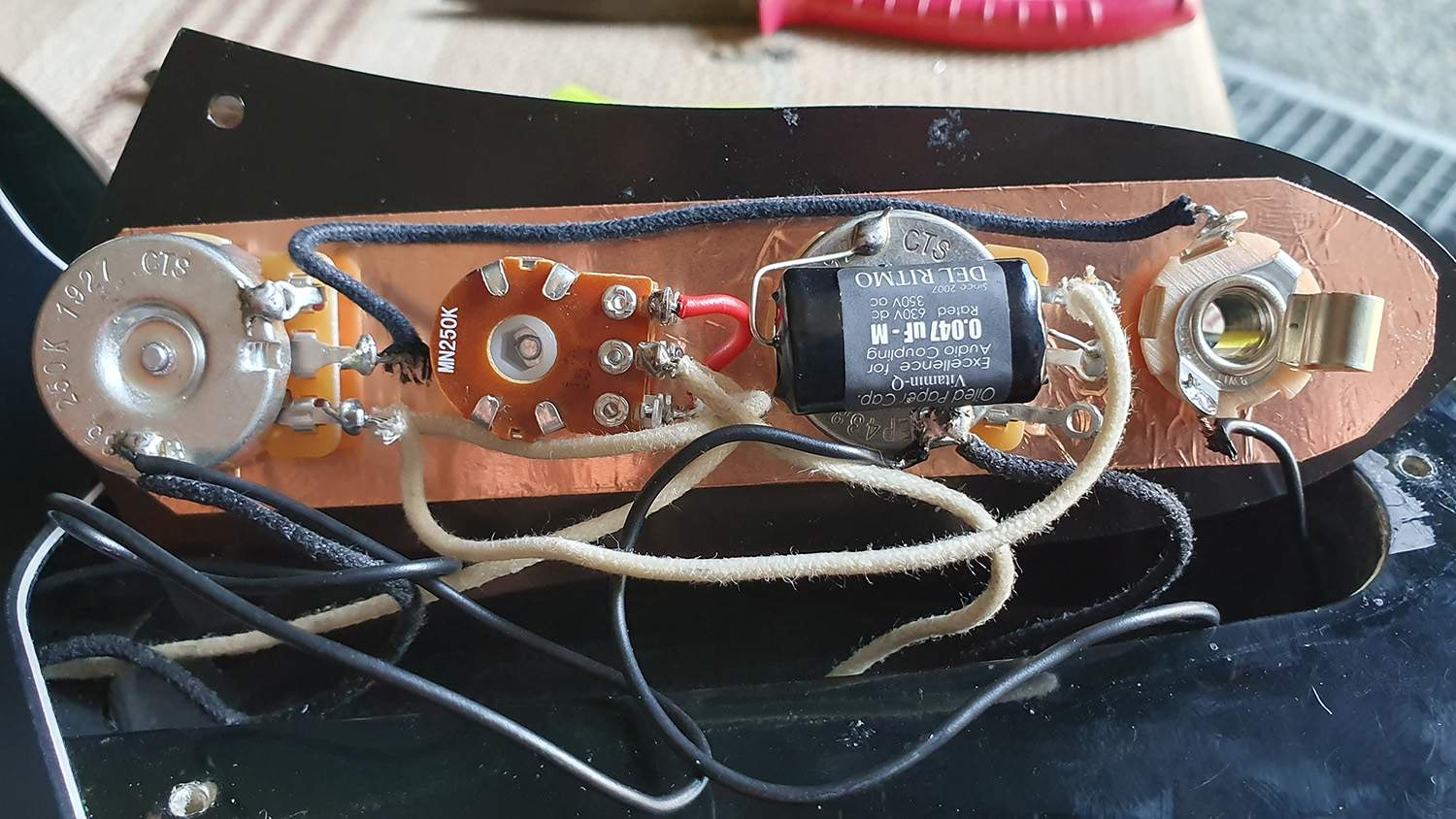
This is the shot I posted at post #165 of this thread

I did this ungrounded pot mod on my P/J bass using a 250K M/N. For my needs, it's great, as I tend to not do delicate blends, but run the bass really in two settings: full on P or center detent blend with the J pickup. I could have used a switch and been just as happy, but I just had to try this blend.
I have read that a 100K M/N allows finer blending. I'm sure it does, but I don't have first hand knowledge of it. However, I already had a 250K M/N and wanted to keep the loading impedance as high as possible to retain clarity with the Wilde pickups on the bass. I use a 500K linear volume and 500K audio tone pot on the bass.
I have read that a 100K M/N allows finer blending. I'm sure it does, but I don't have first hand knowledge of it. However, I already had a 250K M/N and wanted to keep the loading impedance as high as possible to retain clarity with the Wilde pickups on the bass. I use a 500K linear volume and 500K audio tone pot on the bass.
~I did a search through this thread, and can now confirm that the pot is most definitely MN, and that I used the wiring diagram from page 1 of this thread.
This is the shot I posted at post #165 of this thread
View attachment 4385568
The scary part is that I read this whole thread, and only during the last few days, but did not recall your pic until YOU did.
I saw your post #165 the other day, but I guess that because it was discussing the tone pot and not the blend pot, I must have glossed over it, and consequently also the rest of what was in the pic.
Plus, I now can see in your pic that there is no ground wire soldered to one of the lugs of the blend pot [the lug is bare], where such a wire would need to be connected if a person had wanted grounding, so furthermore that is evidence that you indeed are using the non-grounded version of this blend circuit.
And upon reviewing that series of posts, I am reminded of something else which I was meaning to mention to the OP, regarding tone pots.
I'll save that for another post.
~
~I did this ungrounded pot mod on my P/J bass using a 250K M/N. For my needs, it's great, as I tend to not do delicate blends, but run the bass really in two settings: full on P or center detent blend with the J pickup. I could have used a switch and been just as happy, but I just had to try this blend.
I have read that a 100K M/N allows finer blending. I'm sure it does, but I don't have first hand knowledge of it. However, I already had a 250K M/N and wanted to keep the loading impedance as high as possible, to retain clarity with the Wilde pickups on the bass. I use a 500K linear volume and 500K audio tone pot on the bass.
This leads me to an observation which I have wanted to make about how this blend/balance hookup functions.
The signal flow chart is like this :
Pickups > Blend Circuit > Tone Circuit > Volume Circuit > Output Jack
I wish to initially address the relationship between the blend pot and the volume pot, in the ungrounded version, and without cutting any traces of the blend pot.
What we essentially have is each pickup feeding into the volume pot through a rheostat [a variable series resistor], which is one or the other gang of the blend pot.
So, if the blend pot is 100K [per gang] and the volume pot is 250K, then it means that for each pickup we have a voltage divider between two resistances, with each upper leg of the divider representing anywhere between 0 K and 100K, depending upon the blend setting, and the lower leg is a constant 250K.
With those ratios, at first glance one would expect most of the signal of the unfavoured pickup to still be getting through when the other one is favoured, yet people have reported that hardly any of the signal of the unfavoured pickup gets through.
"Why is this ?", some may ask.
It is because the favoured pickup is connected directly across the volume pot when it is favoured, for HALF of the rotation of the MN tapered blend pot, and has a much lower resistance than the volume pot itself does, and consequently contributes in a large way to the attenuation/division of the signal of the unfavoured pickup.
If we speculated that each pickup has a 10K internal resistance [and some do], then instead of the unfavoured pickup's signal seeing simply a 250K resistance to ground when it reaches the volume pot, allowing most of the signal to go into the volume pot, it also sees the 10K resistance of the favoured pickup in parallel with the volume pot, which loads down the signal of the unfavoured pickup much much more than the volume pot alone would, sufficiently so that we hardly notice the unfavoured pickup's signal when the favoured pickup is set to maximum.
So when we are running tests of MN tapered blend pots of various resistances [100K, 250K, etc] effect upon the unfavoured pickup, we must consider the ratio between the resistance of each gang of the blend pot and the resistance of the favoured pickup, moreso than the ratio of resistance between the blend and volume pots.
~
Last edited:


