• TalkBass has been independent since 1998. Add your voice.
    Create a free account to reply to discussions, view embedded media, and browse with fewer display ads.
    Join freeLog in
    Want zero display ads or expanded classifieds tools? Compare plans.

Double Bass Underwood Pickup Club

Yes-
The braided shield is connected to the brass casing - it is crimped - not sure if it is soldered.
The conductor is soldered to the metallic (brass?) hexagon.
See below:
View attachment 748814 View attachment 748816

Excellent!

Here's what I believe is happening. The round disk is the piezo ceramic. It looks about 2mm thick, maybe, so it's resonant frequency is nice and high at about 1MHz, which means that it's very flat in the range of the bass frequencies. The shield of the cable (ground) is attached to the brass casing, while the center conductor is attached to the foil piece, which is cut to hang off the edge of the ceramic disk when the pickup is all put together (oblong hexagon?). The foil piece contacts the disk with even pressure, giving a solid electrical contact over the entire top surface of the piezo. The bottom of the piezo also makes solid contact with the casing. On the other side of the foil, there is an insulator and then a compression foam between the insulator and the brass casing.

The very cool thing about this design is that the solder connections, which create lumps in the surface, are made off to the side of the piezo element's surface. Everything is sandwiched and sealed in between the 2 halves of the brass casing, but the piezo itself is not soldered directly to anything. It's brilliant!
 
Last edited:
Lowfreqgeek is right, except for the compression foam. The black stuff is elastic material that is put around the pickup for isolation and maybe also to hold the stuff together of in place. Compression foam would alter the sound and damp high frequencies a lot.

BTW, piezo crystals have an orientation, one cut is more sensitive to compression (like with pressure sensitive pickups like the Underwood), the other cut direction is more sensitive to bending (like with piezo disks that work as speakers or are glued to surfaces). Both work with pressure and bending, but with higher output in the preferred direction.
 
  • Like
Reactions: lowfreqgeek
The round disk is the piezo ceramic. It looks about 2mm thick,
FYI - the ceramic disk is .100in or 2.54mm thick.

The black stuff is elastic material that is put around the pickup for isolation and maybe also to hold the stuff together of in place.
Yes. Commonly known as RTV Silicone ( or Silicone Rubber).
 
  • Like
Reactions: lowfreqgeek
FYI - the ceramic disk is .100in or 2.54mm thick.


Yes. Commonly known as RTV Silicone ( or Silicone Rubber).

Well, I was a little off. Still, that puts the resonant frequency around 780kHz for most materials.

I couldn't tell if the black stuff on the non-disk side was foam or RTV, but I guess it was RTV. That makes sense, though, as it does harden up quite nicely and still has some compliance when compressed.
 
  • Like
Reactions: Don Kasper
lowfreq....
Could you attempt to describe, (for me), in non-technical terms, how the thickness of the disk determines the resonant frequency, and determines the subsequent frequency response of the pickup/element?
I have very limited electronics knowledge.
Thanks, in advance, for your time and expertise.
 
lowfreq....
Could you attempt to describe, (for me), in non-technical terms, how the thickness of the disk determines the resonant frequency, and determines the subsequent frequency response of the pickup/element?
I have very limited electronics knowledge.
Thanks, in advance, for your time and expertise.

Sure, Don.

First off, think about playing bass in a room of a particular size; when you hit certain notes, you get standing waves which cause the room to "ring" and resonate depending on the room's size in relation to the frequency of the sound waves. That's more or less what is happening in the piezo material. However, whereas the speed of sound in air is 343 m/s, it is about 2005 m/s in most piezo ceramic materials. The resonant frequency is simply the speed of sound through the peizo ceramic divided by the thickness of the piezo ceramic. (As a side note, piezos also have anti-resonant frequencies, much like a room has "dead spots").

Now - when used as a sensor - the resonant frequency is the frequency at which the piezo crystal (or ceramic) is the most sensitive, i.e. has the largest output signal. As the frequency of the sonic wave approaches the resonant nodes, the material moves more freely and generates a larger output signal. The sensitivity/frequency curve is very linear and flat up to about half of the resonant frequency, then it starts getting exponentially steeper (more sensitive) as the frequency nears resonance. It's important for the sake of linear frequency response that the resonant frequency of the sensor be at least several times higher than the maximum frequency that the sensor will see. Now 790kHz might be overkill, since the flat response is still up at 395kHz, but this is a case where overkill is of no concern. Besides, when the piezo material is mounted mechanically to any kind of mass, the resonance is altered by a lot. Setting the bandwidth on the raw piezo element very high will ensure that additional mass, glues, or other "treatments" don't drop the resonance down to where it might start to effect the sensor response.

There's a whole lot more to get into with complex equivalent circuits and all that, but this covers the basic idea.

I hope that's helpful!
 
Last edited:
Sure, Don.

First off, think about playing bass in a room of a particular size; when you hit certain notes, you get standing waves which cause the room to "ring" and resonate depending on the room's size in relation to the frequency of the sound waves. That's more or less what is happening in the piezo material. However, whereas the speed of sound in air is 343 m/s, it is about 2005 m/s in most piezo ceramic materials. The resonant frequency is simply the speed of sound through the peizo ceramic divided by the thickness of the piezo ceramic. (As a side note, piezos also have anti-resonant frequencies, much like a room has "dead spots").

Now - when used as a sensor - the resonant frequency is the frequency at which the piezo crystal (or ceramic) is the most sensitive, i.e. has the largest output signal. As the frequency of the sonic wave approaches the resonant nodes, the material moves more freely and generates a larger output signal. The sensitivity/frequency curve is very linear and flat up to about half of the resonant frequency, then it starts getting exponentially steeper (more sensitive) as the frequency nears resonance. It's important for the sake of linear frequency response that the resonant frequency of the sensor be at least several times higher than the maximum frequency that the sensor will see. Now 790kHz might be overkill, since the flat response is still up at 395kHz, but this is a case where overkill is of no concern. Besides, when the piezo material is mounted mechanically to any kind of mass, the resonance is altered by a lot. Setting the bandwidth on the raw piezo element very high will ensure that additional mass, glues, or other "treatments" don't drop the resonance down to where it might start to effect the sensor response.

There's a whole lot more to get into with complex equivalent circuits and all that, but this covers the basic idea.

I hope that's helpful!

lowfreqgeek,
Very Helpful!
Thanks - I believe I have a better understanding of the piezo puzzle.
It appears that Don Underwood understood that by over-engineering the (raw) resonant frequency of the piezo ceramic, he would create a flat(ter) frequency response in the audible frequency range.
I was always fascinated by the fact that this pickup had no apparent "moving parts", so to speak. (At least a microphone has some kind of diaphragm, that captures the sound...).
This pickup was a real game-changer when it was introduced in the 1970's - even though most (bass) amplifiers at the time may not have been designed to optimize it's performance. (Impedance with regard to frequency response?)
I am still amazed by how good it sounds and how "simple" it is to operate. It is still relevant today, decades after its introduction.
Thanks for your time and expertise.
 
lowfreqgeek,
Very Helpful!
Thanks - I believe I have a better understanding of the piezo puzzle.
It appears that Don Underwood understood that by over-engineering the (raw) resonant frequency of the piezo ceramic, he would create a flat(ter) frequency response in the audible frequency range.
I was always fascinated by the fact that this pickup had no apparent "moving parts", so to speak. (At least a microphone has some kind of diaphragm, that captures the sound...).
This pickup was a real game-changer when it was introduced in the 1970's - even though most (bass) amplifiers at the time may not have been designed to optimize it's performance. (Impedance with regard to frequency response?)
I am still amazed by how good it sounds and how "simple" it is to operate. It is still relevant today, decades after its introduction.
Thanks for your time and expertise.

My pleasure, Don.

I'm actually working on a couple of systems to drive piezo elements into resonance (in the MHz), which is basically the opposite of what we're doing with these as pickups. A voltage is applied at the resonant frequency to turn the piezo into a motor, more or less, which then sets up ultrasonic waves in a fluid and focuses all the particles in the fluid into a node, so to speak. I fully intend to use some of the extra piezo material to make my own pickups for several instruments... :)

Currently I'm using a Full Circle, and I really like it for the most part, but I'd love to try an Underwood someday. I've always been drawn to the Spiro/Underwood sound for certain things, at least as an option for particular genres where I might otherwise play fretless bass. I sure wouldn't mind having one as a backup, too.
 
  • Like
Reactions: Don Kasper
........Thanks - I believe I have a better understanding of the piezo puzzle.
It appears that Don Underwood understood that by over-engineering the (raw) resonant frequency of the piezo ceramic, he would create a flat(ter) frequency response in the audible frequency range.

Having spent over a hour chatting with Don Underwood, I can definitely confirm that Don was a very astute engineer. He worked with Baldwin Piano on the Electric Harpsichord, as an engineer. Apparently,
the pickup system in the Harpsichord used piezo pickups. He also talked about the Bass Bridge being one of the earliest t cantileiver arches.

...........This pickup was a real game-changer when it was introduced in the 1970's - even though most (bass) amplifiers at the time may not have been designed to optimize it's performance. (Impedance with regard to frequency response?)
I am still amazed by how good it sounds and how "simple" it is to operate. It is still relevant today, decades after its introduction.
Thanks for your time and expertise.

Walter Woods consulted Don, on the Underwoods impedance, so he could match it with his amps, thus setting the input for all the various models of Walter's amps at 1 meg ohm. For a long time the Walter Woods was one of the few amps with that input impedance. Oddly enough, all three input impedances, on the much reviered Ampeg B-15N, were also set at higher input impedances. 5.6, 1, and 2.2 megohms respectively

Ric
 
Last edited:
  • Like
Reactions: Don Kasper
He also talked about the Bass Bridge being one of the earliest t cantileiver arches.

I've often wondered, (based upon my rudimentary understanding of bass (violin) bridge physics), if the E side element captures/produces more sound/information as a result of the bassbar/E side of the bridge being the more "elastic" of the 2 halves. The G side, (soundpost side) of the bridge, always strikes me as being rigid (see "cantilever..."), compared with the relative "springy-ness" of the bassbar/E side of the bridge and top plate.
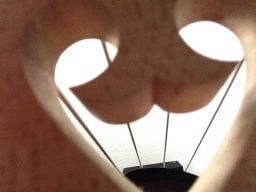
I once installed the single Underwood element in the "heart" cutout of my bridge, for sheetz and gigglz, (thinking that the element would be closer to the top of the bridge, where all the "action" was), but it was very weak - not at all usable. Maybe the Underwood "wing" placement works, because of its proximity to the top plate, via the E side leg of the bridge? Maybe the "wing" location is capturing more of the movement and vibration of the bridge foot and leg, AND top plate, NOT so much the upper area of the bridge?
Just spitballin' here.
Thanks for your time and expertise.
 
I wonder if anyone has ever used a LIDAR (like a RADAR, with lasers) to analyze the top of a bass (or any acoustic instrument)? That would be ideal as it could give a very accurate measurement of the displacement over the entire top of the instrument for any given note. Seems like there's a Masters Thesis in there somewhere...
 
There are some analyses and pics of vibrational modes of string instruments in some books about musical acoustics (I'm away from home and cannot look inside) and there is ongoing research, mostly on violins.
The higher the modes the less common are the patterns for different instruments of the same kind, as I remember.
 
Well, I guess I can join the Underwood club. Recently, I picked up a Full Circle Platinum Pro Bass off the TB classifieds and so, I decided to toss the Underwood onto the bridge after I dialed in the Full Circle pickup, because I'd never run the FC through a good upright preamp, much less the Underwood. What I came away with was, the Underwood had a LOT more punch and cut through the preamp, but the FC has the nice big fat tone I like. So, for smaller acoustic guitar accompaniment gigs, I'll probably use the FC, but for the full band (horns, keys, drums, etc.) I'll give the Underwood a whirl and see how it cuts. It carries a lot of bottom end, so that's not much of a concern, and for the curious, I put both elements in.

And I also have the mic, which I could feasibly mix in a lot of body for a MBOL type of feel.
 
Hi
Thanks to you guys I realized my 35 year old Underwood pickup is pressed to hard in place
Did some adjustments lowering up the preassure and suddenly the harsh´n ugly highs were gone!
Fat and round sound coming out of my beloved Underwood. Spent some years with the Realist but never learned to like it. Amazing!
 
  • Like
Reactions: rolandm
About 10 years ago, after using an Underwood for a long time, I got a Full Circle. I'm an upright bass repairman. I installed it, and dug it right away.
I've been trying pickups for a while now. My theory, is WHERE the pickup sits in the bridge, is important, and the further away from the strings it is, the darker, and less detail it has. The opposite is true. The closer to the strings, the more string sound/ noise. Some of the really nice, expensive drilled-in installed pickups sound a lot like an electric bass to me. The wings seem to be the ideal place to put a piezo transducer.
I even have a very old Polytone brass pickup! When you use it, it kinda sounds like your bass is in the next room! lol! I tried the BP-100, had two of them over the years, hated them. Tried two Realists, and although great pickups- totally unusable with a loud drummer, and my dark bass. I discovered something that I think all of us know. There is nothing that sounds as good as a good studio microphone, in the studio- I want that live. I bought an Audio Technica ATM 350 from a fellow TB'er, and it really sounds wonderful. Last night, New Year's Eve, I played a gig with an eight piece jump swing band. I brought WAY too much gear.Two amps, two cabinets, and a small mixer with phantom power for my ATM. Set the whole thing up, and had a sneaking suspicion that it would all be for naught. It really sounded pretty good, though. The problem? About eight monitor cabinets spread out all over the stage, loud horns, me about 5 feet from the drum kit, and a loud guitar amp.. a sure fire recipe for switching to electric bass for the gig. That was not an option, the venue insisted on a swing band with upright bass.
As soon as we began, my vibe proved correct. Not able to attain a loud enough volume, and little definition in the bass sound, I could barely hear myself through a Scroeder 15L and an Ampeg 2-10! Everything I tried just made it worse. Second set- I just plugged the Full Circle only, into the amp. A lot better. But still, there really wasn't enough volume and definition to be usable in that kind of situation. Then, I remembered something. I never had any audibility issues with the Outpsyders, a western swing band I played with.. and on my gigs with Mitch Woods and the Rocket 88's. I remember having both The Underwood, and The Full Circle pickup on one of Mitch's gigs. The Full Circle was too boomy and undefined for the room, and the music.
I just put the Underwood back on my Lowendall. VOILA!' Growl for days, and the presence has returned. The other thing that I had forgotten, is how much variation in the tone you can get by moving the elements around! I tried both, then one, then both elements again, finding the placement I liked, then just left them there. Through my low wattage Zorko El Basso- all tubes, it sounded absolutely killer.
The Underwood pickup, is a great design, and it's unbeatable for certain types of music.
 
Last edited:
  • Like
Reactions: babaseen
A P.S. here... many years ago, I had an issue with my first Underwood pickup. This prompted a call to them. I was pleasantly surprised to actually get Don Underwood on the phone. We had a nice conversation. What I found unusual, is that he is not a bassist. He's a saxophonist. I asked him, so, how and why does a sax player come up with a popular pickup for upright basses? His answer: "I just got tired of hearing really sh____y sounding basses." He fixed my pickup, and I still have it.
Don, if you're reading this.. thank you.
 
A P.S. here... many years ago, I had an issue with my first Underwood pickup. This prompted a call to them. I was pleasantly surprised to actually get Don Underwood on the phone. We had a nice conversation. What I found unusual, is that he is not a bassist. He's a saxophonist. I asked him, so, how and why does a sax player come up with a popular pickup for upright basses? His answer: "I just got tired of hearing really sh____y sounding basses." He fixed my pickup, and I still have it.
Don, if you're reading this.. thank you.

On another note, Walter Woods was also a sax player.