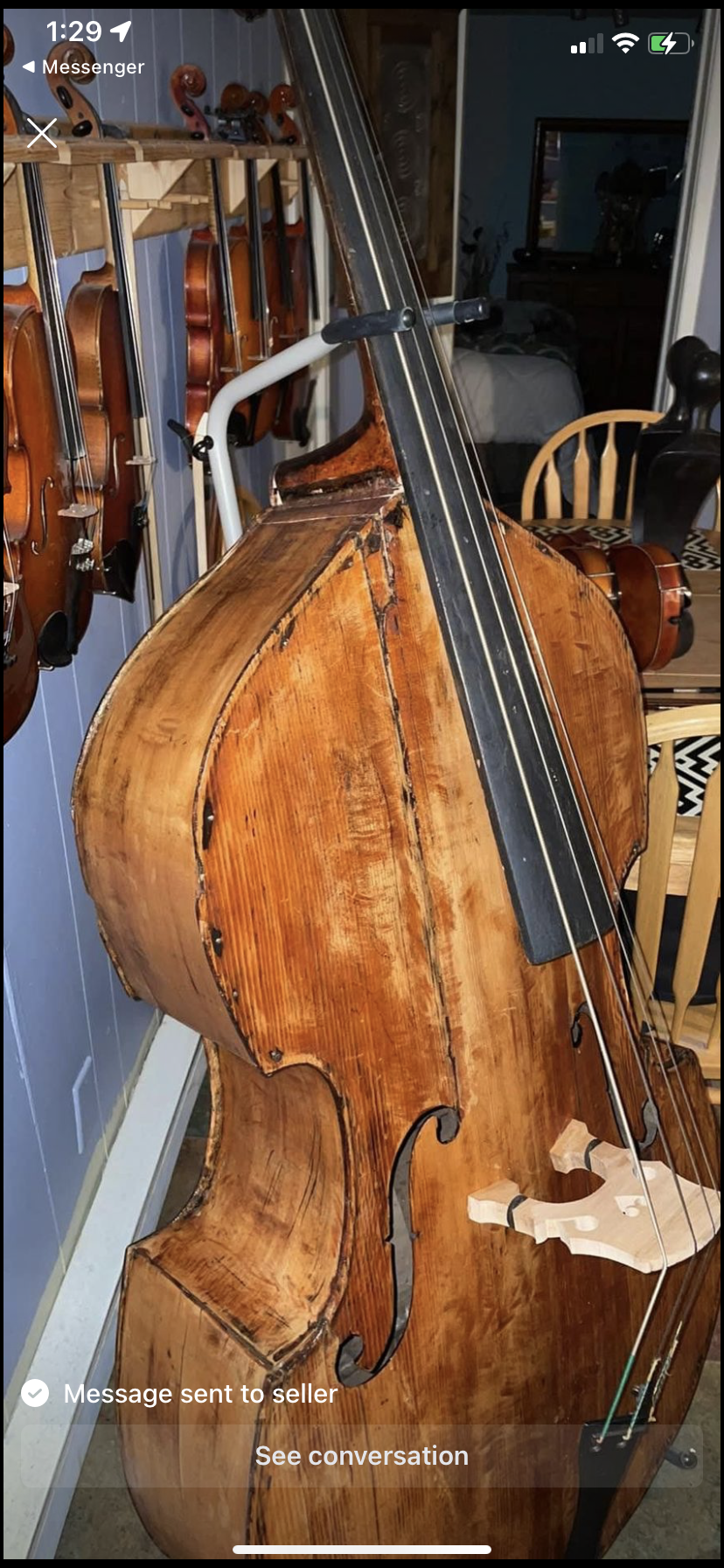
Hi guys, I’m looking at this bass here. It’s not labeled or marked. It’s seen it’s better days but still very playable. Any idea of value and age/maker. Or if it’s even worth messing with. Any help is appreciated.


Enjoy the benefits of a premium membership!
Upgrade Account
-
TalkBass has been independent since 1998. Add your voice.
Create a free account to reply to discussions, view embedded media, and browse with fewer display ads.
Join free Log in
Want zero display ads or expanded classifieds tools? Compare plans.
You are using an out of date browser. It may not display this or other websites correctly.
You should upgrade or use an alternative browser.
You should upgrade or use an alternative browser.
Double Bass Unknown Double Bass- HELP
- Thread starter Tub
- Start date
-
- Tags
- bass help unknown bass
More options
Who Replied?


Probably want to move this thread to the double bass side for a better shot at solving this mystery.

I sure hope you aren't thinking of using actual currency to buy that.
"Hot hide glue? What's that? Hand me the finish nails!"
"Hot hide glue? What's that? Hand me the finish nails!"

It looks like it fell down a flight of stairs.Hi guys, I’m looking at this bass here. It’s not labeled or marked. It’s seen it’s better days but still very playable. Any idea of value and age/maker. Or if it’s even worth messing with. Any help is appreciated.

Welcome here, Tub.
You could call that a 'Western bass' on account of the wide open spaces!
Alright then:
It's a solid-wood instrument, not ply. It's old. It's had a crapload of breaks and repairs. A bunch of those repairs are so unrefined as to be suspect.
The shoulder humps where the neck meets the body are a sign that this bass may have been built without a neck-block, i.e. with the sides set into a slot on the neck. That was a fairly common build modality in Germany and Czechoslovakia at the end of the 19th Century. Those basses are nicknamed "blockless wonders." Many of them had neck-blocks installed during some repair. That's a good thing, because not having a neck-block means it's impossible to reset the neck angle without opening up the bass, and opening up the bass costs money, and closing the bass costs money, and any repairs in between costs money.
That bass is so beat-up that it needs thousands of dollars of work to get back into sound condition. (And when a bass that beat gets that much work it may need some come-back work a couple of years later as things get used to 'normal.') So if it belonged to your beloved grandma and would remind you of her every time you played it, that's one thing. But if you have to spend actual green dollars just to bring it home you should consider investing in a sturdier instrument before deciding to buy this one.
You could call that a 'Western bass' on account of the wide open spaces!
Alright then:
It's a solid-wood instrument, not ply. It's old. It's had a crapload of breaks and repairs. A bunch of those repairs are so unrefined as to be suspect.
The shoulder humps where the neck meets the body are a sign that this bass may have been built without a neck-block, i.e. with the sides set into a slot on the neck. That was a fairly common build modality in Germany and Czechoslovakia at the end of the 19th Century. Those basses are nicknamed "blockless wonders." Many of them had neck-blocks installed during some repair. That's a good thing, because not having a neck-block means it's impossible to reset the neck angle without opening up the bass, and opening up the bass costs money, and closing the bass costs money, and any repairs in between costs money.
That bass is so beat-up that it needs thousands of dollars of work to get back into sound condition. (And when a bass that beat gets that much work it may need some come-back work a couple of years later as things get used to 'normal.') So if it belonged to your beloved grandma and would remind you of her every time you played it, that's one thing. But if you have to spend actual green dollars just to bring it home you should consider investing in a sturdier instrument before deciding to buy this one.

- Dec 13, 1999
- 11,736
- 8,941
- 70
- Disclosures
- Chuck Sher publishes my book, WALKING BASSICS:The Fundamentals of Jazz Bass Playing.
And just to augment some of Sam's advice - you need to get a dental mirror (or some such) so you can look at the repairs to those long cracks on the top from the inside, because if the repairs were done by the same person that nailed down an open seam, it's likely that they are just as poorly done. So, as Sam intimates, the top is going to have to come off and that means many, many $$$$$$.
Carved German and Czech factory basses (i.e. made in an assembly line type process rather than by a single maker or apprentices working under a single maker) , depending on the way they sound and in good, playable condition have been going for between $7500 and $10,000 (contingent on where they're being sold, larger, metropolitan markets getting the higher prices). So if there are any actual double bass luthiers in your area, have them look at it and give you an estimate on the repair costs. And the timeframe that will keep the bass out of your hands (or off the market, if you're looking to flip it). If you're going sink $500 into buying the thing and then another $5,000 putting it back together AND you won't be able to play (or sell) it for 3 or 4 months, why not find a $5-6K bass that's already playable and buy that?
Carved German and Czech factory basses (i.e. made in an assembly line type process rather than by a single maker or apprentices working under a single maker) , depending on the way they sound and in good, playable condition have been going for between $7500 and $10,000 (contingent on where they're being sold, larger, metropolitan markets getting the higher prices). So if there are any actual double bass luthiers in your area, have them look at it and give you an estimate on the repair costs. And the timeframe that will keep the bass out of your hands (or off the market, if you're looking to flip it). If you're going sink $500 into buying the thing and then another $5,000 putting it back together AND you won't be able to play (or sell) it for 3 or 4 months, why not find a $5-6K bass that's already playable and buy that?

...Any idea of value and age/maker. ...
I'm trying to get my head around whether it is a meaningful concept to discuss a NEGATIVE value.
I'm sure others have seen worse, but those are about the worst looking repairs I've ever seen. That is in the category of, "If someone offered this to me for free, would I accept it?" And I'd question the legitimacy of a shop that would offer that for sale.
Amuse us - what is the asking price?
Might be worth a VERY low number as parts - or firewood.

- Jan 12, 2004
- 1,493
- 1,270
- Disclosures
- Owner, Stand Up Guy Basses (Repair/Sell/Buy upright basses)
Nobody mentioned the "bondo" at the bottom of the treble f hole!
In terms of parts, the fingerboard seems to be painted wood. The tuners, if they're the original old hat pegs, will look cool. But those can range from horrendous to great quality. On an inexpensive, badly abused bass, I wouldn't expect much.
It has very little value, but probably not a negative value. Someone who wants to learn about repairing might have a good time with it.
In terms of parts, the fingerboard seems to be painted wood. The tuners, if they're the original old hat pegs, will look cool. But those can range from horrendous to great quality. On an inexpensive, badly abused bass, I wouldn't expect much.
It has very little value, but probably not a negative value. Someone who wants to learn about repairing might have a good time with it.

If you want to see if the bass has negative value, leave it on the curb overnight and next morning go out and see if there are similar basses alongside it.
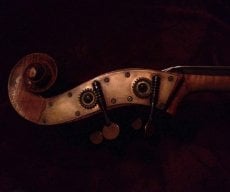
Tyrolean blockless, maybe late 1800s. I would personally pay up to $500 for it as it sits because I’m capable of doing the full restoration it’s going to need at my own pace. Depending on where you are, you could easily end up spending $10,000 to own a nice old $8,000 bass.

Lots of red flags. I'd just look into getting a carved Shen/Christopher/Eastman. Even if it's a nice turn of the century German/Bohemian bass, it could cost thousands of dollars to get it in playing condition, and the import carved basses in my experience often sound better.
Last edited:

I agree with most of what has been said so far. Nail holes are a red flag that says ‘run’.
Put good money into a good bass, not good money into a dubious bass.
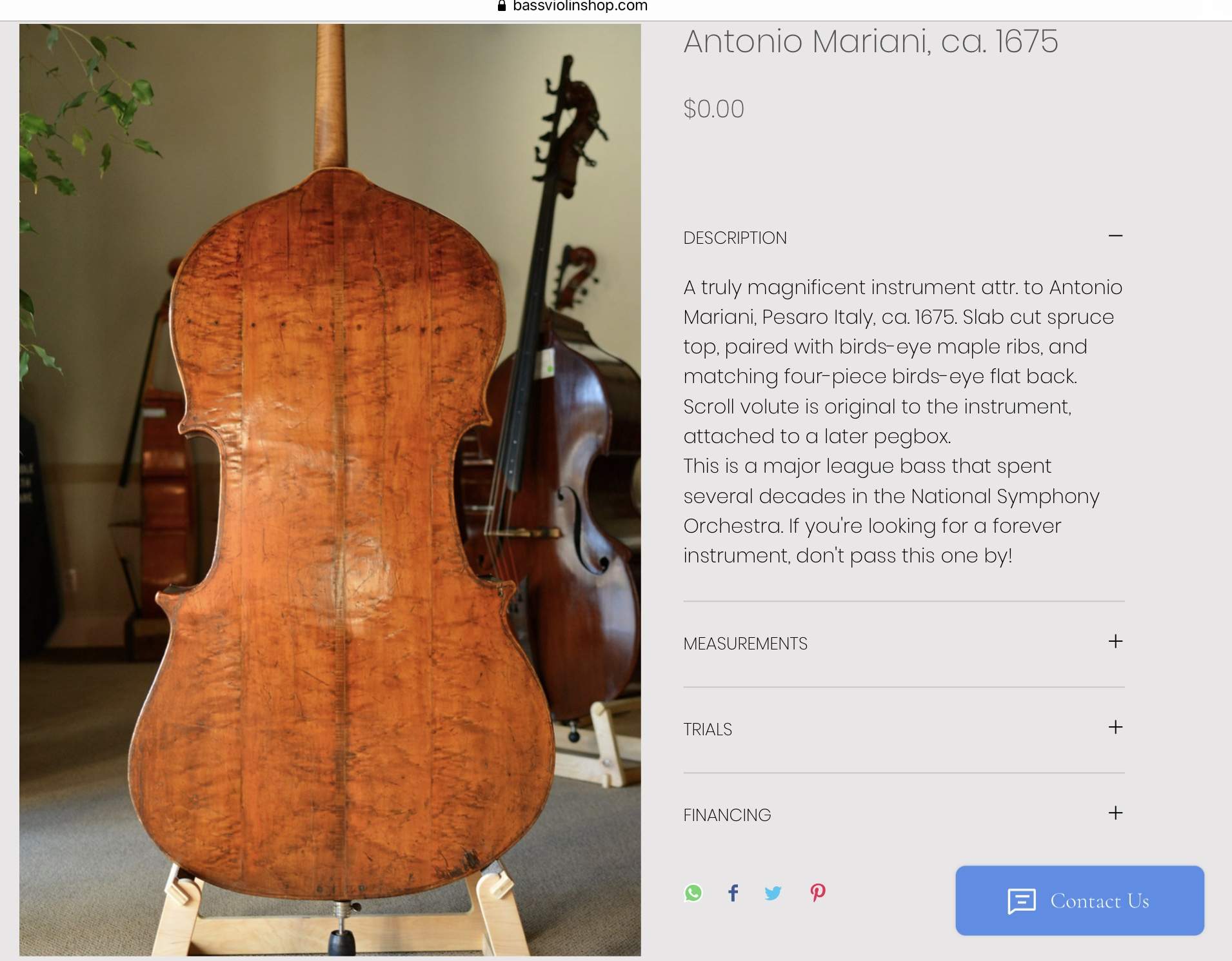
On the other hand, here is a bass that has had some of the same workmanship, described as
‘truly magnificent’, ‘major league’ and a ‘forever instrument’.
Currently available for the price of a small rural home or new Germanic auto.
The bass world can be fickle.
Put good money into a good bass, not good money into a dubious bass.
On the other hand, here is a bass that has had some of the same workmanship, described as
‘truly magnificent’, ‘major league’ and a ‘forever instrument’.
Currently available for the price of a small rural home or new Germanic auto.
The bass world can be fickle.
I’d be more concerned about the bass bar crack than about the nails. I’ve restored at least one nice old bass that had been nailed shut. You just use more care removing the plate.

I agree with most of what has been said so far. Nail holes are a red flag that says ‘run’.
Put good money into a good bass, not good money into a dubious bass.
On the other hand, here is a bass that has had some of the same workmanship, described as
‘truly magnificent’, ‘major league’ and a ‘forever instrument’.
Currently available for the price of a small rural home or new Germanic auto.
The bass world can be fickle.
View attachment 4579376
that bass is at the bass violin shop, right?
bob and the guys down there are real experts. I see the nail holes, but they were likely already removed, or very carefully inspected. I had an issue with a bass from them and they went above and beyond - lost money - making it right. I doubt they would sell a high-grade bass with potential problems. In the case of that old italian bass, it has huge value even if it needed $10k in repairs.
The OP's bass has just the nail holes ,and many other signs of horror. while i totally get your point, a bass of extreme pedigree being sold by a very reputable and highly skilled luthier doesn't compare to one that *only* has bad indications.
I'm sure removing and repairing the nails would not be that big of a deal. but i'm also sure getting that bass into a condition where the bass violin shop, upton, or kolstein would take it on consignment would be a big deal.
I'd love to see it end up in the hands of a luthier-student, and be rejuvenated, nonetheless.
- Jan 12, 2004
- 1,493
- 1,270
- Disclosures
- Owner, Stand Up Guy Basses (Repair/Sell/Buy upright basses)
... I would personally pay up to $500 for it as it sits because I’m capable of doing the full restoration ...
I wouldn't 100% rule out buying something like this. But then I start to think that I'm running a rescue shelter. I still like this as a project for a beginner.
It looks like there was a botched attempt to finish it with black paint or very dark stain and it has been sanded back down most places except for edges and the scroll.
[Invalid or Expired Link Removed]
I tried this bass out a couple years ago. IIRC one of the previous owners had to screw the back the to the cross brace because they were on an island with no luthier available. It's a nice bass otherwise and the repairs amounted to plugging holes and some cosmetic eccentricities. The point being, the nail holes are not a dealbreaker, but there are a number of other red flags.
[Invalid or Expired Link Removed]
I tried this bass out a couple years ago. IIRC one of the previous owners had to screw the back the to the cross brace because they were on an island with no luthier available. It's a nice bass otherwise and the repairs amounted to plugging holes and some cosmetic eccentricities. The point being, the nail holes are not a dealbreaker, but there are a number of other red flags.
It looks like there was a botched attempt to finish it with black paint or very dark stain and it has been sanded back down most places except for edges and the scroll.
[Invalid or Expired Link Removed]
I tried this bass out a couple years ago. IIRC one of the previous owners had to screw the back the to the cross brace because they were on an island with no luthier available. It's a nice bass otherwise and the repairs amounted to plugging holes and some cosmetic eccentricities. The point being, the nail holes are not a dealbreaker, but there are a number of other red flags.
I've played that bass at Steve's recently, it has a really great sound but the endpin would not work, like the bass would slip down as I played. I also found the Jason Brown extension to rattle a lot. Did you have that experience as well?
The preceding posts warning against buying this bass are good advice and certainly make financial sense. On the other hand, my experience may be instructive…
In 1980 I purchased a “rescue” bass similar to this one: mid-1800’s Tyrolean “block-less wonder,” playable but with multiple screws/nails, sunken top on the treble side, many top and back cracks 1/8 wide filled with epoxy, some very funky looking scabs, etc for $1000. I brought it to Chuck Traeger’s to see what they could do with it. They said, “How much did you pay for this,” and when I told them they said, “You should have talked to us first.” Anyway, being this far into it, I asked for a price to fix it up; they said $1000 (remember, 1980’s $$). I said OK and left it with them. A couple of weeks later they called me and said it would actually cost $500 more. I asked them if it was worth it to put that much more into it, they said “Yeah, this will be a really great sounding bass when we’re done.” When I picked it up it was indeed a great sounding bass, better than almost everything they had in the shop. I used it as my everyday bass for about 10 years, after which the scroll started to come apart and separate from the neck. I took it to local luthier in Vermont (Greg Wylie) who for $500 sawed the scroll off, fixed and reglued all the cracks and grafted it back on to the neck. He said that he had never done this kind of repair on a bass but “thought he could manage it.” This bass has remained my everyday bass since 1980, having played literally thousands of gigs with it in all venues both high and low end and numerous recording sessions, always getting high marks for sound and playability from other bass players and recording personnel. A few years ago I took it to Upton for a formal appraisal and Eric said, “We can appraise it for $5,000 for insurance purposes, but realistically speaking, because of its appearance if we put it up for sale here for $2500 it would just sit around.”
So I’ve put a total of $3000 into it, but after 40 years it would barely sell for $2500. Still, I’ve gotten far more out of it than I’ve put into it. It’s not always about the $$!
In 1980 I purchased a “rescue” bass similar to this one: mid-1800’s Tyrolean “block-less wonder,” playable but with multiple screws/nails, sunken top on the treble side, many top and back cracks 1/8 wide filled with epoxy, some very funky looking scabs, etc for $1000. I brought it to Chuck Traeger’s to see what they could do with it. They said, “How much did you pay for this,” and when I told them they said, “You should have talked to us first.” Anyway, being this far into it, I asked for a price to fix it up; they said $1000 (remember, 1980’s $$). I said OK and left it with them. A couple of weeks later they called me and said it would actually cost $500 more. I asked them if it was worth it to put that much more into it, they said “Yeah, this will be a really great sounding bass when we’re done.” When I picked it up it was indeed a great sounding bass, better than almost everything they had in the shop. I used it as my everyday bass for about 10 years, after which the scroll started to come apart and separate from the neck. I took it to local luthier in Vermont (Greg Wylie) who for $500 sawed the scroll off, fixed and reglued all the cracks and grafted it back on to the neck. He said that he had never done this kind of repair on a bass but “thought he could manage it.” This bass has remained my everyday bass since 1980, having played literally thousands of gigs with it in all venues both high and low end and numerous recording sessions, always getting high marks for sound and playability from other bass players and recording personnel. A few years ago I took it to Upton for a formal appraisal and Eric said, “We can appraise it for $5,000 for insurance purposes, but realistically speaking, because of its appearance if we put it up for sale here for $2500 it would just sit around.”
So I’ve put a total of $3000 into it, but after 40 years it would barely sell for $2500. Still, I’ve gotten far more out of it than I’ve put into it. It’s not always about the $$!


