• TalkBass has been independent since 1998. Add your voice.
    Create a free account to reply to discussions, view embedded media, and browse with fewer display ads.
    Join freeLog in
    Want zero display ads or expanded classifieds tools? Compare plans.

Unplayable Fretless Bass

Hello!

I currently have a fretless squier which a friend has recently given me. She removed the strings because they were roundwound but when she tried to restring it with flatwounds the neck itself was virtually unplayable. I've had a look at it myslef, the truss rod doesn't seem to be damaged at all from what I can tell, but the neck's tension doesnt seem to be responsive when looseing the rod. The neck itself doesnt seem to have a bend, it seems to be level, but I am by no means an expert. It truly is unplayable, the strings are rigt on the neck, notes cannot be distinguished until the 10th fret, but even then it's rather unpleasant and quite buzzy.

If anyone has any idea of why this is happening, I would greatly appreciate any advice you can provide,

Thank you very much,
Zac
 
Thanks, Aidil and thank you for responding!

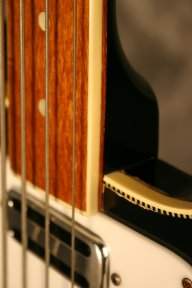
I just can't seem to get a decent enough picture at all, the one I've included is probably the best example I could capture. As you can see, the strings are right on the neck, there is absolutely no space between the neck and the strings. I've relieved the tension on the neck thinking that could possibly help, but it just doesn't seem to help at all.

Thanks again,
Zac
 

Attachments

  • bass neck.jpg
    bass neck.jpg
    65.8 KB · Views: 24
  • Like
Reactions: jamro217
I think possibly the truss rod may be broken, the tension of the rod itself is incredibly stiff, nothing at all seems to change the string height at all. The truss rod nut itself has been previously been removed apparently which doesn't necessarily seem like a good thing at all. It seems like it's nothing more than an ornament now haha. I honestly don't what to do. I'll probably have to take it in somewhere.

If you have any other advice at all, it would be greatly appreciated, but thank you for the advice you have already provided!
 
  • Like
Reactions: DJ Bebop
Hey!

Yes I have, but the saddles are pretty much as high as they can go, it looks freakish haha. I'm not too great at these things and it sort of stresses me out doing it myself honestly. Without sounding lazy, I think I'd rather someone with more experience to take a look at it. I'll take it to my local guitar shop and see what they can do
 
  • Like
Reactions: Double E
Give the bass a proper setup and see what is up. It will almost assuredly need some work to get a proper fretless setup. Every single fretless VM I have played/owned has required work to be playable. They all need the board levelled and the nut cut, at a minimum. They don't level the board after installing the fretlines leaving you with little plastic frets that cause a bunch of buzz. They are decent basses once you give them some work but they are crap out of the box.
 
  • Like
Reactions: AlexanderB
The truss acts as a counter to the tension of the strings which, if the t-rod was loose means that there is not enough string tension to pull the neck forward.

You can experiment first by tuning UP all the strings about two or three half steps to create more tension and pull the headstock forward. This may or not help but it’s an easy first attempt. If this helps, then higher tension strings can straighten it out.

Since your saddles or peaked, the next thing I’d try is shimming the neck (you can use a torn business card or piece of sandpaper). You will need one at the front of the neck pocket to tilt the entire neck towards the body thereby lifting the strings off of the fingerboard. You can actually just loosen the strings a bit, flip it over and unscrew all 4 screws a few turns but loosen the 2 screws closest to the headstock a bit more, enough to slip the shim in. Then, tighten all 4 down. You may also then have adjust your saddles down (which is a good thing).

Try those things and see where things end up.
 
I encountered a similar problem on a bass once. The bass was shipped to me in two pieces - neck & body. While unloaded, the neck took a set bowed back. I screwed around with it for quite a while to no avail. What I finally did was loosen the truss rod considerably and tighten the strings up in such a way to induce forward bow onto the neck evenly. I had to crank them up alot. They were scary tight but not much to lose at that point. IIRC I had the bass set on a table with a support under the nut area of the neck. While tightening the strings I occasionally applied moderate pressure to the middle of the neck to help coerce it in the direction I wanted it to go. I let it set for a few days or a week that way. Using different strings I then set the bass up normally and the neck has been fine since.

It hasn't been mentioned yet, but when I turn a truss rod, I always 'help' the neck move by hand in the intended direction of movement. IOW if I want to induce forward bow, I loosen the rod a bit and while clamping the body with my arm I push on the back of the headstock. Vise verse for backbow. The rod is a piece of steel embedded in a wooden channel. It can be sticky to move and mechanical assistance helps alot.
 
Last edited:
The truss acts as a counter to the tension of the strings which, if the t-rod was loose means that there is not enough string tension to pull the neck forward.

You can experiment first by tuning UP all the strings about two or three half steps to create more tension and pull the headstock forward. This may or not help but it’s an easy first attempt. If this helps, then higher tension strings can straighten it out.

Since your saddles or peaked, the next thing I’d try is shimming the neck (you can use a torn business card or piece of sandpaper). You will need one at the front of the neck pocket to tilt the entire neck towards the body thereby lifting the strings off of the fingerboard. You can actually just loosen the strings a bit, flip it over and unscrew all 4 screws a few turns but loosen the 2 screws closest to the headstock a bit more, enough to slip the shim in. Then, tighten all 4 down. You may also then have adjust your saddles down (which is a good thing).

Try those things and see where things end up.
All good ideas, but first I would check to see if the neck is is already over-shimmed the other way which may have created the problem to begin with.
 
  • Like
Reactions: mdogs and neckdive
You need to get the strings up off the fingerboard using some method. If the bridge saddles are at max height, you need to shim in the neck pocket to tilt the neck forward (shim at the headstock end of the neck pocket).

Once you get the strings where they can vibrate freely above the fingerboard, you can re-address string height & playability with the bridge saddle adjustment and truss rod adjustment.
 
All good ideas, but first I would check to see if the neck is is already over-shimmed the other way which may have created the problem to begin with.

I agree. If there was already a shim in the front position (closest to the body), you can take it out and the problem may inprove.

It hasn't been mentioned yet, but when I turn a truss rod, I always 'help' the neck move by hand in the intended direction of movement. IOW if I want to induce forward bow, I loosen the rod a bit and while clamping the body with my arm I push on the back of the headstock. Vise verse for backbow. The rod is a piece of steel embedded in a wooden channel. It can be sticky to move and mechanical assistance helps alot.

This is absolutely true and likely the number one reason truss rods are damaged or broken IMO.

The rod is strong enough to ‘hold’ the neck in place but not strong to ‘pull’ the neck into place against all of the string tension, hence the correct technique of using your hand to push/pull on the back of the nut to assist the movement.

Pushing or pulling at the very end of the headstock can snap the headstock, even for a Fender paddle-style but particularly susceptible if it’s a Gibson tilt-back style
 
Last edited: